From Camden School for Girls to Bletchley Park: the remarkable life of Joan Watkins
Tuesday, 10th March 2015
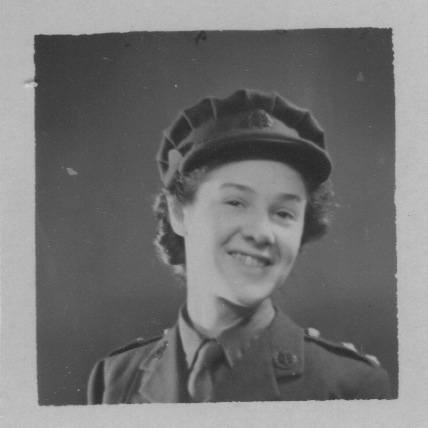
THE husband of a Second World War codebreaker has donated documents and photographs from her remarkable stint at Bletchley Park to her former school in Camden Town.
Jimmy Thirsk, 100, said he wanted to keep the memory of his wife Joan Watkins alive by handing the items to Camden School for Girls. Joan died in 2013, aged 91, after a life which saw her become a lauded Oxford University academic and a leading historian.
“She was an extraordinary woman,” Mr Thirsk said. At the outbreak of the war she had two choices: to stay in Switzerland, where she was studying German on a scholarship year abroad, or make a 600-mile break for freedom across France and the Channel back to England. The 17-year-old chose the latter and turned up on her anxious parents’ doorstep in Hampstead without a scratch, having negotiated trains filled with mobilising troops and a lift on a boat accompanied by a destroyer.
She was evacuated with her Camden School for Girls classmates to the east Midlands, beginning several months of “lessons on wheels” as the girls from the Sandall Road school were shipped first to Uppingham, then Grantham and Stamford.
Mr Thirsk told the New Journal his wife often spoke with admiration of her teachers who coped cheerfully in difficult circumstances, running classes for the schoolgirls in empty cinemas during the day.
In 1942, Joan was plucked from thousands of the best and brightest for her language skills to join the code-breakers at Bletchley Park – subject of the recent award-winning film The Imitation Game, about the father of modern computing, AlanTuring. Joan worked in the Fusion Room – later linked to the famous Huts 6 and 3 – where she scrutinised decrypted German messages for patterns and codes.
When Mr Thirsk met Joan at Bletchley Park in 1944 she was a sergeant working on traffic analysis. He was attached to Hut 6 – which was run by code-breaker Gordon Welchman – a Cambridge scholar recruited alongside Mr Turing. He said: “The work was at times a little dull until Welchman came and spoke to us one day and revealed the secrets of the Enigma machine to us. It made our work more exciting. Joan was already there when I arrived and was analysing messages to see if anyone’s name or a place cropped up multiple times – so you could piece it together like a jigsaw. We were working on a jigsaw, you see, and a lot of the pieces were missing.”
Mr Thirsk later wrote an autobiography, Bletchley Park: an Inmate’s Story,
The pair married on September 12, 1945, and had two children, Martin and Jane, and four grandchildren. After the war Joan returned to studying but switched to economic history, starting a life-long career in academia, including a lectureship at the London School of Economics from 1951. Joan retired in 1983 and was made a CBE in 1994.
Mr Thirsk, who had worked as a librarian, said he would love to see a plaque installed at one of the addresses she lived in during her 50 years’ living in Camden. But he was told by English Heritage that it could only be done 30-years after her death.
“I’ll be 130 by then,” he said. “It will be my children who will have to do that. I just think she deserves one.”
Did she own the world's most famous wardrobe?
By ALICE HUTTON
JOAN Watkins possibly owned the world’s most famous wardrobe after moving into a cottage in Oxford once owned by children’s book writer CS Lewis. Mr Thirsk said that the author left behind the closet which inspired the magical portal to Narnia in The Lion, The Witch And The Wardrobe.
“It was a plain 1920s wardrobe and far too big for the room. It didn’t suit our needs at all and so we wanted to get rid of it. These men wanted to buy it, I think in the end we sold it for £10 or something. They had to take it apart to get it through the door and put it back together.”
The couple were in Oxford after Joan was appointed a reader in economic history and a fellow at St Hilda’s College.
Of the wardrobe, Mr Thirsk added: “I heard that it is in a museum in America somewhere.”
