War hero gets official marked grave more than 100 years after being blown up
Service held for 23 year old machine gunner from Hampstead
Friday, 1st May — By Tom Foot
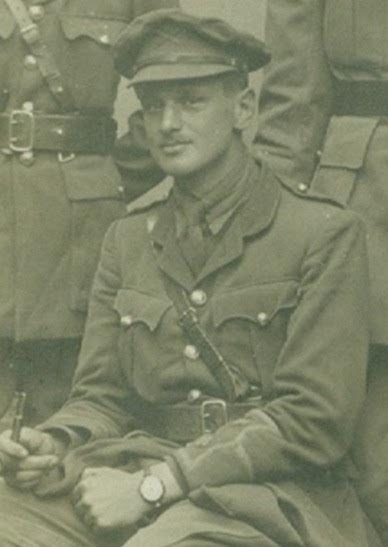
Lt George Kenneth Steinberg
AN unmarked grave has been rededicated to a missing First World War hero from Hampstead more than a century after he was blown-up by an enemy shell.
Lieutenant George Kenneth Steinberg died during the “German Spring Offensive” in March 1918, eight months before the war officially ended.
The 23-year-old machine gunner had fired 20,000 rounds “defending his position” under heavy fire in what would have been a terrifying final few hours.
The Ministry of Defence said his body was initially buried by German troops within a few hours of his death, but after the war ended the remains were moved to an unmarked grave at the Croisilles British Cemetery, northern France.
An inscription on the freshly engraved headstone, chosen by his great nephews, reads: “He died like a brave man fighting to the last and leaves a glorious memory behind.”
Rosie Barron, a caseworker for the Joint Casualty and Compassion Centre, said: “Lt Steinberg was clearly a very brave man, who did his duty to the end under very difficult circumstances.
“It is very pleasing to know that his family now have answers as to what happened to him and can come and pay their respects at his graveside.”
Lt Steinberg’s relatives had made an application for the marking to the Commonwealth War Graves Commission that was rejected due to lack of evidence.
The case was “re-examined” and following further research confirmed earlier this year.
A new headstone with the inscription was laid down following a “lengthy investigation” by the JCCC, a body that coordinates discoveries of human remains of people killed in the First and Second World Wars.
Born in 1893 in Hampstead, George Kenneth Steinberg worked as an assistant to a patents agent before being enlisted shortly after the start of the war.
He joined The Royal Berkshire Regiment, and later The East Lancashire Regiment before transferring to the Machine Gun Corps, arriving on the Western Front in 1917.
On March 21 1918, Lt Steinberg was “instructed to fire indirectly” towards an enemy that was only visible after “a haze which had been present earlier in the day had cleared”, the MoD said.
He went on to direct fire throughout the day “which he kept up until dusk having fired 20,000 rounds”.
At a service on Thursday, he was remembered this week as an “intelligent, sober, and punctual man” and, despite his young age, “a strong leader” who was awarded the Military Cross for “conspicuous gallantry” a few months before his death.
The citation for his medal reads: “During an enemy barrage, one of his machine guns was blown up, and shortly afterwards, all the non-commissioned officers became casualties.
“Nevertheless, he collected the guns and moved them forward to an advanced position, personally superintending the action of each gun under the heaviest shell fire.”
This week, Catherine Nell, identifications manager at the Commonwealth War Graves Commission, said: “The completed research means that we are now able to mark the grave as that of Lieutenant George Kenneth Steinberg MC, who lost his life in the Spring Offensive of March 1918.
“His newly engraved headstone ensures his appropriate commemoration now and for generations to come”.
The rededication service was conducted by the Reverend Joseph Roberts, Chaplain to 1st Battalion The Royal Anglian Regiment, and attended by serving personnel of The Royal Anglian Regiment and The Band of The Royal Yorkshire Regiment as well as members of the Machine Gun Corps Association.
In 2013, following a two year campaign, the New Journal travelled with two families from Kentish Town and Islington to a small town of Markelo in the Holland where a Fallen Airmen Memorial was unveiled for a group of young pilots killed in the Second World War.
Among the 18 British, New Zealand and Australian pilots who died were the Halifax’s Flight Sergeant Stanley Watt, 44, of Kentish Town; Flight Sergeant Denis Kelly, 20, of Islington; and Squadron Leader and pilot Peter Elliott, 25, of Crouch End.
Up until that point, many of the families had just a telegram as the sole evidence of their loved one’s death.
