Review: Michaelina Wautier, Royal Academy of Arts
Artworks from a 17th-century enigma
Thursday, 30th April — By John Evans
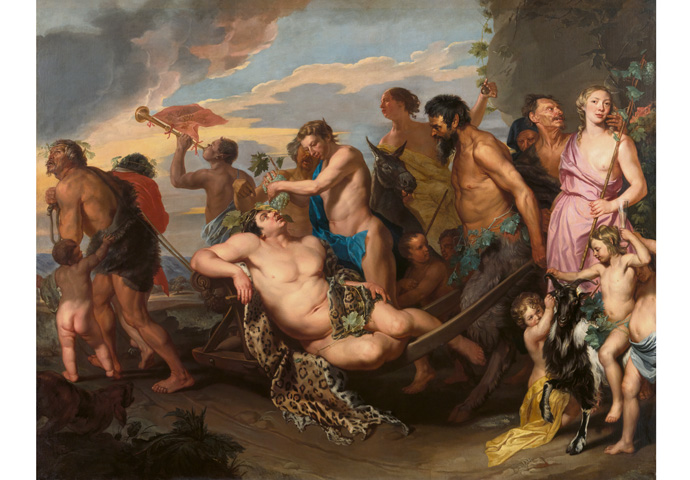
Michaelina Wautier, The Triumph of Bacchus, c 1655-59, oil on canvas, 271.5 x 355.5cm, Kunsthistorisches Museum Vienna Picture Gallery [© KHM-Museumsverband]
IT’S the late 1650s and as the god of wine is carried across an impressive canvas, a bold character on the right looks out at the viewer.
This is the trailblazing Baroque artist Michaelina Wautier, who placed a self-portrait into The Triumph of Bacchus, in a striking statement of her ability and ambition. She alone in this impressive oil looks directly at us.
“Michelle” Michaelina Wautier (c1614-1689), the Royal Academy reminds us in its new exhibition, was forgotten as an artists for nearly 300 years, only to re-emerge in the last couple of decades as “…one of Europe’s most significant artists of the period”.
Some 25 paintings are exhibited, the most complete show of her work to date, though she remains a remote figure. Born in Mons, then in the Spanish Netherlands, she and her painter brother Charles (1609-1703) lived in Brussels near to the royal court. Her most important patron was the Archduke, Leopold Wilhelm but little detail of her life is known, with none of her letters or documents discovered.
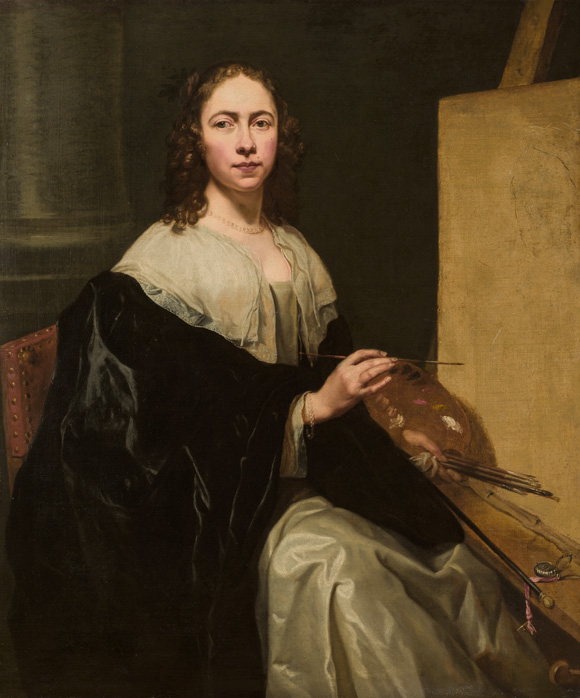
Michaelina Wautier, Self-portrait, c1650, oil on canvas, 120 x 102cm [Private collection]
Curated by the RA’s Julien Domercq and Rina Sagoo, an emphasis is placed on how her art defied contemporary convention.
For example, her only known drawing (from a private collection) is on display, a chalk study of the “Medici Ganymede Bust”, or copy of it, about 1640-50. It was in Rome at that time and such drawing from classical sculpture was very much a male preserve.
Another intriguing insight into Wautier’s practice is her self-portrait from about 1650, also from a private collection, depicting her at an easel, with an unpainted canvas (the real thing left unpainted), and with the palette of colours, seemingly, that she actually used; though she surely wouldn’t have worn the fine clothing for the work itself.
In addition to oils by her brother Charles on display, there is also a 1643 engraving of one of Wautier’s lost works, that of a prominent army commander in the Spanish Netherlands, which she painted when aged about 28.
A strong 1646 oil portrait of another soldier, this one unknown, hangs nearby and further illustrates she was both well connected and accomplished by then.
A later portrait of a military figure is thought likely to be of another brother, Pierre, who was a cavalryman.
A show highlight sees a lighthearted take on the The Five Senses, unusually depicting young boys with some humour, for example, with Smell the child pinches his nose when he encounters a rotten egg and with Touch the boy has a cut finger.
Wautier’s talent is a rare example of a 17th-century woman producing history paintings and religious works on such a scale. And there has been misattribution in the past, for example with the Bacchus, because women were denied the opportunity of drawing the male nude.
But Wautier’s skill can be seen too in major religious paintings, such as The Mystic Marriage of St Catherine, 1649, from the Séminaire de Namur, in Belgium, and Saint John the Evangelist, about 1656-59 (private collection).
With this artist there is a genuine feeling of an ongoing quest for more and the RA admits, “With her last known dated painting completed in 1659, almost 30 years before her death, that leaves a remarkable 40+ years of unaccounted-for work. Whether she stopped painting completely or there are undiscovered works yet to resurface is unknown.”
• Michaelina Wautier is at the Royal Academy of Arts, Burlington House, Piccadilly, W1J 0BD until June 21. www.royalacademy.org.uk
