‘The Victorian public loved a good murder – so long as it did not frighten the servants’
A sensational Victorian murder caught the public’s attention and is now the subject of a new book by Taggart writer Glenn Chandler. Dan Carrier talked to him
Thursday, 22nd October — By Dan Carrier
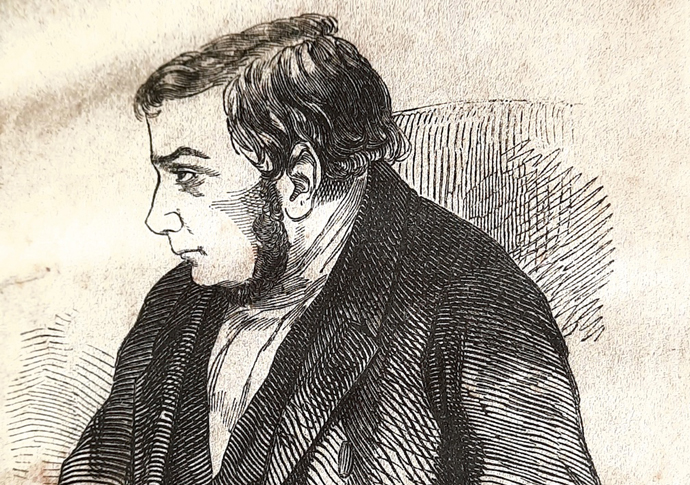
James Blomfield
DISGUISED in a wig, the assassin brazenly strolled into Stanfield Hall, pulled out pistols and shot dead Judge Isaac Jermy and his son.
The murders would grip the nation – and now the bizarre and enthralling story of the life and trial of the accused, a farmer called James Blomfield Rush, has been told by author Glenn Chandler.
It is a thrilling Victorian melodrama, with “ingredients [that] included the suggestion of secret poisons, a bewigged and cloaked assassin, forged documents and conspiracies in dark places. It involved an inheritance dispute. It had a family massacre,” he explains.
Glenn has an impressive bibliography: he has written previously on sensational cases, including the story of male prostitute Jack Saul who was involved in a male brothel in Cleveland Street, Fitzrovia, and Sidney Fox, who was hanged for the murder of his mother in Margate.
Glenn also has extensive playwriting credits to his name. Perhaps his best known creation is the Glaswegian detective, Taggart – the seminal Scottish crime TV series.
This latest book tells the story of murders that rocked Victorian society.
“The year 1848 was a tumultuous one,” he writes, citing revolutionary fervour that swept from Paris across Europe, gold being found in California and cholera epidemics in London.
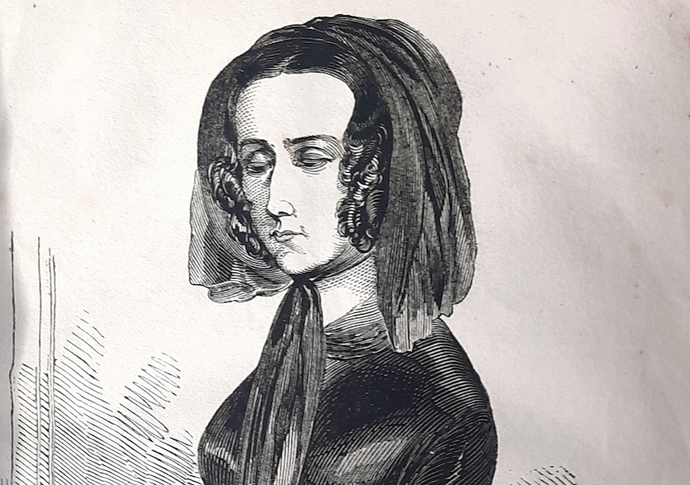
Emily Sandford
But he explains these big-ticket tales were knocked off the front pages by a crime committed in a quiet corner of Norfolk.
“The Victorian public loved a good murder, so long as it did not frighten the servants, and the Rush case gave them everything – a story more melodramatic than anything a theatrical impresario might have put on stage,” he adds.
The victims were “men of standing” – a judge and his son, who lived in the perfect setting for murder mystery – an Elizabethan mansion with a moat, the crime committed on a blustery autumn night, with servants injured during the attack.
The story included Emily Sandford, a solicitor’s daughter who had become romantically embroiled with Rush, a man who was not who he seemed to be.
The case alone was sensational, but it also happened at a time when mass communications were changing the world.
“Norfolk newspapers had a bonanza,” he reflects.
“It was the biggest thing ever to have hit them.”
This was a period where a mixture of rocketing literacy rates combined with leaps in printing technology.
And the editors of these mass-produced news sheets needed content to get their readers’ attention. The murders provided plenty of that.
While Rush’s behaviour is gripping, the impact it had on his secret girlfriend, the innocent Emily, is another crucial part of the story.
She was the daughter of Joseph Sandford, who had speculated on railways – one of the boom of investors hoping to cash in on the railway building craze in the mid-Victorian period.
We learn he dealt in railway shares and invested money in property, buying a family home in Bartholomew Place, Kentish Town, “an attractive terrace that had once been a home to Mary Shelley, who wrote Frankenstein”.
His daughter Emily was well educated. She had, it was reported, run a small boarding school in Somers Town.
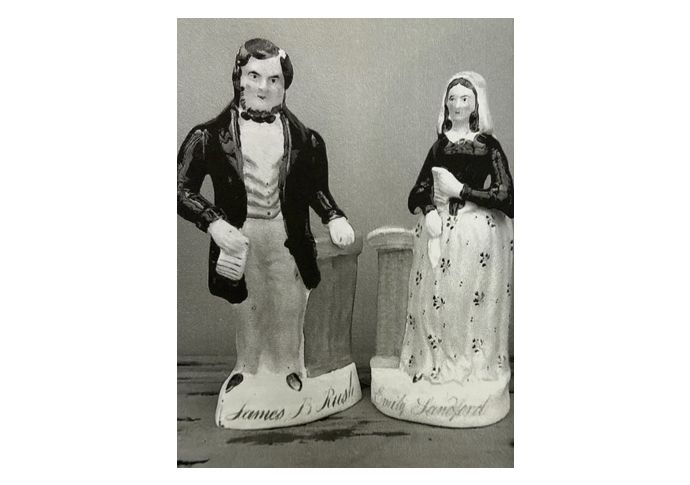
A Staffordshire pottery figurine of Rush and Sandford
But in 1846, the great railway bubble burst and Joseph’s family security was destroyed overnight.
“Desperate to find a position for Emily, [her mother] Ann scoured The Times for adverts,” he adds. Her eyes alighted on an advert for a governess – and it would draw Emily into the sphere of a man who on paper was respectable, but in real life was a murdering crook.
A “heavily whiskered and God-fearing gentleman with the weatherbeaten air of a countryman,” Glenn describes Rush. His wife had recently died and he had been left with a number of children.
Rush, “farmer, cattleman and auctioneer”, was well known in Norfolk, and his reputation was not savoury: “Unsubstantiated rumours of bastard children, ignoble attention paid to servant girls, and whisperings of financial indiscretions went before him. Around him a kind of darkness had accumulated. He was not trustworthy. He could lie to your face without turning a hair. He got away with murder.”
Glenn discovered that Rush’s stepfather had been shot and while it was ruled suicide, the stench of suspicion hung over the incident. His mother had also died unexpectedly – just days before she was due to give evidence against him in a bankruptcy case.
“He was suspected of murder,” Glenn says. “He rowed with his stepfather constantly. The father did not like guns, yet shot himself with one.
“But there was no forensic evidence, although the coroner said the wound was in a ‘strange’ place.”
As for Rush’s victims at Stanfield Hall, neither were well liked:
“It grabbed the public – it had everything,” Glenn says. “I could not find a good thing said about Jermy. He was not a popular man. He was a strict judge and handed out heavy sentences. And his son was not popular, either.”
Writing the book pulled together a topic that had long fascinated Glenn.
“I had known about the story of Rush for around 30 years.”
Glenn is a collector of a series called Notable British Trials, 100 volumes of detailed court proceedings.
The Rush scandal was in one volume.
“I read his speeches in defence and it was just fascinating,” he recalls.
And the crimes were committed during a truly golden period for British newspapers.
“There were acres of newsprint about the trial,” adds Glenn.

Author Glenn Chandler
This wonderfully crafted story is the archetypal page-turner, creating a brilliant window on the past, and illuminating a tragedy.
Glenn’s experience in creating the character Taggart shows what a master storyteller he is.
He recalls how the head of Scottish TV approached him and asked if he could write a story about a Glaswegian detective.
“They wanted a character who came up through the ranks,” he remembers. “I went round Glaswegian cemeteries and looked for names. I came across Taggart.
“I didn’t know about Glasgow police and it was hard at first – I wanted to make it as realistic as possible.
“I remember my first line was his assistant Livingstone looking at a body and saying to Taggart ‘Strangulation with a ligature, Sir.” He replies: ‘We do not have ligatures in Glasgow, Livingstone.’ Taggart was born out of that.”
Actor Mark McManus made Taggart his own – and working with Mark helped create the character.
“He was Glaswegian and rough round the edges so I kept him in mind when I wrote the character,” he says.
“I would sometimes write something and Mark would say: ‘Taggart would not say that.’ Sometimes I’d write 10 words and he’d distill it down to three… and then into just a look.
“I remember once I wrote a line with Taggart saying ‘I’m agog!” and Mark cut it. He gave me a T-shirt at Christmas saying: ‘I’m agog.’”
• Bloodlands: The True Story of James Blomfield Rush and The Stanfield Hall Murders. By Glenn Chandler, Grosvenor House Publishing, £11.99
