PROPERTY: Twentieth Century Architects: The modern men of ABK who upset Prince Charles
Thursday, 12th April 2012
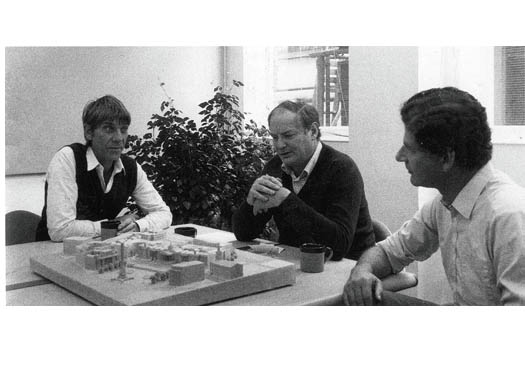
Pictured top: The ABK partners discussing the National Gallery project in the early 1980s
Pictured bottom: A Modernist ABK design proposal for St Anne’s Church in Soho that was never built
Published: 12 April 2012
by DAN CARRIER
BACK in 1984 the Prince of Wales was at the swanky annual Royal Institute of British Architect’s dinner at Hampton Court Palace, where he was due to award a Royal Gold Medal to Indian architect Charles Correa.
The heir to the throne was expected to stand up, say a few kind words about Mr Correa’s achievements – perhaps draw on his work fighting poverty in India – and then propose a toast.
But it didn’t pan out like that.
Instead, he used the platform to attack the whole concept of Modernism in British architecture – and criticise work by Kentish Town architect Richard Burton.
Mr Burton’s ABK practice had won a competition to design a new extension of the National Gallery, but the Prince’s opposition led to its eventual cancellation.
It was one of the first cases of him using monarchical muscle to meddle in planning issues.
In a new book that charts the history of Mr Burton’s Ahrends, Burton and Koralek (ABK) practice, the work of the trio is celebrated – and the story of the Prince’s attack is recalled.
ABK got it both with barrels, with their design being called “a monstrous carbuncle on the face of a much-loved and elegant friend”.
The scheme was never implemented and, later, a closed competition gave the gallery an extension that was a pastiche of what was there already.
Architect Richard Rogers described the ABK design for the gallery as “beautiful… [with] a palette of materials that responded to the existing National Gallery without resorting to imitation.
The design was elegantly modern, with a small piazza that brilliantly separated their building from William Wilkins’ 1832 Gallery.”
He added: “The Prince’s intervention seriously damaged the standing of ABK, an exceptionally talented and sensitive practice.”
It meant work fell off, as it did for other Modernist practices.
But, despite not enjoying dubious Royal patronage, ABK has been one of the leading practices for the past 50 years.
During the 1960s when ABK was formed the public sector offered architects the scope to work on projects for the good of all.
There were homes and schools to be built, and new red-brick universities to design.
It was a good time to be working at a drawing board.
They pioneered ideas of consulting the tenants of a development in Basildon, while workers in a factory in Shotts were involved in discussions before work commenced.
After the criticisms by Prince Charles, work for ABK in England was not always immediately forthcoming, but the company’s Irish office flourished.
The country has a series of civic and educational buildings designed by ABK that have won various awards.
Mr Burton was partly persuaded to become an architect when he met Hugh Casson, who was working on the Festival of Britain.
His partners came from Europe: Paul Koralek was born in Vienna and came to London with his parents as they fled the rise of Fascism.
Peter Ahrends was from Berlin and also left to escape the Nazis.
The book explains the influences that shaped them.
While the Architectural Association was known for its Brutalist ethos, it didn’t mean that there were not diverse schools of thought there. ABK came to epitomise this.
They found their own voice in ideas of form, function, cost and environmental concerns.
This informative book doesn’t just tell the personal stories of one of the most important architectural firms to have practised in the post-war period, it uses three of the UK’s most innovative and stylish thinkers in architecture to highlights trends in design.
• Twentieth Century Architects: Ahrends, Burton and Koralek. By Kenneth Powell. RIBA Publishing, £20
