For the love of Omar
Playwright Hannah Khalil talks to Lloyd Bickham about the man (and moustache) that inspired her backstage comedy currently at Theatro Technis
Thursday, 14th May — By Lloyd Bickham
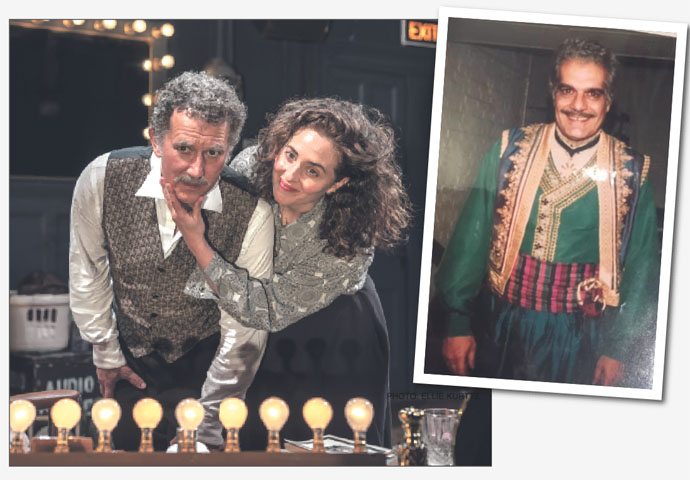
Al Nedjari as Omar and Lara Sawalha as Mag in Love Omar [Ellie Kurttz] Inset: Omar Sharif in the 1983 production of The Sleeping Prince
“I DON’T think I’d exist if it wasn’t for him,” says Hannah Khalil of Omar Sharif. Her mother, a village girl from Ireland, “had probably never seen a black or brown face before. She got obsessed with Sharif’s films, and then, at a party, met my dad. He bore a resemblance to Omar; beautiful brown eyes, the moustache…”
Sharif, star of Lawrence of Arabia, is the focus of Hannah’s new play, Love Omar, currently premiering at Theatro Technis. The drama takes place backstage during his 1983 run at the Chichester Festival Theatre, a “piece of Arab theatre history” that Hannah discovered “in the queue for the loo” at the venue.
“There was this production shot on the wall from [Terence Rattigan’s] Sleeping Prince with Sharif,” she recalls. “It was so bizarre – why was Omar in Chichester?”
Hannah’s play mirrors the mania which accompanied Sharif’s celebrity casting, with the Egyptian attracting crowds of female fans, alongside bags of sexualised letters each night – the latter causing complaints from the local sorting office.
In Camden, we walk through backstage corridors at Theatro Technis on our way to the auditorium, which lavishly lays out Omar’s dressing room with great attention to detail.
“I had the privilege of talking to lots of people who were involved in that original production,” says Hannah, with many of the play’s rich anecdotes ripped from memories of those who worked alongside Omar. They paint a nuanced picture of the actor: his charm, his loneliness, his aged pride.
That iconic moustache became a point of contention during the Chichester run, as Sharif would dye it each night to hide its greying. Audiences would laugh as he kissed his co-star, Debbie Arnold, smearing black across her upper lip. Debbie complained, and “relations between the two cooled somewhat. She is actually coming to the show later this week!”, beams Hannah.
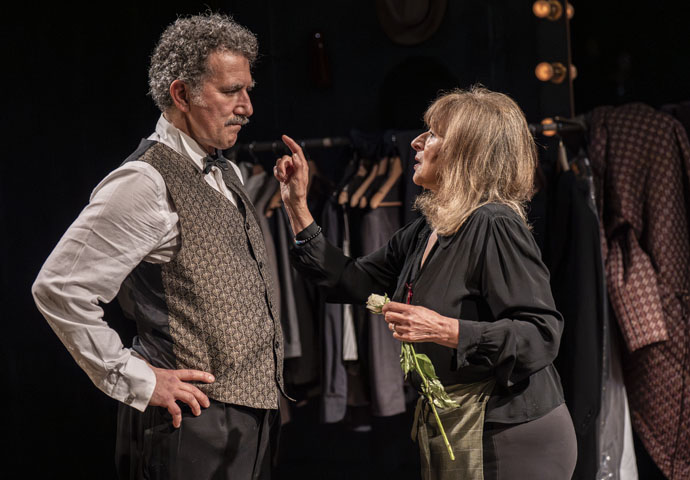
Al Nedjari as Omar and Ishia Bennison as Daphne [Ellie Kurttz]
It is Daphne, Omar’s dresser, who must navigate the eye of the storm, pleading that he stop colouring his facial hair, as well as dealing with the fallout of him gifting his weekly pay packet to a younger member of the crew as a birthday present – another factual anecdote.
This was seen by English theatre managers as inappropriate behaviour – “there are so many cultural etiquette differences, and that generosity is definitely up there”, says Hannah.
Tensions of identity and ethnicity are explored through the character of Mag, the fictitious Scottish-Lebanese assistant director who is tasked with asking Omar to run through his lines.
“Mag is sort of me, wrestling with what it is to be mixed heritage in the UK,” admits Hannah.
Through this character, she asks why Sharif changed his first name from Michel – “he was smart, a bit like my dad, really good at PR. He thought about how he would be perceived, and thought, well, if that’s what they want, I’ll give them that.”
Even now, Hannah wrestles with this central conflict: “She [Mag] is frustrated because Omar’s not what he says he is – he is, but he isn’t.”
Despite having been written a few years ago, this is the first time Love Omar has been performed.
“There was always the question about who would play Omar,” explains Hannah. “Al Nedjari had been on my radar for a while. He came and met us [at Theatro Technis] and we just knew we had to have him. He’d had a similar experience to Omar. His first job was a huge storyline in Coronation Street, and as a result he was getting underwear and pictures in the post as well.”
Looking back over her script, Hannah found striking similarities to contemporary politics. “I’d needed to land the play in 1983, which was achieved through a radio news broadcast at the beginning,” she says. “It talks about shipping disruption in the Suez, which suddenly feels really relevant again.”
That hazy photograph in a West Sussex corridor has, too, proven a timely relevance.
“Omar had the privilege of not always playing Arabs. And the moment we’re in now, that can’t really happen,” says Hannah. “I started writing 24 years ago because I was so frustrated by the lack of opportunities for Arab actors. I’m doing it now because those parts still don’t exist.”
• Love Omar runs until June 6 at Theatro Technis, 26 Crowndale Road, NW1 1TT, various time slots. Tickets from £13.50. There is a Q&A with the playwright and director on Wednesday June 3 following the show at 7.30pm. www.theatrotechnis.com/
