Byronic pleasures
Church of Sound 10th Birthday British Jazz Songbook – part of the EFG London Jazz Festival, The Barbican, November 20
Thursday, 26th November — By Rob Ryan
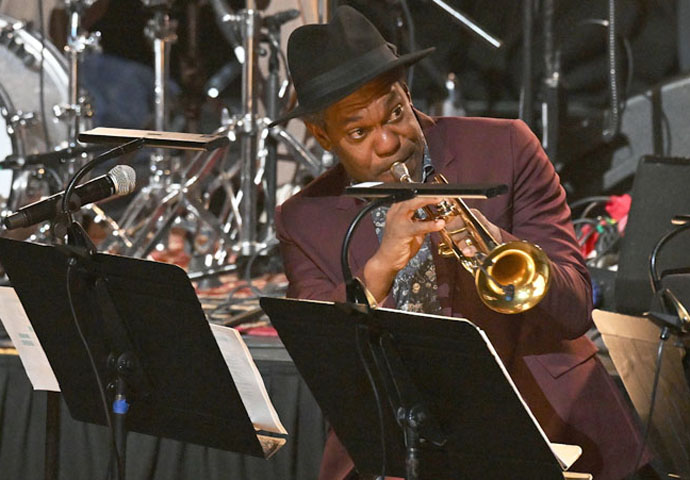
Byron Wallen [Mark Allen]
THIS show, a double celebration, was one of the most joyous I have witnessed at the Barbican. The celebrants were Alexis Blondin and Spencer Martin – marking 10 years of their Church of Sound project, the Clapton venue that has done much to put jazz front and centre for a new generation – and British jazz itself.
The full title of the concert was The Reverberations of British Jazz 1965-1975. It was towards the end of that period that I came to London and, as a newbie to the music, found myself seeing many of the musicians and composers who were feted during the gig. So, there was an added blast of nostalgia for me.
The evening opened with Stan Tracey’s stately Starless and Bible Black, with the melancholic melodic weight shifted from the original’s elegiac saxophone (played by Bobby Wellins) to the clarinet of Tamar Osborn, the gorgeous theme fractured and re-assembled with the help of Byron Wallen’s trumpet. And that set the tone for the evening – familiar music (to me at least) used as a springboard for a crop of young players, who didn’t feel obliged to treat their elders’ work as museum pieces.
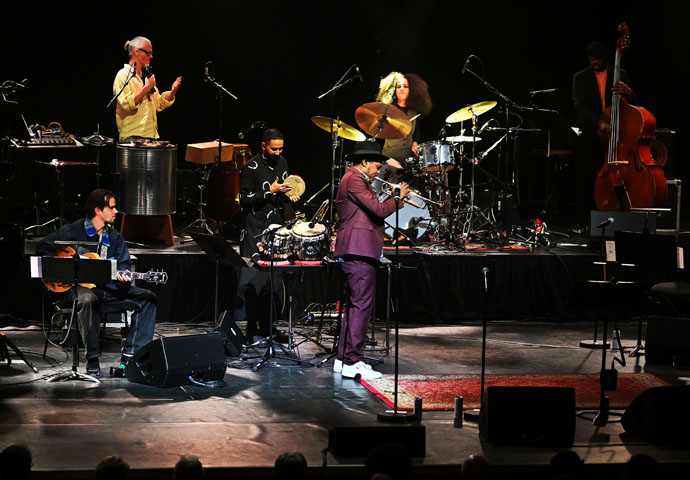
East London’s Church of Sound marks 10 years with its Barbican Hall debut as part of the EFG London jazz Festival on November 20 [Mark Allan]
Wallen admitted that he was not familiar with all the music before the concert – for example, the lovely Black Marigolds by the Don Rendell/Ian Carr Quintet from 1966 was new to him. Even though Carr (another legend) had taught the young Wallen trumpet (in Kentish Town), the student hadn’t made a full investigation of the master’s past (although he did know of Carr’s pioneering fusion band Nucleus).
But then, much of this music was widely ignored for decades, a victim of jazz falling out of fashion, although discerning collectors often paid hundreds of pounds for the deleted Decca/Deram/Argo/Fontana recordings. Belated re-recognition came a few years back when Gilles Peterson co-curated two compilations called Impressed, which featured all the individuals being celebrated and many more. This meant a whole new set of fans discovered Goan guitarist Amancio D’Silva (his Indo-jazz tune Jaipur became a jazz DJ favourite) and jubilant Bajan trumpeter Harry Beckett. Many of the records have recently been re-mastered and re-released by the labels who left them languishing in the vaults for far too long.
Not every composition showcased on the night was historic – Musical Director/arranger Wallen snuck one of his own tunes in to the first half – something I thought a bit cheeky until the band played his Harmony of the Spheres, a contrapuntal extravaganza that fully deserved its place in the repertoire.
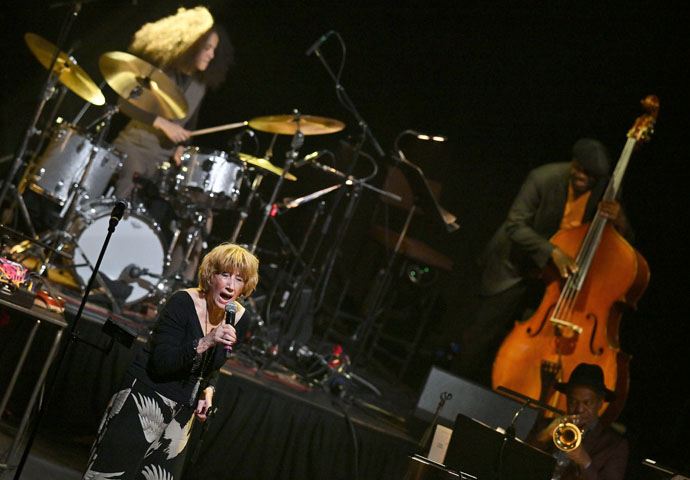
Norma Winstone at the Church of Sound Anniversary [Mark Allan]
As did vocalist and lyricist Norma Winstone who, as she pointed out, was one of the few survivors of the era and the only one on stage. She’s in her eighties now and I anticipated that her voice might have lost a little of its elasticity, but it is still a lustrous thing of wonder, and she rolled back the years, displaying a quiet power and sophisticated storytelling ability on Michael Garrick’s The Heart is a Lotus. Joe Harriott and Armancio’s Stephano’s Dance demonstrated her peerless navigate of wordless vocals in choppy musical seas. She is a uniquely British one-off.
Norma was a fixture of my jazz experiences in the 70s and continues to create and perform adventurous music with the likes of Kit Downes. But the band that first set me on the jazz road back then was Chris McGregor’s Brotherhood of Breath, a mix of South African exiles and stalwarts of the London scene, who played a lunchtime concert to about six people (seven, including me) at my uni.
My goodness what a sound they made, playing as if they were trying to reach the baffles of the Albert Hall and get that statue of Sir Henry Wood moving. It was township jive colliding with Sun Ra and coming off best. Wallen & Co played saxophonist Dudu Pukwana’s Mra from the band’s eponymous Island album, and it brought memories of Dudu, Mongezi Feza (pocket trumpet), Harry Miller (bass) and Louis Moholo (drums) flooding back, as the newbies captured much of their predecessors’ exhilarating exuberance on stage.
I watched the show with broadcaster and author Robert Elms and there were two things that struck us. One is that British jazz has evolved to become seriously funky. Dynamite drummer Jaz Kayser (who has played with Lenny Kravitz) and go-to bassist Daniel Casimir demonstrated how club culture has influenced modern players, insinuating its way into the rhythms and making venerable pieces sound stunningly contemporary.
Secondly, how women have blossomed and taken their place in the frontline in jazz. Back in the decade of 65-75, there was Norma, the brilliant and underrated Barbara Thompson and trombonist Annie Whitehead representing the XXs of the species. And, er, not many more. Now there are scores of fantastic female players.
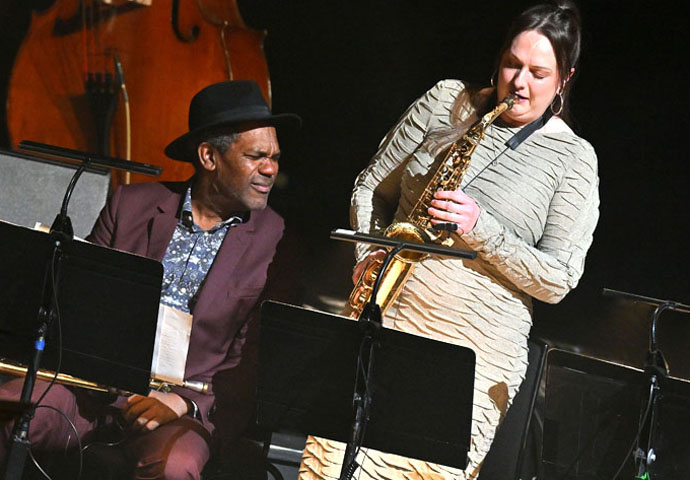
Rachael Cohen with Byron Wallen [Mark Allan]
When I interviewed Nubya Garcia for this paper back in 2017 she said she hoped that one day soon the gender of a player would barely pass comment. We are almost there. Suffice it to say, Harben Kay, Tama Osborn and Rachael Cohen on various members of the sax family all produced exciting, incisive and inventively crowd-pleasing solos (but then so did their male colleagues, including Nathaniel Cross on trombone and Al McSween on keys).
A single show couldn’t cover all aspects of this rich seam they mined on the night. There was no Alan Skidmore, Harry Beckett, Keith Tippet, Ray Russell, Kenny Wheeler, etc etc. But you know what that means? Byron, Alexis, Spencer and the Barbican will just have to do it again. And I’ll be there like a shot.
• Most of the 120-plus shows (so far) at Church of Sound were recorded and there is a new release to mark its tenth anniversary.
Clapton Prayers features performance by Tony Allen, Moses Boyd, Byron Wallen (his band Indigo playing his Harmony of the Spheres mentioned above), Jeff Parker, Kahil El’Zabar’s Ethnic Heritage Ensemble and more. Highly recommended.
Buy it here:https://churchofsoundrecordings.bandcamp.com/album/clapton-hymns-vol-1-10-years-of-church-of-sound-2016-2026
