‘She always felt photographing women came very naturally to her’
Dorothy Bohm’s daughter talks to Dan Carrier about her mother’s photographic passion
Thursday, 23rd April — By Dan Carrier
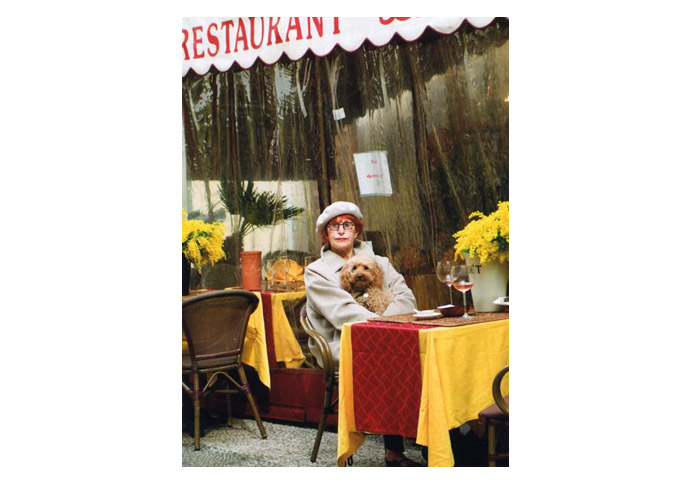
Menton, South of France, 2008 – one of Dorothy Bohm’s photographs from the exhibition
TRAVERSING post-war Europe, photographer Dorothy Bohm’s lens captured the real-time impact of six years of genocide, of cities and towns razed to the ground, of villages stripped of life, of fields once productive now silent, post-battle.
It is hardly surprising, in the context, that her photographs were not the imagery of women in a man’s world. They were not glamorised in the manner of the golden age of Hollywood. They were real, and all the warmer and understandable for it.
Now a new exhibition of the late Hampstead-based photographer’s work reveals a seven-decade relationship between her artist’s eye, her camera and one particular subject matter: women.
Dorothy Bohm: About Women runs at the Lee Miller Gallery in Chiddingley, Sussex, until the end of July – and offers the chance to see how the photographer, who lived in Church Row up to her death aged 98 in 2023, featured women around the world as a subject matter she returned to time and again.
She published a book in 2015 called About Women, laying out her approach. “I think of women as the most natural subjects for me, in two senses,” she said.
“Firstly, because women often express more in their faces, and are less inhibited in showing emotion. Being a woman has been a great advantage to me personally in being a photographer. Women subjects are less threatened by a woman, so it is easier for me to approach them without seeming intimidating. I can win their trust, move in closer.”
The exhibition has a range of her work from across decades and places with this theme. Her daughter, the art historian Monica Bohm-Duchen, has curated the show.
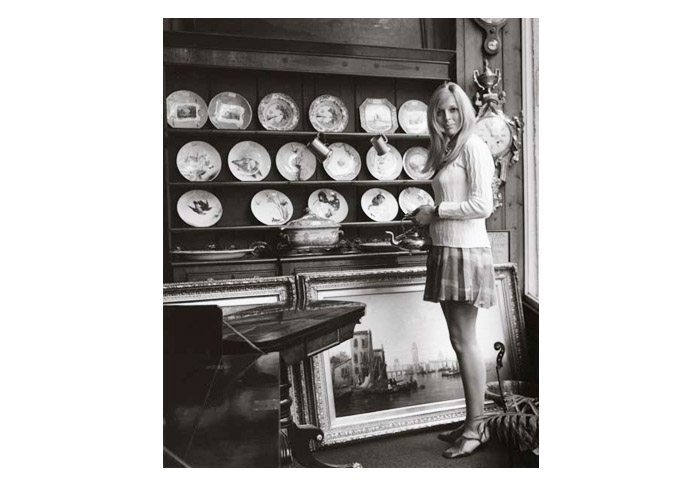
Antique Shop, Hampstead, London, 1960s by Dorothy Bohm
“She always felt photographing women came very naturally to her,” says Monica.
“I wanted to consider her ideas about women – and they were different approaches than ones she used when photographing men.
“Her shots of men were often sardonic or gently mocking. She never saw herself as a feminist, but she was very attuned to the lives of women. She also never saw herself as a pioneer, or ground-breaking – despite the fact it was quite unusual for a woman aged 21 to set up a studio business on her own.
“When she started working outside the studio, she did not feel her gender was a barrier in any way. For example, she lived in America during the 1950s and she would go off on her own, getting on board a Greyhound bus, to explore with her camera. She always said being a woman was actually an advantage as a photographer – she said people felt she was unthreatening. She just got on with it.”
Choosing what to include from an archive built up since the 1940s meant trawling through work that said something about the time, place and era images captured.
Two previous shows acted as valuable guides: one was held in Manchester in 2010, while Dorothy was alive, and a second was held at Hampstead’s Burgh House two years ago.
“Choosing what to include was quite pragmatic,” Monica says. “The images were taken across the world and across decades. I had this cache of work to form the nucleus of the exhibition, and then I considered other works.”
Dorothy began with her own studio in Manchester aged just 21. But her work would quickly move from the restrictions of interior photography, a facet the show also celebrates.
“My mother took a series of really tender, really empathetic images of women in the immediate post-war period in Europe,” says Monica.
In a 2009 essay about her mother’s work, Monica wrote: “Images – whether taken in Spain, South Africa, England, the USA or the USSR – are a more unambiguous celebration of the strength that comes with youth and confident sexuality, while others again speak poignantly of the (misplaced?) aspirations and expectations of women in western society, that persist even today.
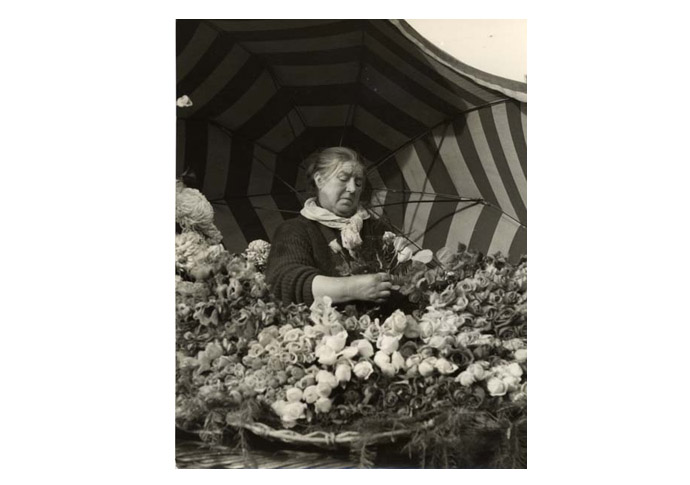
Rue de la Loi, Brussels, 1949 by Dorothy Bohm
“In a picture taken in Manhattan in the 1950s, for example, a young woman gazes longingly at a dramatically-lit bridal mannequin, to which she bears an uncanny resemblance.”
Women of different ages gave her camera material. As the essay recalls: “the photographer has commented that when she herself was young, she felt herself drawn to capture moments in the lives of older women; and it is striking that now, in her later years, it is young women who attract her most.
“Her oeuvre contains a number of memorable images of women in their middle years. Some of these – often wittily – depict women clearly no longer in their physical prime, yet formidable and vigorous, and almost larger-than-life. A Parisian cleaning lady, for example, wields one broom like a weapon, while a second broom, perfectly parallel, stands waiting, and her stocky outstretched arm dares us to enter her terrain at our peril. Others speak eloquently of the disappointments and disillusion of middle age. The pleading expression of the Islington stallholder clutching the doll stands in painful contrast to the blithe obliviousness of the doll-like child taken 20 or so years earlier.”
Her introduction to capturing daily life instead of the restrictions of studio portraits began when she travelled to Ascona in 1947, a town in the Italian-speaking region of Switzerland.
“There was a colony of anti-fascist artists there and she was inspired by the beauty – it was something of a landmark for her, a starting point,” she says.
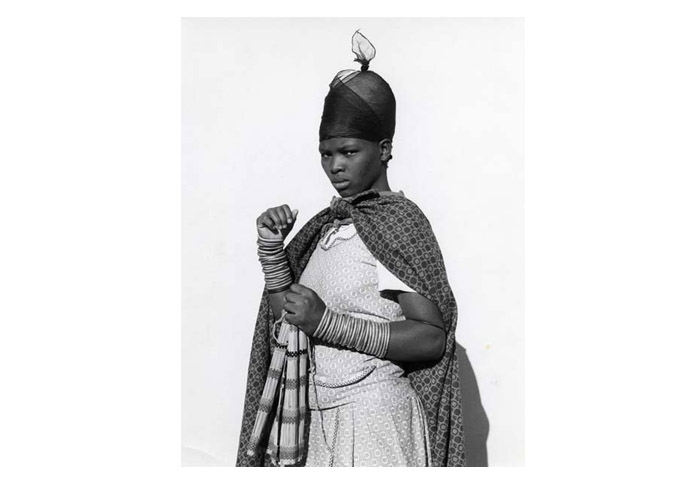
South Africa, 1974 by Dorothy Bohm
Closer to home, Sussex played a role in Dorothy’s life. The show’s appearance at the Lee Miller Gallery is in keeping with the fact Miller was another trailblazing female photographer, whose husband, the Hampstead-based art collector and critic Roland Penrose, gave Dorothy her first solo show at the ICA in 1969. But also the gallery is near the village that gave Dorothy her first taste of England as a teenager.
She was born in east Prussia in 1924 and arrived in England aged 14 as war broke out.
She went to school in Ditchling, Sussex, before heading to Manchester to study photography at the Municipal College of Technology. In the late 1960s, she and her husband bought a farm in west Sussex.
The exhibition is in a part of the world Dorothy considered home turf and draws together a changing world Dorothy observed.
“She worked totally instinctively,” adds Monica. “She was able to find a way to capture a time and place. When she felt inclined, she’d take her camera out and notice things without planning what she was looking for. She just knew the right moment to click the shutter. She did not have pre-formed subjects in mind.”
But while this sounds like a scattergun approach, Dorothy’s eye remains a constant.
“Most importantly for her was the idea of sympathy, dignity and empathy – they were what mattered to her and that comes over in her work,” says Monica.
“She said she wanted to represent the dignity of humans after the inhumanity of the war. She was interested in people, not the rich, not the privileged. She could capture the melancholy of people on their own. She found a sense of dignity.”
• Dorothy Bohm: About Women is at Farleys House & Gallery, Chiddingly, East Sussex, BN8 6HW. Open until July 26, Thursday, Friday, Sunday & selected Saturdays, 10am-4.30pm. www.farleyshouseandgallery.co.uk/
