My days as a spy and other stories
It’s the way she tells them. Dan Carrier talks to Xandra Bingley about what lies behind her razor-sharp observations of everyday human life
Thursday, 23rd April — By Dan Carrier
“PROUD breasts!” The exclamation would ring out of a cubbyhole of an office in Greek Street, Soho, from a reader brandishing a manuscript from a tottering pile of unsolicited novels sent to publishers Casper. There was always a fair slab among the wannabe authors’ works that would have a handsome hero making love to a woman with such a description.
It made Xandra Bingley laugh enormously.
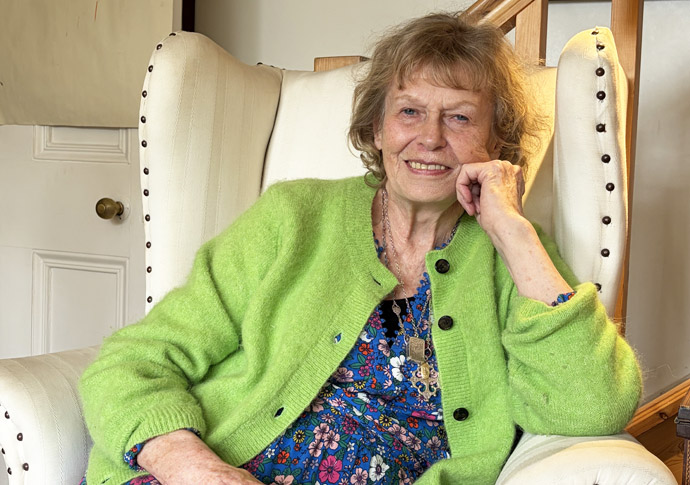
Xandra, who has worked as an editor, reader and literary agent, has a new collection of short stories out this week.
The Primrose Hill-based writer draws together vignettes of life and offers the reader a box seat to observe how the everyday can illustrate something fundamental about the human experience.
They cover everything from conversations with strangers on buses and trains to a memory of watching James Brown perform live. Some are contemporary – others are gleaned from thoughts and moments that Xandra, 84, has experienced through the years.
Xandra has seen much of the literary world through her work on the editing and production side, and recalls her time as a reader.
“We had around 3,000 unsolicited manuscripts come in every year, and we took turns to read them,” she recalls.
“It could be quite heart-rending – there were always the same categories: ‘It was always sunny when I was a child’, ‘How to break up the world’, ‘My dog, my cat, my snake, that I love more than anything…’ The readers were lovely. There was one called Paul who would gleefully shout: ‘It’s Proud Breasts’ again!”
Xandra, who was Ali Smith’s agent, has crafted a funny, touching, insightful and sometimes sad collection – and she says they are the product of a habit.
“I write most days, but do not write with the intention of being published. It’s like going for a run. Roald Dahl said if something comes to you, write it down. He would stop the car to do so. That’s my approach – I have a thought, I write it down. And people are full of stories, but they may not know it.
“Everything is a story and you don’t have to be a writer to see it like that.”
In the introduction, Margaret Atwood wonders at the shape of the stories: “Is it social reportage, the eye at the keyhole, the ear at the door? Is it a cross between Ivy Compton-Burnett, who writes novels entirely composed of conversations and Molly Bloom’s soliloquy at the end of Ulysses? Is it a study in textures and tones – the ripples on the pool of Being?”
Xandra says it is about observing and recording.
“Inspiration does not fall from the sky. They are all reality – though Henri Matisse once told a student: ‘Remember it never harms to exaggerate in the direction of truth’. If you think about that for writing, you can go anywhere. Stuff happens. As Margaret Atwood said ‘it is all material, Xandra’.”
And she is a born story teller. She tells Review how as an 18-year-old she joined the Secret Service, because she had read a novel about a Communist takeover in Britain. Her uncle was in the Royal Navy and told him she was concerned about the USSR.
“He said there’s nothing to worry about,” she recalls. “But if you are really scared about this, I will introduce you to people who are as foolish as you are.”
She went to Curzon Street for an interview with spooks. “The last question they asked was what magazines I read for pleasure,” she says. “I said Horse and Hound. There was a ripple of pleasure and I was in.
“But I very quickly did not like it. There is something very strange about gathering secrets. If you have three, you quickly want six, then 10, then 60. They were bugging people who were Communists, but also anyone left-wing – working-class people, who were going on strike for fair pay and holidays – and I really didn’t like that.”
The book is written in her own form of “Gonzo”-style prose: as someone who has worked as an editor, manuscript reader and literary agent, she has cut the ropes of grammar rules.
“Many years ago, I asked Margaret, who has been a friend for over 40 years, what was the most difficult thing – and she said punctuation.
“That gave me a licence. I found a book called Letters From My Windmill, a collection of short stories by Alphonse Daudet and he only uses a full stop, or … I loved that. The reader knows how to breathe – what is a comma? It is telling you how to breathe!”
Rhythm is vital in writing, she adds – so much so, Xandra has decided to learn a new skill – playing the drums.
“I am very music-dependent,” she says. “I am getting a drum kit. My grandson has one and I played it and enjoyed it. It will help me with my rhythm. And after all, there are obvious rhythms in the written world.”
• Ways Of Telling. By Xandra Bingley. Notting Hill Editions, £11.99
