Property News: Writer who saved Georgian Camden gets Blue Plaque – Acknowledgement for Sir John Summerson
Thursday, 22nd March 2012
Published: 22 March 2012
by DAN CARRIER
IT is incredible to think that the Georgian architecture that is so fundamental to the look and feel of the streets of Camden was once considered to be disposable.
Yet this was the case. They were seen not as something worth cherishing, but as poorly designed and built, and past their sell-by date.
Today they are some of the most valuable parts of our heritage – and this is partly thanks to the work of one man, whose achievements have been celebrated this week.
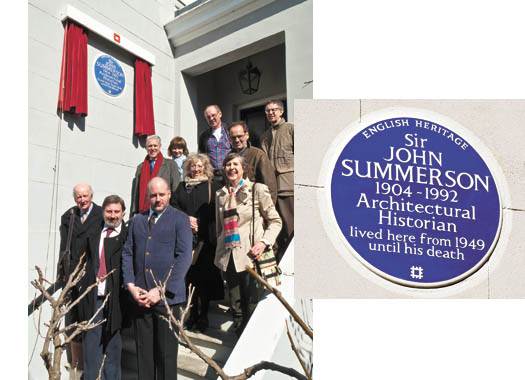
Sir John Summerson, who lived in Eton Villas, has been honoured with an English Heritage blue plaque at the Chalk Farm property he lived in from 1949 until his death in 1992.
Historian Howard Spence said Sir John was not only a well respected historian who brought the study of homes out of the realm of being merely a hobby into serious academic study, he also did so at a crucial time in London’s development. His championing – along with the likes of Sir John Betjeman – of the Georgian townscape not only saved swathes of terraces and squares from demolition it also gave the public a fresh eye with which to appreciate the period.
“When he first started off lauding Georgian architecture, it was very much under threat,” said Mr Spence.
Terraced homes in Bloomsbury had been lost as the University College London built Senate House. Sir John, who worked at the Sir John Soane museum in Lincoln’s In Fields, frequently saw another slab of older London disappear.
“It was not held in high esteem, and he helped make it highly regarded,” said Mr Spence. It wasn’t simply Summerson’s passion for architecture that drove him – it was his ability to write neat and readable copy.
“He was someone who moved the game on,” said Mr Spence.
“Before Summerson, architectural history was an amateur’s pursuit.
“He wrote with astonishing elegance about architecture.”
Sir John was born in Darlington in 1904. His father died when he was young and his mother Dorothea was fairly nomadic when he was a child. He said his first interest in architecture came from being educated at Riber Castle in Matlock, Derbyshire, a Gothic revivalist pile.
From here he went to Harrow and then on to the Bartlett School of Architecture at University College London.
Sir John worked with Sir Giles Gilbert Scott and then taught at the Edinburgh College of Art. He had originally been a champion of Modernism, but felt later that it had “conquered the whole building world and was repeating itself endlessly”.
He began his career as a writer on architecture when he wandered along Charing Cross Road in the early 1930s and found a dog-eared set of drawings in a bargain bin. They were John Nash’s, and it set him off to write a biography of the architect, published in 1935.
Sir John married Elizabeth Hepworth, the twin sister of sculptor Barbara in 1938.
They had triplets in 1947.
Sir John’s influence on London can be seen by his work during the Second World War.
He helped establish the National Buildings Record, primarily to note blocks threatened by the Blitz.
It would later become English Heritage’s National Monuments Record.
When the war ended, he was appointed the director of the Sir John Soane’s Museum, a post he held until 1984.
It gave him the platform to write a series of books on British architectural schools.
Heavenly Mansions (1949), Georgian London (1946) and Architecture in Britain, 1530-1830 (1953) became key texts for architects and the conservation movement, but were also devoured by those simply interested in design.
Summerson was appointed to the Royal Fine Arts Commission, the Royal Commission on Historical Monuments, and the Historic Buildings Council.
A founder member of the Georgian Group in 1937, his attitude to conservation was selective, unsentimental and occasionally controversial.
For example, he supported the post-war rebuilding of Chelsea Old Church and the selective reconstruction of John Nash’s Regent’s Park estate, but damned part of Georgian Dublin as being of “very slight architectural distinction”.
The current director of the museum, Tim Knox, describes Summerson as a “magisterial figure in British architectural history: a great writer and an eloquent speaker, and for 45 years curator of Sir John Soane’s Museum in London.”
He added: “It is fitting that his residence at number 1 Eton Villas is to be commemorated by an English Heritage blue plaque, making him part of the history of the city he so loved and celebrated in his writings.”
