Not Only for Ourselves
Dr Joseph Finlay’s new book explores the work of Edie Friedman, founder of the Jewish Council for Racial Equality, and the British Jewish community’s response racism, race relations and immigration
Thursday, 13th August — By Dan Carrier
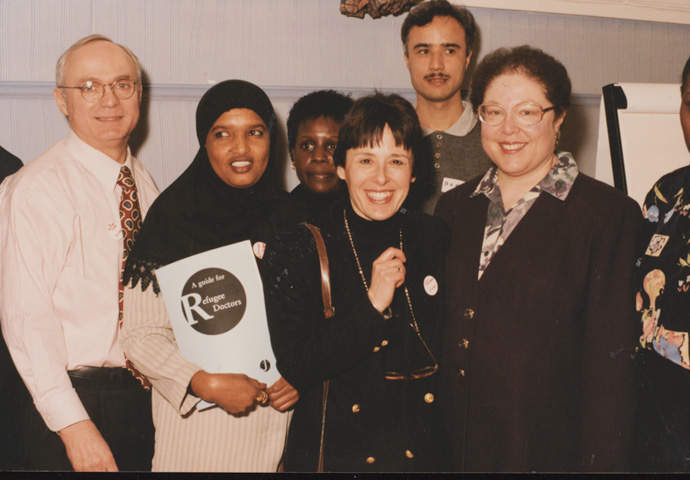
JCORE members Dr Edie Friedman with Dr Richard Stone, Rabbi Jackie Tabick and the Refugee Doctors group
WHEN Edie Friedman moved to Leeds in the early 1970s, she brought with her a lived experience of working in the civil rights movement in the United States.
She founded the Jewish Council for Racial Equality (JCORE) and now a new book by historian Joseph Finlay has considered the response of the British Jewish community to racism and immigration – and in today’s climate where the blatant, divisive lies told by Reform politicians have been allowed to enter our public discourse, offers an empowering story of solidarity and co-operation.
Dr Finlay studied for a PhD at Southampton University, researching British Jewish communities and race relations in the post-war era. The records of Jewish Council for Racial Equality are stored at Southampton and he came across the works of Edie Friedman.
“It was a live issue,” he recalls. “There seemed to be a lot of unexplained stories around how the state had looked at race relations and ethnic minorities, and the links between black people and Jewish people.”
He noted while many Jewish people worked as individuals to forge black and Jewish partnerships and continue the activism that grew out of anti-fascist movements, others felt scared to get involved.
“They were afraid that too much public involvement could make Jewish people a target for racists again,” he says.
“Edie came over from the US, where there were black and Jewish alliances but she found little here. But she settled in Leeds where there was a sense of vibrancy in this northern community.”
As Dr Friedman says in the book, she was part of a generation of people of Jewish origin who were politically active and, as she says in a foreword, “enthused by the prevailing zeitgeist of 1960s campaigning”: “The lyrics of Joan Baez, Bob Dylan and others made us feel we could sing our way to a fairer society, reinforcing a sense of hope that a better future was possible,” she states.
She noted that the UK had a far more advanced concept of social provision – the post-war welfare state – but also noted how there was an “apparent lack of a strong Jewish communal voice in pursuing social justice”.
She recognised a need for a body that would honour the “proud tradition of Jewish social activism”, and for a voice to take part in a national conversation on race and asylum, “to work together with other minority communities and to be much more at ease and confident in speaking out on these issues, providing a visible presence at the same time reframing the concept of ‘what is good for the Jews’ is what is good for the rest of society”.
She states: “I was aware that refugee and race issues were complex and could sometimes be contradictory – the very language was contested and constantly subject to change.
“For example, who and what is an ethnic minority? How should, Jews define themselves? Is anti-Semitism a form of racism? If so, how similar is it to, or different from, other forms of racism? How do you define Islamophobia and what are its connections with anti-Semitism?”
Dr Finlay, who lives in Belsize Park, ran JCORE for 46 years and saw a range of challenges, from draconian legislation and divisive language of political leaders, attacks by a right-wing media on social cohesion, the impact of migration and the perpetual conflicts raging in the Middle East.
“Despite the obstacles, we did achieve the ambition of becoming the UK’s Jewish voice – for many years the only one – on race and asylum, and one that the mainstream organisations, other minorities, campaigns, peers and politicians alike respected and looked to for our unique perspective.”
Friedman was born in Chicago in 1949. Her parents were first generation migrants: her grandparents spoke Yiddish and she recalled how their Jewishness was expressed through politics and social responsibility, instead of traditional religious observance.
She studied politics and was influenced by a class led by a Reform Rabbi that highlighted a link between student activism and the Jewish faith.
Friedman volunteered with the Black Panthers Free Breakfast movement, and she found solidarity with black people. She had noted lingering bigotry against Jewish people, too.
She came to the UK to study for the third year of her degree and while living in Leeds became a volunteer for Oxfam. It would lead to a job that saw her able to return after graduating.
As the book describes, the UK had a Jewish population of somewhere between 300,000 and 400,000 people in the immediate post-war years.
“It had felt the impact of the Holocaust far more viscerally, having been so close to Nazi-occupied Europe and only just escaping Nazi conquest in 1940,” the book states.
“The community had been slow to involve itself in the growing world of ‘race relations’ both because of its parochial, inward-looking nature and simultaneously due to a fear that outspoken advocacy for black and Asian Britons might endanger the social position of the British Jewish community.”
In 1976, Friedman established the Jewish Social Responsibility Council and attracted support from the likes of Jonathan Miller and Arnold Wesker.
It would have a number of aims, from considering the imbalance of wealth distribution and how to deal with racist organisations such as the National Front.
The group wanted to build strong bonds with African Caribbean and South Asian communities and would provide support to people recently migrating to the UK. It became London-based when Friedman moved south in 1983 and their work took on national importance.
As Dr Finlay, says: “This tells a wider story. It is concerned with how and when the British Jewish community intervened in the field of race relations in the post-war period and how it engaged in issues of immigration and social responsibility more broadly.”
As Dr Finlay’s extensive research illustrates, fighting bigotry never ends, and communities achieve success when they recognise how societal problems are endured by all and solved by all. By tackling them together, we can beat the far right.
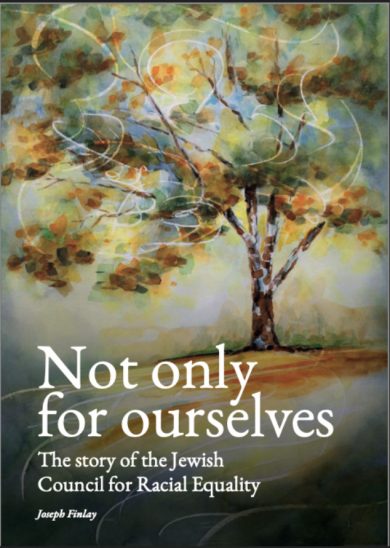
• Not Only for Ourselves: The Story of the Jewish Council for Racial Equality. By Joseph Finlay. University of Southampton. www.toratalbion.org.uk/not-only-for-ourselves/
