‘Memory is the most beautiful thing you have – it is amazing’
‘You write because you want to speak to the world. You want to tell the people in your life what you have discovered.’ Steven Berkoff tells Dan Carrier what it means to revisit your life
Thursday, 19th November — By Dan Carrier

Steven Berkoff [Aliona Adrianova]
STEVEN Berkoff’s career has spanned both rigorously intellectual stages with his adaptations of Kafka and Shakespeare, through to playing archetypal Hollywood villains in James Bond films and alongside Eddie Murphy in Beverly Hills Cop.
Now the actor, whose award-winning work ranges from his performances on stage and screen through to his work as a writer and director, has travelled through a lifetime to find landmarks and highlights that shaped him. It has been a glorious adventure – something that comes over in the superb telling of an extraordinary story in his new autobiography, Shouting At Night.
“Memory is the most beautiful thing you have,” he tells Review. “It is amazing – memory is an island you can return to.”
Roving through decades means self-reflection. “You re-run your past, you look at your regrets. There can be pain felt for some of your actions and decisions you took.
“You can look back with sorrow, ways you behaved, relationships where you feel you could have been more nourishing to the person at the time. In my case, it is the relationships I had with women.
“You write because you want to speak to the world. You want to tell the people in your life what you have discovered – you are exploring your own self.
“You explore this great island and you find all these wonderful flowers, jewels and precious plants, fruits. You decide to put everything in, even the negative. They reveal something of the world and something of yourself. You look at your flaws, you look at what was wonderful. I feel I wanted to confess the pains and horrors that I went through.”
He recalls a war-torn London.
“I was living in the East End in my early childhood,” he says. “It was full of fascinating areas, a gigantic bomb site. It was like a great sculptural metamorphosis, with all the buildings broken like an extraordinary sculpture by some mad European genius.
“As a child, you did not know about the horrors these bombsites really represented. Everything fascinated you.”
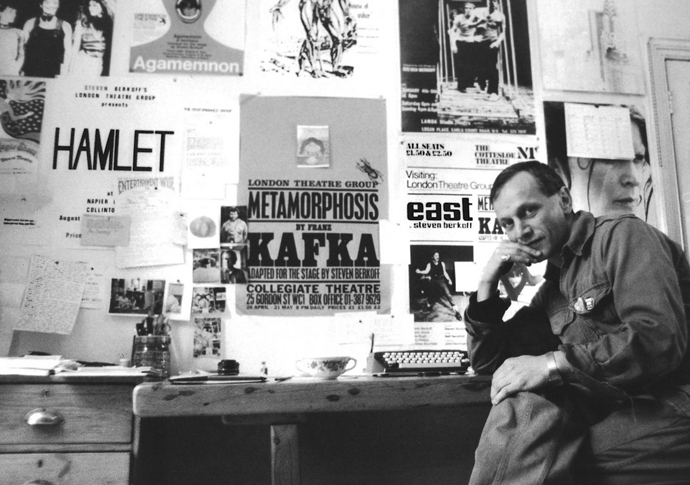
Steven Berkoff at home in Devonia Road, Islington c1982
He remembers fire brigade water tanks used to put out Blitz bombs. Steven and his friends would use them as impromptu swimming pools.
“They fascinated me,” he says. “They contained an extraordinary amount of water skaters, stag beetles, all sorts of bizarre creatures from this slum world.”
A formative period of his childhood saw Steven and his mother emigrate to join family in New York. It was supposed to be the start of a new life, with his father aiming to follow them.
Instead, it was a brief interlude and Steven and his mother returned to London after his father failed to make the trip across the Atlantic.
As for so many of Steven’s generation, America was a golden land – it would spur his acting ambitions – and his memory of New York is romantic. Experiencing Broadway at the age of 10 gave him ambitions to be an actor.
“London made me appreciate New York in a most fantastic way,” he says. “We were just poor working-class people. We had to save for years for the fare to join family in the Bronx.
“We arrived at dawn and we could see the lights of the skyscrapers, soaring up to heaven. I was astonished. This was a total fantasy. We stayed in a slum with my uncle Joe, but I did not mind: I was in America.”
Returning to the UK, he passed his 11-plus and was at the Raines school in Wapping until his mother was given a council flat in Stamford Hill.
“We had been living in a slum,” he reflects. “Suddenly we had an indoor toilet and bathroom, my own bedroom. I became ambitious, wanted to learn, improve. I went to evening classes and studied French.
“I left school at 15, and thought that until my big break as an actor came I should get a job.”
He went into selling menswear. “I worked at half the menswear shops in London. You are communicating, persuading, cunning. Drag them in, say anything – blag it.”
Steven’s desire to learn saw him head to Holborn’s City Lit and join a night school drama class.
“It was £5,” he remembers. “There were 24 young men and women in roll-neck sweaters and duffel coats. I thought: I am in heaven, this is where I belong.
“The teacher said welcome. To start, I just want to see you move.
“Walk across the room and have something on your mind, something we can read. I thought: this is wonderful. I walked, I turned, and now I am acting.
“The teacher would say: ‘I want you to take a piece of Shakespeare and learn it’.
“I’d actually be feeling the words. They were sizzling inside me. I was in my little bedroom saying my lines – and it was not too bad, not too bad. And then I thought: I’ll learn a speech from Kafka’s short stories. Kafka flowed through me like blood through my veins.”
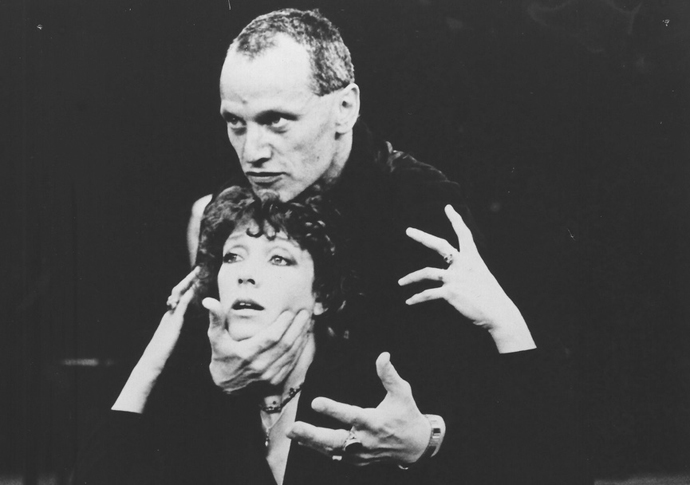
In Hamlet at the Roundhouse
From the City Lit, Steven studied at the Webber Douglas academy and received a grant from the London County Council to cover fees, books, costumes and living expenses.
“We came from a bombed-out country, our cities had been shattered, London was crumbled, broken,” he says.
“The powers knew we had to revive. They knew we had to train our youth, inspire them, help them be creative, be powerful and ambitious. That’s why they had these grants.
“The post-war generation were supported: the post-war settlement saw the power of the arts, saw the power of investing in higher education, in health, in housing.”
Steven learned his craft the hard way – working in rep theatre, doubling up as an assistant stage manager. It helped when he moved from acting to writing and directing, giving him a wider knowledge of stagecraft.
“You didn’t get actors from Rada doing this,” he adds. “They would not dream of it. I learned much about blocking, lighting.”
Another key stage in his development was watching the great French mime artist Marcel Marceau.
“I thought this was much more exciting,” he adds. “It was metaphysical, magical, mysterious, monstrous… I saw how you can make magic with your body, create shapes, objects, attitudes, atmospheres. I thought this is truly art.”
He studied in Paris at the studio of Jacques Lecoq, a leading mime artist.
“I thought I’d do a production using movement and text. I did Hamlet at the Edinburgh Festival. I used no set. We did it in a revolutionary way.”
His experience in rep persuaded him that there was a dearth of strong contemporary British dramas.
“When I was doing these plays, some were better than others, but mostly they were not taking me anywhere I had imagined I might go, so I tried writing. I did not have a subject in my head so I thought I’d adapt great stories. And I wanted to adapt the most thrilling, exciting, fantastical story ever written – not the kitchen sink stuff… I wanted to adapt Kafka, a story about a man who changed into a giant insect. I had enough mime in me to create the insect.
“I hired the Roundhouse. It was my first production and I knew this element – writing,and directing as well as acting – was perfect.”
• Shouting at Night: From East End Rebel to Hollywood’s Master Villain. By Steven Berkoff, Supernova Books, £19.99
