Joe Cole: Luxury Player
Dan Carrier talks to the lad who learned his skills on patches of ground in Camden and went on to play football for England
Thursday, 1st January — By Dan Carrier
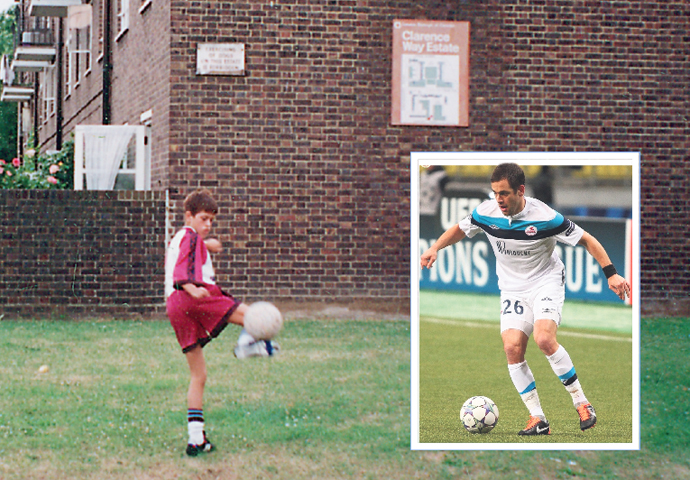
Joe Cole in the early days, practising skills on Clarence Way estate; inset: Playing for OSC Lille in 2011 in a Champions League game against PFC CSKA Moscow [Vladimir Maiorov]
JOE Cole’s life story travels from curling footballs into the top corner of garage doors on the Clarence Way estate to slaloming his way through Manchester United’s defence to bang in the goal that helped Chelsea win the title.
The boy from Camden Town won the lot – and his autobiography reveals the background to the creation of a talent whose career came at a time when the game was in a state of change, an evolution from the 4-4-2 tactics that dominated for decades into the modern football we enjoy today.
Joe grew up in Donnington Court, Castlehaven Road. His father George was a market trader – he had a stall in Inverness Street – and Joe went to Haverstock School.
Such was his talent as a kid that clubs flocked to sign him. He recalls how in May 1994, his mum, Susan, answered the phone to hear Alex Ferguson hoping to speak to her 14-year-old.
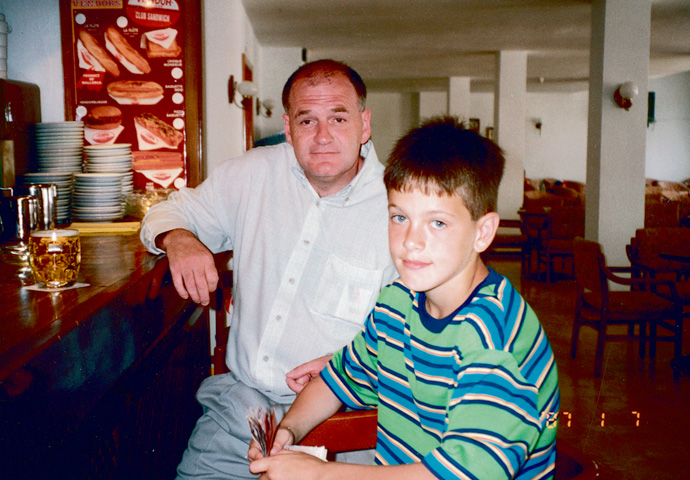
Young Joe with his father, George Cole
Joe began his career at West Ham, guided by his father’s wisdom about the best way to forge a career in a brutal industry.
“He said I would go where I was happiest and money had nothing to do with it, although of course money was always mentioned,” he says.
“Clubs would size us up – two parents and three kids in a Camden Town council flat – and assume dad could be bought.
“But he was adamant. My dad could make money one way or another to support his family. That wasn’t my job. He just said to me I should go where I felt comfortable.”
George’s steady guidance runs throughout the book, and Joe’s love for him is obvious. Aged 10, his father took him for a walk. Joe says he knew immediately something was up as his dad, who ran a minicab firm on Kentish Town Road as well as the market stall, “never really walked anywhere if he could help it”.
“On that walk, George told me four things. First, that he was my dad. Second, that he loved me and always would be my dad. Third, he told me that he was not my biological dad. Fourth, he said if I ever wanted to meet my biological dad then that would be fine. George would organise it and it would not change anything about the relationship the two of us had.”
Joe speaks brilliantly – and frankly – about his life growing up in Camden. “I occasionally get on my bike and find myself heading from my home in west London back to explore those streets of Camden,” he reveals.
“They may have changed, sometimes for better, sometimes for worse, but all the things I needed as a child are still there. Outside my parents’ council flat is the small expanse of concrete between two sets of garages that was the first place we would stage football matches, that would draw children from all over the estate. From there I can map out all the scraps of ground we would play football.
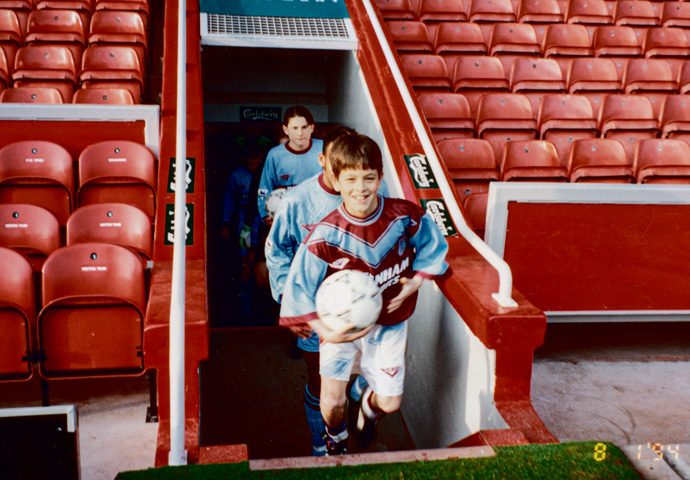
With West Ham United Youth Team
“We played on what was then a patch of tarmac on Castlehaven Community Park, strewn with broken glass and sometimes the needles of addicts. Or Talacre Gardens, the small park in Kentish Town.”
Stories flow: he remembers how as a teenager his two big heroes were Paul Gascoigne and Noel Gallagher. “I must have been around 14 when I knocked on the door of a big house in Primrose Hill,” he says.
“We had found out where Noel lived. I read he liked football and so I reasoned he’d like nothing better than to put his Manchester City shirt on and join us. To our disappointment Meg Matthews, Noel’s then wife, answered the door and she was not happy. Understandably, she told this group of teenagers to do one. When she closed the door we did what all irritating teenagers do – we knocked again. There was a pause and then it was opened by the man himself. I was speechless.
“Noel was from a background like ours and he knew how to deal with us. “Sorry lads,” he said. “I can’t play football today. I’m off on tour and I’ve got to get ready.”
Tales of a Camden scallywag light up pages, but he recognises the hard times too. “If I am to focus on all the possibilities I felt, then I also cannot forget the fears we held,” he says.
“It all leads me back to one event that dominated the community for a while. The murder of 15-year-old Richard Everett in Somers Town in August 1994.”
He recalls the impact it had, the upset and misinformation that attempted to stir up trouble.
“Richard’s death cast a shadow over all of our childhoods,” he says. “His family have had to live with it for ever more. It is important to remember Richard and the destructive feuds that led to his murder, to assemble a proper picture of what life was like in the 1990s.”
Joe references the work of Dr Rosemary Harris, an academic who studied tensions between young people in Somers Town.
“Reading the pages of her study I find it hard to fathom the reality of life for many kids in that era,” he says. “I am grateful that football kept me away from so much of it.”

Joe Cole commentating on West Ham’s UEFA Europa Conference League final win in Prague in June 2023 [Egghead06_CC BY 4.0]
Joe’s journey went from Castlehaven to the FA school of excellence at Lilleshall in Shropshire, then signing for West Ham before winning trophies at Chelsea.
His career bridged a fascinating time. While Arsene Wenger had ushered in an attention to lifestyle – despite his Arsenal team being known for their hard drinking antics – Joe saw the influx of new money and the game change from hit-it-long-to-a-targetman tactics into the patterns of play we enjoy today. Joe lived through it. He was unfairly labelled as a “luxury” player rather than skilful and hard working – and his experience is highlighted through his return to West Ham after winning the lot at Chelsea. Sam Allardyce was the boss.
Joe uses this experience, having gone from José Mourinho back to an old-school English manager, to highlight just how much our national game has changed. And his take on Allardyce’s management skills are pretty funny, too.
“For much of my life it felt like I was in the wrong place, trying to play a different tune,” he writes.
“It was there as a schoolboy shoe-horned into a coaching system that favoured big lads winning second balls. It was there at the FA school of excellence. Even there they tried to bend me into a certain player, and I resisted. It was there at West Ham when we were either fighting for Premier League survival or fighting to get into the top six. I felt that way with the England teams of Sven and Fabio Capello. I knew something was wrong with the way the team was playing and that we could have been doing it better.”
Joe tells his story with wit and wisdom. The New Journal celebrated him last year as one of Camden’s 60 people to remember, marking the borough’s 60th birthday.
This brilliant read shows why.

• Joe Cole: Luxury Player. Seven Dials, £25
