‘It was a Sliding Doors moment, if I had not gone out then I wouldn’t have been run over by that police car’
Man who lost his leg says he's relying on food bank after welfare shake-up
Sunday, 12th July — By Caitlin Maskell
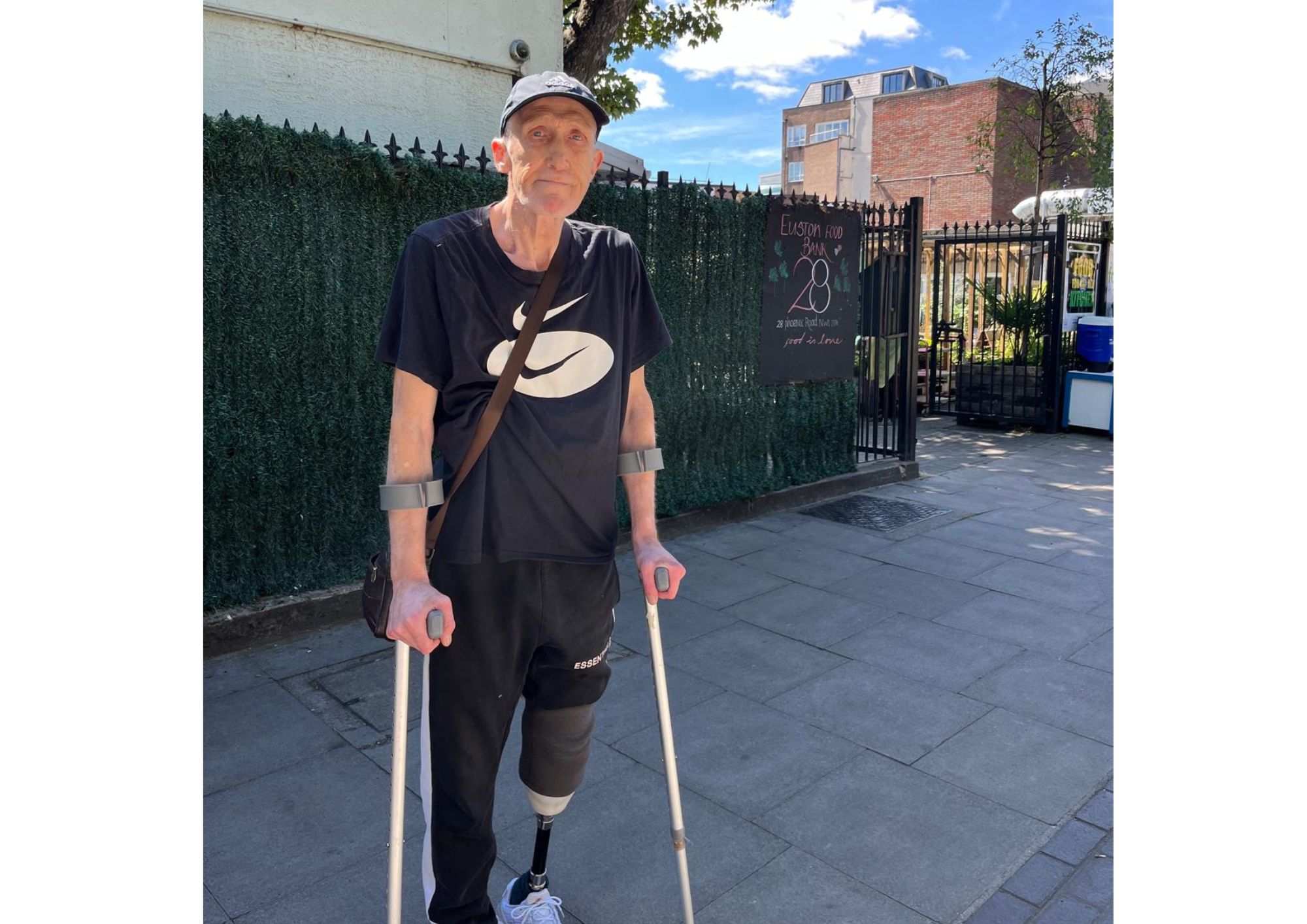
Paul Wells’ life changed forever in December 2005
MORE than 20 years after losing his leg when he was hit by a police car, a man has spoken about the lasting effects of that fateful day in Camden Road.
Paul Wells, 62, had been out doing some shopping when he was struck while crossing the road on December 21 2005. The unmarked police car was travelling at 47 miles per hour without lights or sirens.
“I do think, what if I hadn’t gone out Christmas shopping that day?,” he said this week. “What if I had just stayed in? It’s sliding doors.”
The New Journal reported on the incident at the time amid the concerns that his limb would have to be amputated, and the worst fears came true in 2018 when Mr Wells suffered years of chronic infection. “Sliding doors” became a popular phrase after the 1998 film starring Gwyneth Paltrow about how the course of somebody’s life can change in a single moment.
After decades of working as a carpet fitter in Tufnell Park, he was unable to return to work following the operation to remove his leg. Now, permanently disabled, he had been living on his Personal Independence Payments (PIP) until they were suddenly stopped in September last year.
Since then Mr Wells said his life has been in tatters, having fallen into debt and now unable to pay his bills. He said he has been relying on the Euston Foodbank, close to Somers Town.
He suggested the payment he had received from the Metropolitan Police was simply not enough for the long-term damage it caused.
He said: “I didn’t know if I would ever come back to sanity, waking up and looking down and realising that the leg was no longer there. It pushed me over the edge and questioned whether Paul was going to be there any more.”
Mr Wells had been living in Agar Grove at the time of the incident. He had been heading to Camden Town tube station to travel to the West End to buy some last-minute presents. He broke his leg in seven places and dislocated his shoulder after being thrown 20 feet from the impact.
“I didn’t lose consciousness and could see both bones, my tib and fib, coming up through my jeans,” he said.
“I had never broken a bone in my body up until that stage. I knew I was in trouble but pain wise I think the shock or the adrenaline covered that. “The police did get out of the car, but didn’t apologise or say sorry. I don’t believe they went out to knock me over that day. It was just an accident and I understand why they didn’t say sorry because it would have been them admitting they were in the wrong.
“But at the end of the day they crippled me, whether it was an accident or not. And all of this now – with the PIP – it’s almost like the system is being spiteful to me.”
Six years after the incident, Mr Wells received a payment from the Met: a £53,000 settlement reached out of court.
He said: “In the end I got so fed up, because of my injuries and no one knew whether it was permanent or not – so I couldn’t get disability living allowance. I was snookered. For nearly five years I had no income at all. Nothing. My family were looking after me, feeding me and housing me but I had forgotten what it was like to have just £50 in your pocket. I just didn’t have an income at all. It put me in such a low mood.”
Mr Wells added: “In the end I said to the solicitors that it’s been six years already – but they told me if I settled now it would be final, even if I lost my leg in the future. I knew that but I thought I could be waiting the rest of my life, and in the meantime I was getting worse and worse. My mental health suffering.”
The size of the settlement compared with the later outcome of losing his leg remains a source of frustration.
“I ended up getting £53,000 –which is appalling,” he said. “If it had been a school teacher it probably would have been more. Whether you’re a millionaire or a tramp it shouldn’t matter, if they have run you over they have run you over. The reality is they were never going to give me much.”
It was in August 2018, after years of treatment at UCLH and 17 operations, that consultants told Mr Wells his leg would have to be amputated because of years of chronic infection.
“My consultant said they had tried everything, but the infection was so bad,” he said. “I thought I’d be prepared for losing it, but nothing prepares you for looking down and not seeing your leg there any more. I was like a passionate child before, insisting to doctors I would never go in a wheelchair and that my life wasn’t going to change. I’m not proud of that behaviour looking back, but losing it, it’s like losing part of you.
“And the stump changes shape – what’s rubbing now won’t necessarily be the same in two months, you are always trying to compromise and put up with constant pain. Some days I can barely walk.”
Mr Wells lived in Iverson Road, West Hampstead, until he was seven years old before moving to Agar Grove where he attended Brecknock Primary School and Acland Burghley School.
He later worked as a fitter at B&R Carpets in Tufnell Park opposite his former secondary school. “I’ve never not worked. I liked that you weren’t in the same place every day. One week I could be in Liverpool the next in Milton Keynes or Kentish Town.
“I wasn’t bored by my surroundings and I’d been really careful to never get into debt. I’ve never had credit cards, and was extra careful with my pay-out, but really my life changed in that one day. Sometimes it is the hand you are played in life.”
A Metropolitan Police spokesperson said: “The Met acknowledges the impact that this collision had, and continues to have, on Mr Wells’ life. Our legal team worked closely with those involved to reach a settlement in 2011. Given the time that has passed, we are unable to comment on the specific nature of this settlement in the time frame provided.
“We have contacted our archive colleagues to see whether there is a hard copy of this settlement, however this could take some time.”
Carpet fitter who lost leg relies on food bank after welfare cut
PAUL Wells said this week he feels betrayed by the removal of support which helped him live with a permanent disability.
The government’s decision last year to cut back on Personal Independence Payments [PIP] was removing a lifeline for people in his position, he warned.
“I’ve voted Labour all my life but they have come in this time and taken everything away,” he said. “I feel really betrayed. I get my money in this hand and it’s gone. I still feel embarrassed that I’m having to go to a food bank.
“I have never had to use it before, even though I knew it had been there for a long time. “I really felt for the people that had to – thinking what an awful situation that is to be in. There are nurses that use that food bank and work full time. What is going wrong with this country?”
There were protests outside parliament after the government announced a shake-up over who would qualify for help.
Mr Wells was receiving the benefit for seven years after his leg was amputated and he was unable to work. He suffers from chronic pain and respiratory issues.
He said he received a letter from the Department of Work and Pensions last summer informing him that all claims were being reviewed, but that he was receiving the right Mobility and Daily living allowance and that his claim would not be looked at again before 2027.
Months later he found the support had suddenly ended, only after attempting to pay his phone bill, realising he had insufficient funds.
“At night I barely have a light on,” said Mr Wells. “I’m having to save where I can.” He has appealed this decision and a Department for Work and Pensions spokesperson said: “We’re sorry to hear about Mr Wells’ situation. Entitlement to PIP is determined by the impact a health condition or disability has on a person’s ability to carry out daily living and mobility activities, rather than on a diagnosis alone.
“This case has been back to the independent Assessment Provider for further review and any comments or revised recommendations will be considered by the Department.”
The government is proposing to tighten eligibility for the daily living component of PIP by introducing a new eligibility rule. Disabled people who currently qualify because they have difficulties across several everyday activities could lose their payments if they do not score at least four points in one single activity, even if they meet the existing overall points threshold. A report on welfare benefits is due to be published at the end of this month with final recommendations due in the autumn.
This review is being led by Sir Stephen Timms, minister for social security and disability, and was announced after a rebellion on Labour’s backbenches against the proposed cuts.
Mr Wells said the Euston Foodbank had been a “lifesaver”, but he now was concerned by reports that its future is uncertain. Volunteers have described empty shelves in the food bank’s stores and criticised the charity’s governance over the past six months. Once serving more than 400 families a week, feeding over 1,000 people, it has now reduced its provision to just 120 households a week.
The trustees of Euston Foodbank said: “We are confident that Euston Foodbank is not facing closure. It continues to support thousands of people during their hardest moments across the community. We are currently undergoing a period of change to improve our services. Euston Foodbank continues to distribute emergency food parcels to people facing hunger and hardship, but on a smaller scale to ensure we have the resources to provide more effective advice and support, so that people are less likely to need to turn to a food bank again. See Comment, page 16
