Farewell Nick Peacey, Mr Lauderdale House
Volunteer never sought limelight in transformational community projects
Friday, 7th August — By Daisy Clague
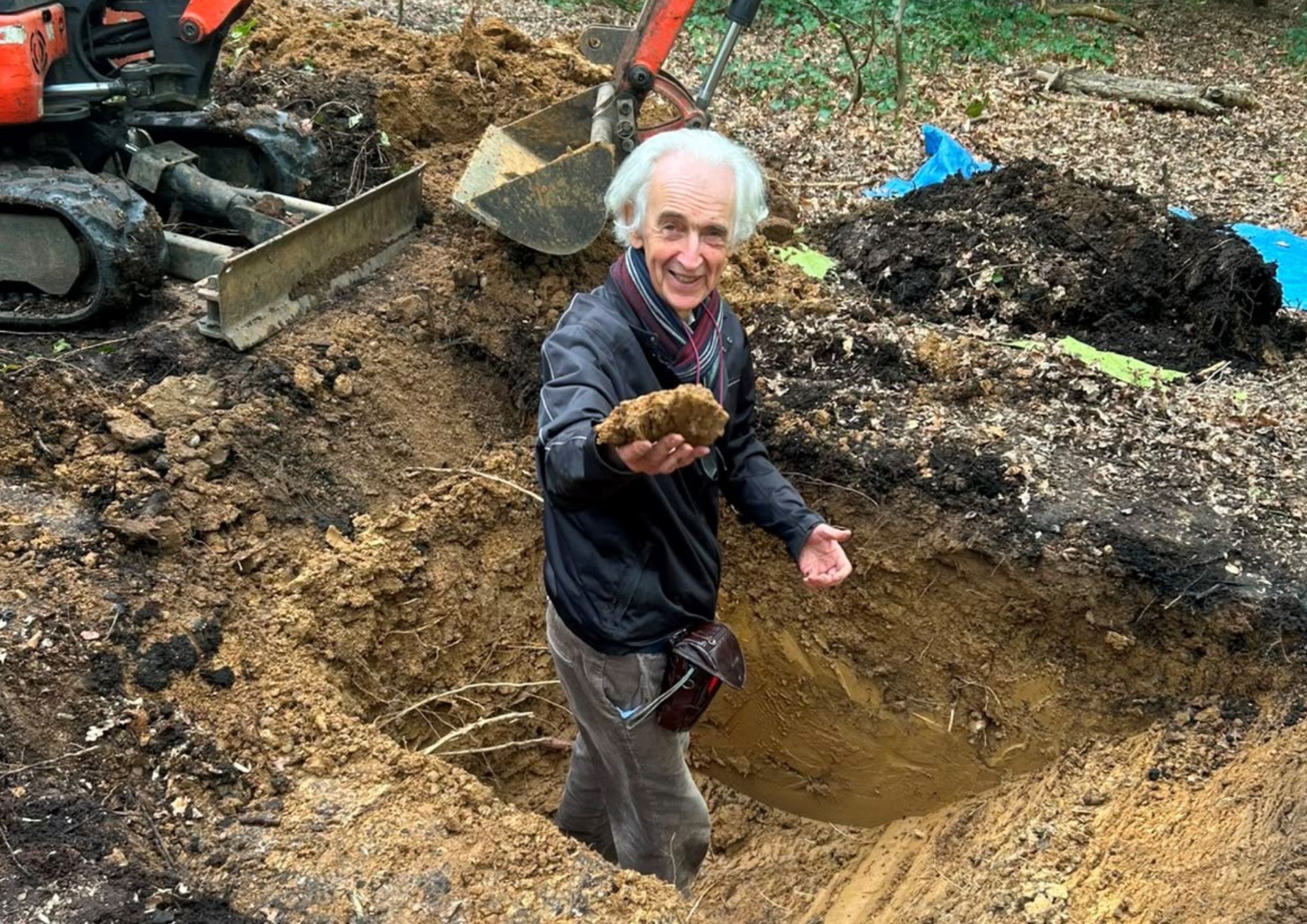
Nick Peacey MBE at the dig for the Roman kiln [Shem Morgan]
IN the 1970s, it would have been hard to imagine a future for the vacant, fire-damaged Tudor building in Waterlow Park – but there was a small group of residents who could, and it was their determination that turned Lauderdale House into the vibrant arts and education centre that it is today.
Among them was the “unstoppable” Nick Peacey MBE, who has died at the age of 83.
Mr Peacey lived most of his life in Highgate, where he was a founding member and trustee at Lauderdale House since its foundation in 1978.
He later served as chair for 34 years until 2017, leading the organisation through a major £2.1 million refurbishment.
“Nick’s love and enthusiasm for this unusual survivor of a Tudor building was palpable from the day I met him at my interview at Lauderdale House,” said the organisation’s director Katherine Ives, who worked with Mr Peacey from 1998.
“He used to talk about when he was first allowed inside the fire-damaged building, which had been left empty and unloved for 15 years with no roof, and discovered that the ground floor was being used to store lawnmowers.
“And I am sure that each time he walked through the door in recent years he must have felt a glow to see the building full.”
She added: “He was always hugely energetic and enthusiastic, but also slightly understated. He never took the limelight, despite making all these remarkable things happen.”
Outside of his almost five decades of work at Lauderdale House, Mr Peacey was a Labour Party organiser, family history aficionado and prolific educator who was noted for his work in the field of special educational needs and disability (SEND).
He was an early campaigner with Teachers Opposed to Physical Punishment (STOPP) in the late 1960s, which eventually led to the outlawing of corporal punishment in schools in 1987, and he later worked at the UCL Institute of Education on SEND and teacher education programmes.
His commitment to Lauderdale House also reflected a broader interest in heritage and he was a driving force in the restoration of a Roman kiln, which had been discovered in Highgate Wood and languished in storage until he raised the funds to open it to the public.
Charlie Andrew, a fellow trustee of the Friends of the Highgate Roman Kiln, described Mr Peacey as a “string-puller, grant-bagger and diplomat extraordinaire”.
“From my first meeting with him, Nick’s warmth and inclusivity marked him out as a rare find,” said Mr Andrew. “He was also the first in line to muck in with the hard work.
“Nick, to me, always seemed unstoppable – and in the truest sense, he still is. His legacy lives on not just in the output from the grants he secured, but in the kindled curiosity of everyone he brought along for the journey.”
Mr Peacey also spent his spare time researching his family history, including writing a book about his pioneering balloonist, parachutist and plane-making ancestors.
Hornsey MP Catherine West was also involved in the restoration of the kiln. She said: “Nick’s legacy is his vision of the power of learning to set us free regardless of our individual experience of the ‘education system’.”
Nick is survived by his wife of more than 60 years, Lindy, and two daughters and grandchildren.
