Did Constable's Suffolk masterpiece have a secret bit of Hampstead in it?
Time for a 'Wain check'?
Sunday, 9th May 2021 — By Dan Carrier

The Hay Wain
EVER since John Constable sat at his easel 200 years ago this month and finished The Hay Wain – perhaps his most celebrated evocation of the English countryside – scholars have been in no doubt the landscape lying in front of the famous painter was that of the River Stour in his native Suffolk.
But now, new evidence uncovered by historian Neil Titley suggests that the image of rural idyll, sold in gift shops across Suffolk, may have been at least partly fashioned on somewhere closer to what had become his home in Hampstead.
In his new book, Under Ken Wood, Mr Titley outlines clues that Constable’s painting may have a more complicated geography including the type of cart being pushed through the river’s shallow waters by two rustic-looking gentlefolk.
In 1819, the artist had moved to Lower Terrace, Hampstead, 200 yards away from Whitestone Pond and it was here he finished the painting, which he was to display to acclaim at the Royal Academy in May 1821. Constable was prolific while living in Hampstead, and he used the area for many studies.
Mr Titley argues Constable was unable to visit Suffolk at the time he painted the piece. Whitestone Pond was, and remains today, a man-made watering hole, “the equine equivalent of a motorway service station”, Mr Titley said.
Each day, hundreds of horses and carts splashed through it.
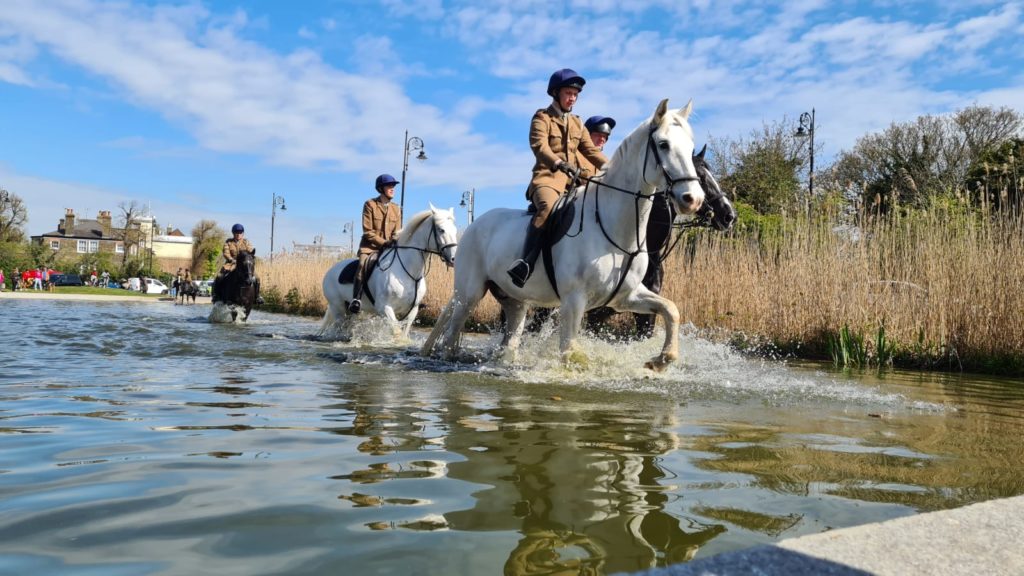
The Household Cavalry ride through Whitestone Pond last week
This was all brought back to life last week when the New Journal reported how the Household Cavalry had sent a troop of horses to the ponds for an event marking the 150th anniversary of Hampstead Heath.
“Its function was to water the horses after an exhausting haul up the hill,” Mr Titley writes of the pond. “Ramps allowed animals to enter without being unhitched.” Constable, a slow worker, faced a tough deadline for the Summer Exhibition.
He had run out of money and, short on time, could not get to Flatford Mill to complete what he had started.
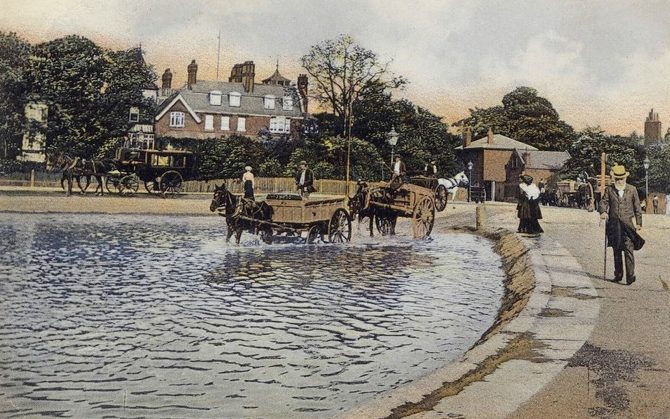
Whitestone Pond in 1900
Mr Titley believes Whitestone Pond provided an answer. Drawing on previous sketches, he could recreate the Suffolk sky and background – but when it came to the cart, he was stuck.
He said: “A stickler for detail, Constable wrote to his Suffolk pupil John Dunthorne, asking for a sketch.”
Constable requested an image of a Suffolk wagon known as a hay wain, built with high sides to increase its load – but the historian argues the cart in the picture looks nothing like one.
Mr Titley asks: “If the meticulous Constable wanted an authentic Suffolk hay wain, he didn’t get one. And why would Dunthorne send him a sketch of a wood cart when he wanted a hay wain?”
This has led him to conclude that the painting owes more to Hampstead than previously thought.
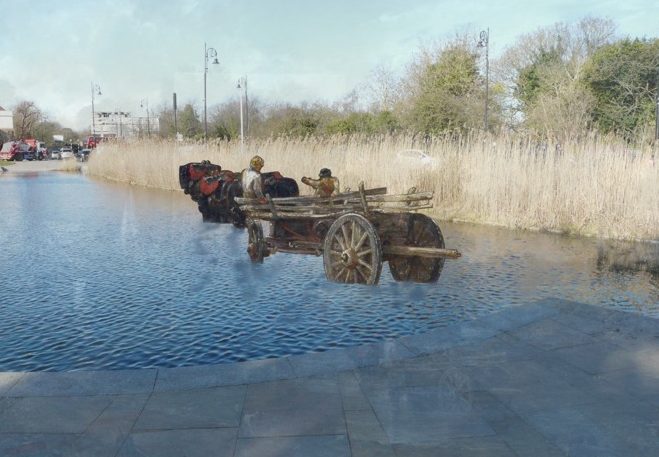
How a hay wain may have looked like in Whitestone Pond [Vanessa Heron]
Mr Titley said: “It is far more likely that Constable relied on a real-life model. Every type of wagon was present within a two-minute walk of his easel.”
Former Tate Britain curator, the art historian Simon Wilson, said he believed the idea held water.
He said: “Neil Titley’s suggestion – that the cart may have had an immediate source in Hampstead – is plausible and a fascinating contribution to Constable studies.”
l Under Ken Wood by Neil Titley is £10 at Keats Library, its website www.keatscommunitylibrary.org.uk/ and Daunt Books, South End Road, with all proceeds going to the Friends of Keats Library
