Burst water main floods road day after Thames Water bosses are grilled at Town Hall
Councillors ask why cash was paid out in dividends and not spent on infrastructure
Thursday, 26th February — By Richard Osley and Daisy Clague
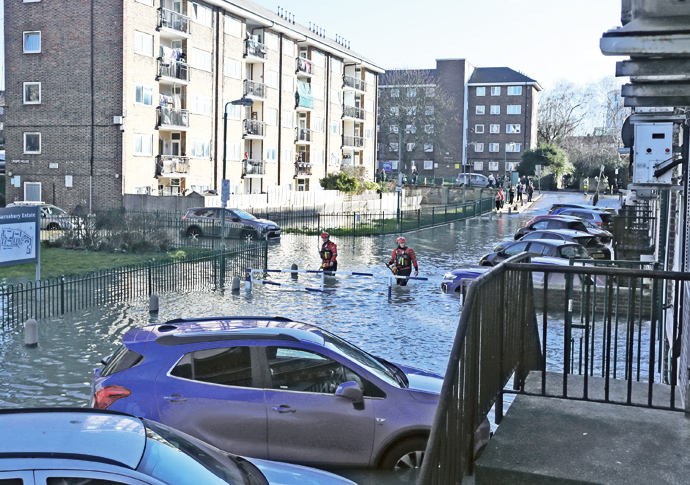
Flooding in the Caledonian Road area
THAMES Water bosses faced a grilling at the Town Hall on Monday about what the profit-seeking company in control of everyone’s supply was doing to prevent flooding.
Less than 24 hours later, a mains burst turned Caledonian Road in neighbouring Islington into scenes that looked like a mirror image of the soggy chaos witnessed in Kentish Town last year and South Hampstead over Christmas three years ago.
Representatives were asked why bills were going up but dividends had been paid by the company, and why Thames Water had not invested more money into its ageing pipes over the years it had doled out cash to shareholders.
Councillors on the cross-party culture and environment committee were told no dividends had been paid for seven years, only for the panel’s chair Awale Olad to pull up the regulator OFWAT’s figures which appeared to show multi-million pound sums had been extracted from the company even since Covid.
The regulator announced last May it had fined Thames Water over what OFWAT’s chief executive then described as “undeserved dividends”.
Labour councillor Rishi Madlani said: “It really, really irks me. My water bill has gone from £20 to £40 a month – that’s typical for most residents.
“We’re all suffering higher bills when your shareholders were given high dividends, extracting money instead of making investment – so how on earth should we trust you? Why should we be paying for your extraction to your previous shareholders? There is a trust breakdown.”
James Abbott, the company’s local engagement chief, said: “We don’t even have shareholders at the moment because the value of the company is so low. Our creditors are in negotiation with the government about recapitalising the company – we can’t be held accountable for what previous owners did.”
It was then that Cllr Olad read out OFWAT figures which show that Thames Water has paid approximately £7.2 billion in dividends since the water supply was privatised in 1989.
The contention is that this could have been used on the infrastructure.
South Hampstead ward councillor Izzy Lenga said she was concerned that the pipe which burst in Kentish Town last October had not been on the company’s list of possible weak spots on the network.
“If this is happening with mains that are not even on the radar, that’s extremely concerning,” she said.
Cllr Lenga added that she was frustrated that Camden was seen as a low-risk area – wrongly in her opinion – which would affect funding decisions.
The images of drenched streets and residents being helped to safety by firefighters are not restricted to Camden.
On Tuesday afternoon, London Fire Brigade crews were deep in the water at the south end of Cally Road in Islington, close to King’s Cross.
It said that a 36-inch main had burst and that specialist teams had “used inflatable boats to rescue 50 people and three dogs”.
Businesses on the busy road were already counting the cost of the damage when our sister newspaper, the Islington Tribune, interviewed those affected.
More than 150 properties were still without power yesterday (Wednesday).
Thames Water has apologised for the disruption and said its teams were still on site, with loss adjusters available.
The night before, Kevin Brown, head of asset planning at Thames Water, told the council committee that 59 per cent of mains in Camden had been replaced since 2000.
This led to more questions from the council committee as to why the number of incidents appeared to be growing. This anecdotal trend was disputed by Thames Water.
Mr Brown said: “There has obviously been a complete change in the weather patterns, which means we do see drier and wetter weather, which does create ground movement which will create leaks and bursts. That doesn’t answer the question as to ‘why Camden?’ – I think it’s happening in a number of places.”
He added: “We are committed to going through and dealing with the bursts and the leakage. As we are replacing more mains – and we are replacing more mains – we’d like to see the number come down. At the moment it is quite high.”
Mr Abbott told the committee the company had a multi-billion-pound budget set aside for dealing with leakages and this was a sign of how seriously it took the challenge.
“We divide our network into sections – each section is characterised according to its age, its condition, the soil condition around it because London clay aggressively heats metal pipes,” he said.
“We use that model to decide where we invest. Every time we have a burst we learn something from it.”
