Blue plaque for Jill Craigie: ‘Her untouched study was a place to explore history'
'She lived in that house for around 50 years with my great uncle Michael Foot since the couple wed in Hampstead Town Hall in 1949'
Monday, 9th February — By Tom Foot
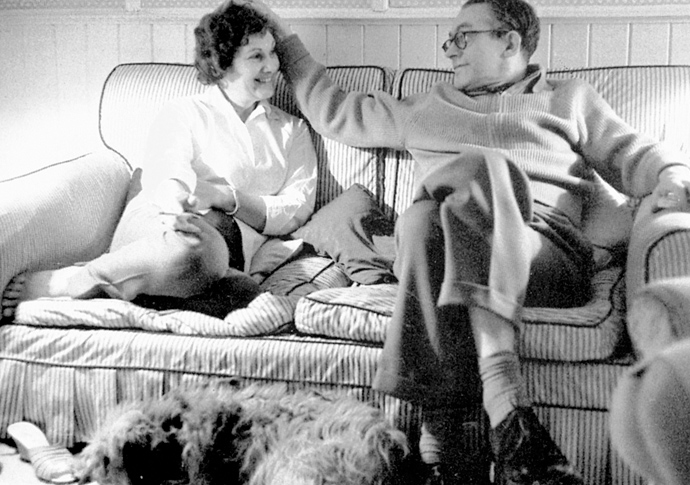
Jill Craigie with Michael Foot
As it’s announced a blue plaque will be put on film director Jill Craigie’s former home in Hampstead, our deputy editor TOM FOOT reflects on his time living there
IT feels like a lifetime ago that I was living in the top floor flat in Jill Craigie’s home in Pilgrim’s Lane, Hampstead.
Distant memories of that magical house have been stirring this week after English Heritage announced it hoped to be fitting a blue plaque there later this year.
Jill was one of the first women to direct feature length documentaries in this country – I think the first to have one screened in cinemas.
And this was despite her work doubling as hard activist journalism.
English Heritage described her career this week as focusing on “housing shortages, labour rights and post-war reconstruction”, describing her as “a committed feminist” whose work “lay the groundwork for later generations of socially engaged British filmmakers”.
She lived in that house for around 50 years with my great uncle Michael Foot since the couple wed in Hampstead Town Hall in 1949.
Michael kept her study untouched for a decade after her death before it was dismantled and the archive of 72 boxes, 100 books and 300 objects were donated to the Women’s Library, now held in the London School of Economics.
The study was filled with books by our greatest women writers – I remember first editions of Mary Shelley’s Frankenstein and Mary Wollstonecraft Vindication of the Rights of Women among others.
But far more interesting was the original memorabilia from the Suffragette movement, hand-stitched protest banners, cuttings, pins and badges, and actual letters from the Pankhurst sisters.
I remember opening a nondescript book at random and finding crushed up inside a letter to Jill from Indira Gandhi, thanking her for a recent hospitality.
The south-facing window looked out over Hampstead toward the Royal Free Hospital, where Jill died of heart failure in 1999.
There were also her boxes of notes of her unfinished book, which I now have and am uncertain what to do with.
One of Jill’s docs will be particularly interesting to anyone interested in Camden’s history, the 1967 film Who Are the Vandals?
about the realities of life on the newly built Regent’s Park estate.
Architects and the council are absolutely savaged in the documentary, I wonder what she would make of the state of place today?
As a child I remember summers in the garden there, a mischievous and twinkly-eyed old great aunt, and later the raging political rows she would have with my dad Paul – about socialism, the Labour Party shortcomings and the pros and cons of differing suffragette leaders.
I moved into Pilgrim’s Lane a few years after she died, with Michael getting increasingly frail and needing some family in the house.
Michael thought the world of Jill and spoke about her endlessly in the six years or so I was there, despite all the smears about their relationship raked up by the Daily Mail shortly after his death in 2010.
The house had to be cleared, tens of thousands of books and paper and bits of history had to be distributed to various archives and trusts.
And at the end of all that, I remember finding one last suitcase hidden under a wardrobe.
It was filled with dozens of copies of The Suffragette newspaper.
I contacted the Women’s Library but as they were mass produced at the time they weren’t particularly interested – so I kept a few.
They are all amazing reads, fiercely independent, organised, local, and peppered with ferocious comment, features, strong news in briefs (nibs) including criticism of doctors “applying forcible feeding and cat and mouse” torture treatment, or calling out “Liberal toadies posing as suffragettes”.
One of the 1914 Suffragette papers opens: “The unrest amongst women can no longer be ignored. The militant acts committed by women are now of a kind too serious to be permanently endured by any civilised community.”
Jill’s memory was brought to fore once again in 2022, with a documentary film about her.
The Independent Miss Craigie, screened at the Everyman in Hampstead, told a story of a career that was systematically stifled by powerful men in male-dominated world, professionally as you would expect but also at home.
I’m not sure if she felt that way or not about Michael, but she would have loved the provocation.
I’m told the English Heritage ceramicists are working on the plaque as we speak, but there will be no official unveiling ceremony and the home’s current owner can still reject the plaque if they choose.
In some ways, it will feel very odd to see a plaque on the wall of that ever-so-familiar house for Jill without Michael by her side.
But it’s right that she is remembered for her own many achievements, not predominantly as the wife of the former Labour leader as she was so often referred to.
And I’m sure dear old great uncle Michael would have approved.
