Apologies flow as Thames Water is grilled by councillors over water main floods
Company representative says the council needs to put in more resources
Tuesday, 17th November — By Richard Osley
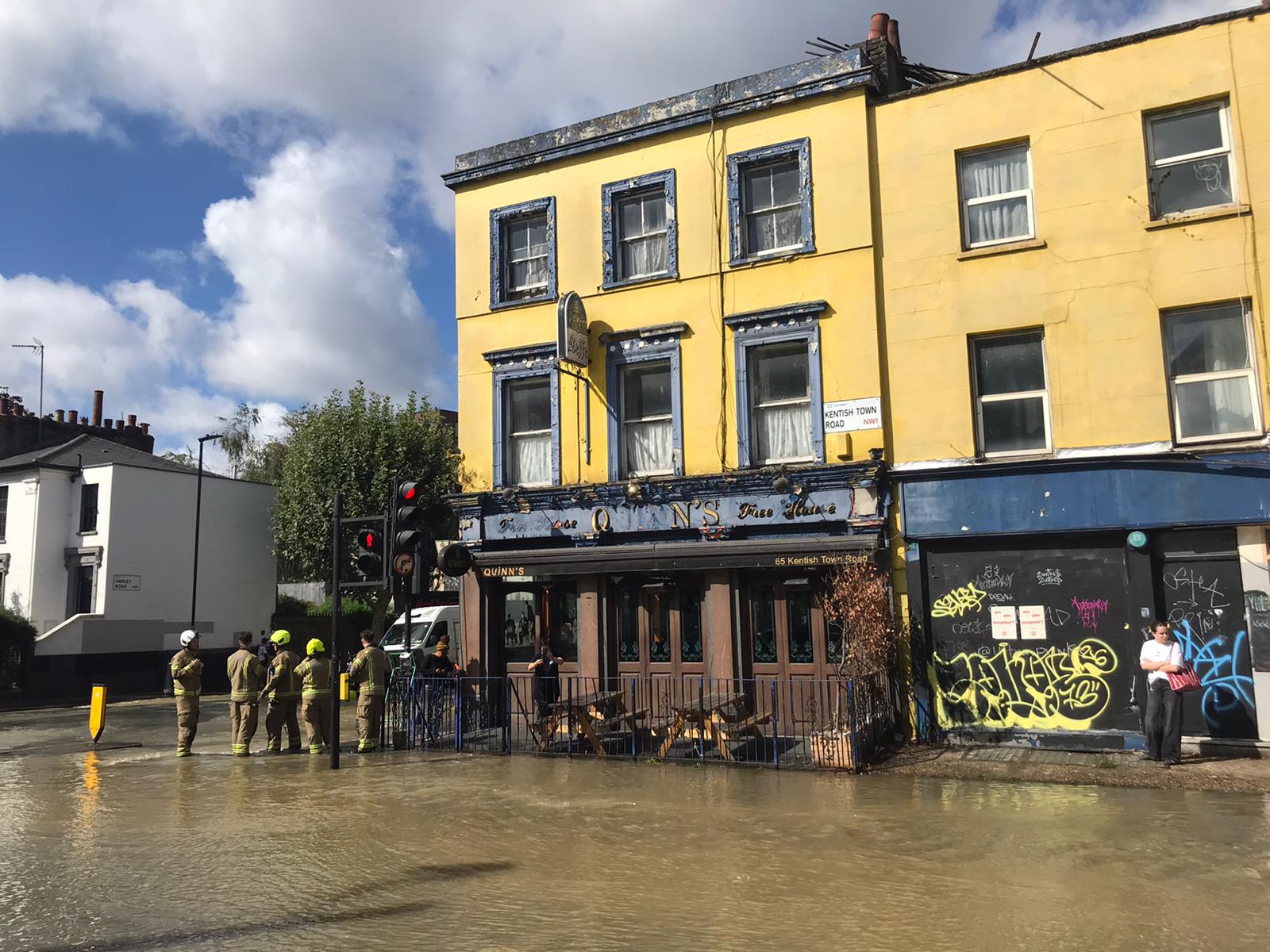
Kentish Town Road flooded in August
THAMES Water apologised repeatedly to Camden councillors over burst mains and roadworks chaos on Monday, but told the Town Hall it should look to its own resources if it wanted more help on flooding.
Alex Nixon, its head of environmental compliance appearing for the company at an all-member council debate on managing water in a changing climate, faced a string of complaints about floods, outages and streets dug up again and again.
Asked by Holborn and St Pancras MP Sagal Abdi-Wali – she also still sitting as a councillor – what he would say to residents who had had to “bear the brunt of a failing system”, he said: “I think, as we said at the time, we’re deeply sorry for that. We appreciate the complete disruption that has on people’s lives.”
He said the company was accelerating its mains replacement programme and working with other utilities “so we can close the road once”, adding: “We’ve delivered, I think, 27 schemes to date like that.”
On missed deadlines for mains replacement work, raised by Liberal Democrat councillor Nancy Jirira, Mr Nixon said: “I can only apologise. It’s not as simple as just digging a hole and putting in a new pipe. The things we discover when we dig up holes, you know, there is – there’s not a great accuracy on any utility company’s database of where cables are, ancestral cables, weird things that we find, unexploded ordnance, all sorts of things make planning that difficult. Where we get it wrong, I apologise. And if there’s more we can do to do that better, please let me know.”
Labour councillor Izzy Lenga said: “Residents have been let down by Thames Water time and time again. They deserve timely repairs, clear communication and meaningful investment in long-term solutions. Instead, too often they have been feeling let down by a system that needs to put people at the heart of it, but doesn’t.”
Meanwhile, Councillor Abdi-Wali, who said she wanted Thames Water to be taken into public ownership during her recent parliamentary by-election campaign, said there were “serious questions about the pace and efficiency of the infrastructure replacement where works are delayed, streets are repeatedly dug up”, while “the shareholders are always benefiting from the substantial profits”.
Labour councillor Matt Cooper said the recent flood in Kentish Town Road “wasn’t an act of God, it was an act of Thatcher”, adding: “For decades the infrastructure has not been invested in, it’s not been managed in the interest of Camden residents, and it’s not been managed in the interest of seemingly anybody local.”
He added there was “a real need to address ownership of water, but it goes really beyond just kind of boxing up Thames Water and having it be run by a government department. We need real democratic control.”
But when the debate turned to flood prevention funding and the need for more SuDS – sustainable drainage systems – Mr Nixon had his own critique of the council ready.
“We have a limited fund for SuDS and I’m trying to eke that money out as best as I can. There are other forms of funding out there and some of them are a little bit bureaucratic to go through. But unfortunately, to secure that funding, you do need resources within the Camden Council,” he said.
“You have one part-time flood risk officer. That is not enough resources when you compare to some of your neighbours who are far more successful in leveraging funding. If I’ve got someone to work with, I can do more, but my hands are partially tied by your own resources.”
Reminding councillors that Camden had the statutory duty for surface water flooding, while Thames was responsible for sewer flooding, he said: “We also have a requirement to support you. But I need to have a lead to work with.” He added: “That is the cold, hard truth.”
SuDS can slow rainwater down and soak it up where it falls, through features such as rain gardens, planted roofs, permeable paving and storage ponds, so less of it rushes into overloaded sewers.
Joan Munro, of the South Hampstead Flood Action Group, told councillors: “We’re not currently one of Thames’ priority areas for action.”
She said: “What happens at the moment is they offer so many thousand pounds but Camden has to find the match funding which is very difficult because Camden’s resources are so tight. It’d be really helpful if Thames paid fully for their SuDS schemes.”
Liberal Democrat councillor Linda Chung said she sometimes cleared gullies herself.
“We have issues of flooding due to poor management and we have a lack of people in flood prevention in Camden. We must change that.” she said, thanking volunteer groups for coming together on the issue.
Green councillor Andre Lopez-Turner said that about 22.4 per cent of the water entering Thames Water’s network was lost to leakage, while household bills had “risen by 31 per cent” and the company carried “£18.5 billion in debt”.
He suggested this was “a serious failure in the management of an essential public service” and asked the Labour leadership of the council: “Given the cost of living and the environmental crisis, will Camden Council consider formally calling on the government to bring Thames Water back into public ownership, putting residents, infrastructure and environmental protection ahead of private financial interests?”
The new council leader, Labour’s James Slater, said: “We have mainstreamed our flooding team across the council,” suggesting there was more than one part-time officer working on the issue.
“I know the Prime Minister has spoken about potential nationalisation and of course that is a matter for government, but on behalf of Camden, I want all options to be on the table,” he said.
“And that absolutely does include public ownership, a position that as a co-op party councillor as well, I would wholeheartedly support.”
