A migrant’s tale
A new film called Theocracy pieces together the life of Bernard Canavan – from abandoned baby to pre-eminent artist of the Irish diaspora
Thursday, 14th May — By Dan Carrier
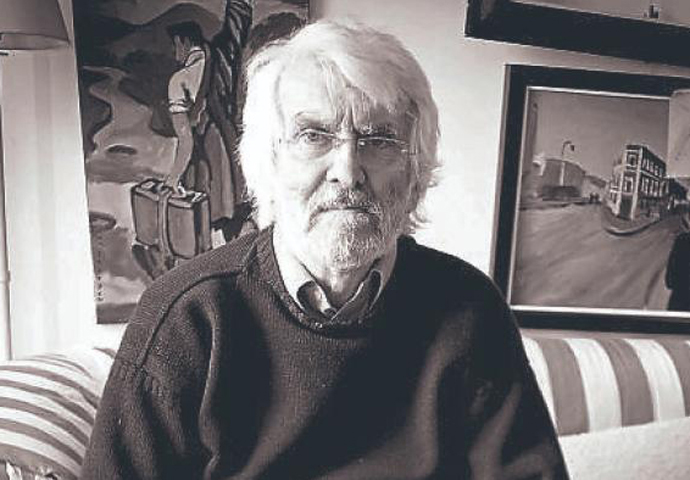
Bernard Canavan
Bernard Canavan’s works are the visual interpretation of generations of émigrés: the Willesden-based artist’s work is recognised as pre-eminent in capturing the Irish diaspora in London.
A new film about his life is being screened next week at the Kiln Theatre in Kilburn, in which he looks back at a life that saw him left as a baby in a harsh religious institution to becoming a man whose work is recognised as seminal in chronicling the lives of Irish people who moved to Britain.
Born in 1944 and taken from his unmarried biological parents, abused and neglected by nuns, he was removed from this hellish childhood by a couple who did not have children of their own. They taught him the power of the written word, and placed crayons in his hand that set him down the road to being an artist.
As the film describes, Bernard’s life holds a mirror up to the London Irish experience. “I am the story of the boy who eventually found his mother,” he reflects. Aged 60, after much detective work, he discovered she had been a model called Helen Power and had moved to America. Eventually able to piece together the story of my life.”
The fact so many people in Ireland were seriously damaged by the Catholic church is a wound that has not been healed, he adds.
“They have never been held to account. They have tried to brush it off,” he says. “They took a lot of babies into their institutes and sold them to Americans. There was terrible racism and people in the US wanted babies without any ‘black blood’, so they bought Irish children. The nuns and priests used to send the bodies of babies who had died to the teaching hospitals. Instead of dissecting frogs, they’d dissect babies. Others flushed the bodies of neglected children into the sewers. They talked about love – but there was very little love in the Catholic church. How could I believe in a God after this experience?
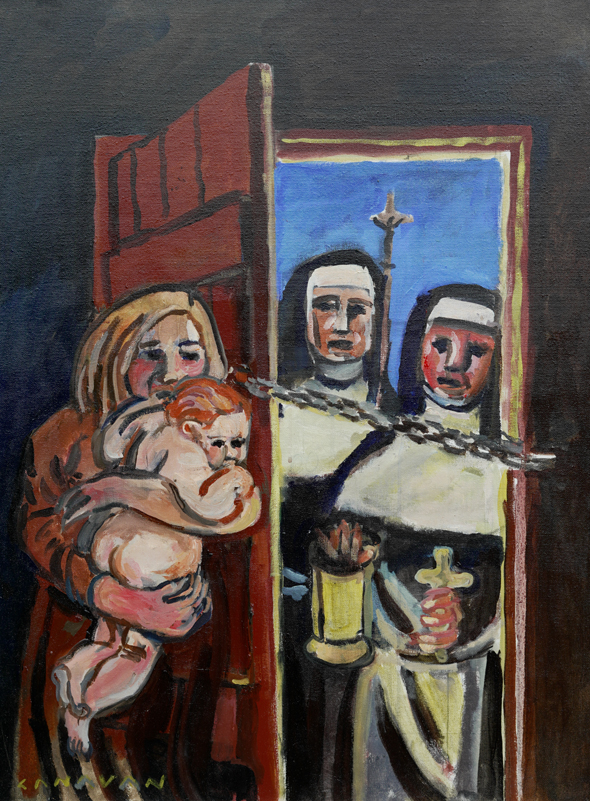
“I ended up in a home with a room full of cots. I didn’t know what a family was, what a mother was. I was in a room with 20 or 30 children and we were not taught a thing – no books, no toys. I was three-and-half years old and was told I had to go and see the Reverend Mother as there was somebody coming to see me. There was a couple there in their 40s who could not have a child, so they decided they would take me.”
His mother was called Margaret Canavan but because there was no law covering adoption in Ireland, she had to buy her new son from the religious order. She ran a village shop.
“I was an only child and that was rare,” he says. It did mean she poured love and learning into him. “My mother taught me to read very early on,” he says. “She was a good teacher and within six months I was reading the Irish Independent. She would tell me to look up words I didn’t know in the dictionary. She bought me crayons and paper and I learned to draw looking at comics and picture books.”
Ireland in the 1950s saw 50,000 people a year emigrate, out of a population of 2.75 million.
“People would come into the shop for a chat and they’d talk to me about England, while I’d tell them stories of the Roman empire,” he says.
His first taste of the émigré life came as a teenager, when he moved to Gloucestershire with his father, working all hours in a saw mill.
The Cuban Missile Crisis saw him return to Ireland and he worked in a psychiatric hospital and then to a job at an advertising firm.
“I used to paint these huge billboards to put in fields advertising Guinness, reminding people to stop at the next pub and have one,” he recalls.
After two years he came to London, where he shared a flat for a time with the historian and anti-imperialist CLR James. He worked for counter-culture and political publications including Peace News, Oz, the International Times and New Society.
“There were always adverts for handymen or labourers in England,” he says. “The girls who went did better because they would train for free as nurses. The men would work on the motorways and then spend their evenings drinking in pubs because they were lonely. Life did not treat them very well.”
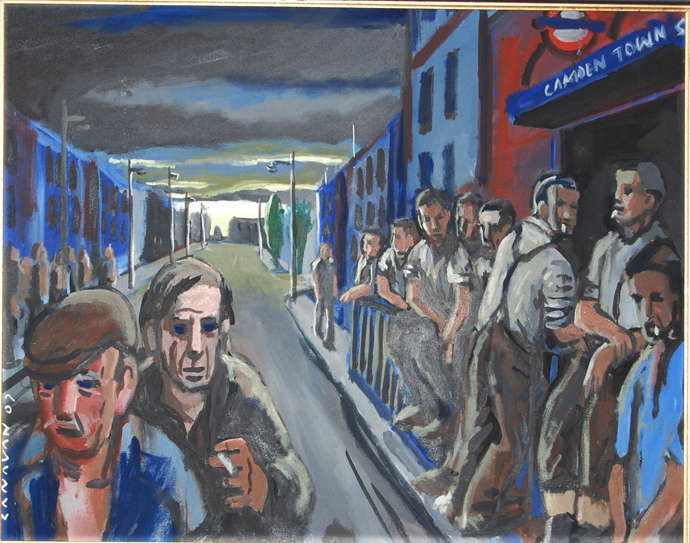
Early morning, Camden Town by Bernard Canavan
Camden was home and in the late 1960s he and friends set up a poetry and song night at the Dublin Castle. Everything was going well, with 40 poets and singers showing up – until a priest got wind of the event and was concerned it might be a little bit “political”.
“This priest, Father Flanagan, put terrible pressure on the landlord not to host us, saying we were Communists,” says Bernard.
“So I walked along Gloucester Avenue and found an English pub. I remember the pause while the landlord did a mental calculation – 40 poets, drinking five pints each on a Tuesday night. The answer was yes.”
Bernard moved from self-education to studying art at the Working Men’s College in Crowndale Road. From there he won a scholarship to study at Ruskin College, Oxford, and then did PPE at Worcester College, Oxford.
He became friends with the radical historian Raphael Samuel and the History Workshop movement, and has produced cover art work for the group’s journal.
A job painting film posters for the Underground followed, then he had a spell working on a history project in the Isle of Dogs and then for Brent Council.
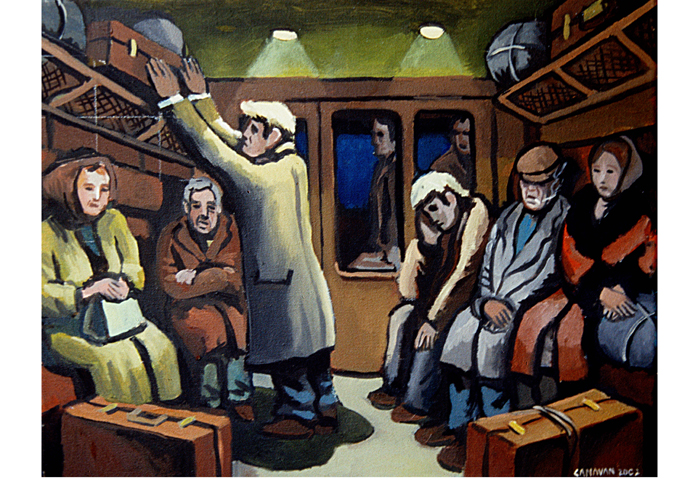
He then turned his eye towards his peers. “I began by painting Irish immigrants – a man by a bed with a suitcase on top of a wardrobe, a single ring to cook on and a window looking out at a wall,” he says. “I wanted to paint the struggle and I painted men because that was what I knew about.”
His art brings a realism that recreates the Irish experience on canvas. “I painted pictures of lodging houses and the loneliness – I had been there myself. They would have these rules – lights out by 8pm, only use the bathroom between these hours, they were run by a series of diktats. I created counter-religious imagery, they were about the real world.
“My paintings were about men and women who left Ireland anonymously and lived tough lives.”
• Theocracy: The Emigrant’s Artist. A Film by Sé Merry Doyle. UK Premiere is on Saturday May 23, 8pm, at the Kiln Cinema, kilntheatre.com/whats-on/theocracy-the-emigrants-artist/
