Deep Lee's Ghost bike memorial to return to blackspot after TFL changes
Thursday, 15th December 2011
Published: 15 December 2011
By TOM FOOT
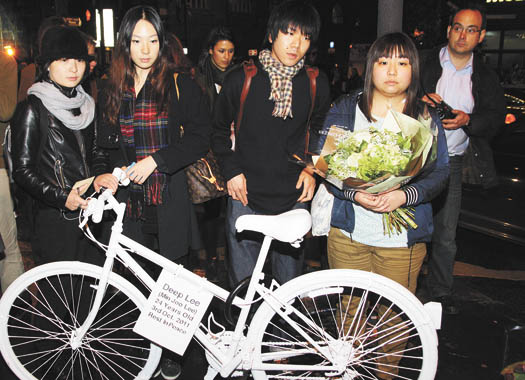
THE white “ghost bike” commemorating Deep Lee in King’s Cross will return to the junction where she died after works to change the junction are completed.
Transport for London (TfL) has been in talks with the boyfriend of Deep Lee, Kenji Hirasawa, about the painful process of removing the powerful memorial, less than three months after the 24-year-old fashion student died.
Mr Hirasawa said: “TfL sent me the email asking to remove the bicycle in January.
They said they would start reconstruction of the junction ‘probably’ in January.”
James Thomas, who organised the memorial with Mr Hirasawa following the tragedy on October 3, said: “There is an agreement with Camden and TfL for the bike to stay. Everybody agreed that at the time.
It is not in anyone’s way. It will return after the works are finished.”
Mr Thomas, an architect who works just by the cycling blackspot, York Way, recalled the day she died that “King’s Cross fell silent” and how it moved him to set up the bike in memory to her.
King’s Cross businesses chipped in and a local graphic designer created a fix-on plaque.
He said: “I cycle through that junction every day. I work 50 metres away from it. I hate that junction. But there is really no other way to get to work.
It just upset me that it was someone so young.
It was such a wasted life.”
Ghost bikes, if stationed on main roads, are the responsibility of TfL.
A ghost bike commemorating 27-year-old Paula Jurek, who was killed by a lorry on her bike in Camden Road, was recently removed after its back wheel and saddle had been stolen.
Many cyclists believe ghosts bikes promote the wrong message: that cycling is dangerous.
But Mr Thomas said: “Ghost bikes serve two causes.
One is for the family and friends as a memorial.
A lot of people say that cyclists are always jumping red lights and are dangerous – well, some are.
The ghost bike is also there because there are many cyclists who do nothing wrong.”
He said Mr Hirasawa had been given the key to the ghost bike lock and was making some arrangements to remove it – but the plan was to wait until the works started.
TfL has promised to review its proposals for the junction following the death.
But it is also under pressure to have the junction changed before the Olympics begin in June.
There is expected to be a 30 per cent increase in pedestrian numbers at the King’s Cross junction, a recent report said.
Campaigners want a cycle lane introduced as part of the review but there are concerns that the important changes will not be considered because in the rush to be ready for the Games.
London Assembly member Caroline Pidgeon quizzed Boris Johnson about why safety recommendations made in 2008 for the King’s Cross junction had been “discarded” by his office.
In a written response, Mr Johnson said that report’s conclusions were “longer term aspirations” that required greater investigation.
When asked whether the King’s Cross gyratory should be removed, Mr Johnson said: “In general I support the removal of gyratories, wherever feasible, and where funding can be made available. TfL does not currently believe that it is feasible to remove it.”
