Visionary works of mystery
John Evans views artworks from a 17th-century Spanish master
Thursday, 18th June — By John Evans

Francisco de Zurbarán, Agnus Dei, 1635-1640, oil on canvas, 37.3 x 62cm Museo Nacional del Prado, Madrid [© Photographic Archive Museo Nacional del Prado]
THE small Agnus Dei is remarkable in itself as a strong religious message conveyed with a realism and emotional power that can only come from a painter in absolute control of extraordinary skill.
But look just to your left in the final room of the National Gallery’s exhibition and there is a crucifixion scene with an odd, even more striking, twist of an unprecedented artistic and painterly statement.
For there is The Crucified Christ with a Painter, c1650. At Christ’s feet with palette and brushes in hand we see Luke, the patron saint of painters, but no doubt his face more closely resembles the work’s creator.
It’s thought to be the nearest to a self-portrait we have of one of the leading painters of 17th-century Golden Age Spain, Francisco de Zurbarán, (1598–1664) in what is the first major monographic exhibition* devoted to his works to be seen in this country.

Francisco de Zurbarán, Saint Francis in Meditation,1635-9, oil on canvas, 152 x 99cm [© The National Gallery, London]
Organised in collaboration with the Musée du Louvre, Paris, to where it will travel and can be seen from October, and the Art Institute of Chicago (to open next February), it features spectacular loans from major galleries, from Bilbao and Barcelona to Bishop Auckland, Bulgaria, and more. With a number from private collections, there are nearly 50 in all.
Born in Fuente de Cantos, Extramadura, Zurbarán was in Seville from about 1614, where he learnt gilding and carving as well as painting, and the city remained his base for most of his life.
Different sections of the exhibition variously explore the painter’s ability to inspire awe with a visionary and mysterious take on subjects; his works for many religious orders in prosperous Seville; his representation of saints as figures of his time, with meticulous depiction of the textures of fabrics, drapery, and embroidery; his iconography, particularly that of the Immaculate Conception; examples of some rare and delicate still lifes; and the paintings he made for private devotion and contemplation, Agnus Dei among them.
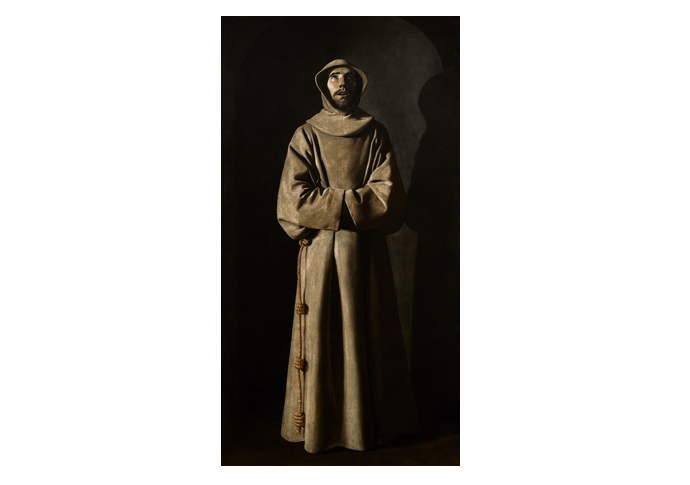
Saint Francis of Assisi, 1636, oil on canvas, 200×110.5cm, Musée des Beaux-Arts, Lyon [© Lyon MBA martial couderette]
In addition one section references Zurbarán’s most important secular commission in 1634 for Philip IV. This was at the new royal palace, the Buen Retiro in Madrid, where in the “Hall of Realms” he contributed 12 paintings, including a series on the labours of Hercules and major battle scenes of Spanish victories. Two paintings, Hercules and Cerberus and Hercules and the Cretan Bull, both from the Prado, are included here.
The court painter was Diego Valázquez (1599-1660) Zurbarán’s friend who the National’s experts suggest was “perhaps” influential in securing the commission.
What stands out with Zurbarán is a serenity and realism, and a deceptive simplicity of composition and use of colour.
Highlights of the show include the chance to see both the National’s own powerful Saint Francis in Meditation from 1635-9, and the even larger 1636 Saint Francis of Assisi from the Musée des Beaux-Arts, Lyon. Notably the latter has the saint in the darkness of his tomb looking upwards in devotion.
Zurbarán can paint with a fervour and religious intensity that releases a sculptural quality. Combined with the tenebrism that intensity often seems to be passed on to his subject.

Saint Apollonia, c1636-40, oil on canvas, 115x67cm, Musée du Louvre, Paris [© GrandPalaisRmn (musée du Louvre) / Stéphane Maréchalle]
And for Zurbarán St Francis was a firm favourite, with at least 14 versions painted, though there were 15 or so Immaculate Conceptions and a dozen crucifixions or more.
But in this exhibition there are other saintly stand-outs, among them Saint Apollonia from the Musée du Louvre. This 3rd-century martyr is shown gripping a tooth with large pincers, a reference to the way her torturers reportedly treated her. Yet here she is calm.
There’s another serene martyr, Saint Casilda, courtesy of the Museo Nacional Thyssen-Bornemisza in Madrid.
And an early 1628 painting, a loan from the Wadsworth Atheneum Museum in Connecticut, shows Saint Serapion in a work commissioned for a monastery in Seville. He’s bound in such a way to show his martyrdom as starkly through the light and shade of his white robes against the darkness as by the tight ropes that constrain him.
Many viewers of a crucifixion scene painted a year before, for a Dominican order, had been convinced it was a sculpture within the monastery darkness.
• Zurbarán is at the National Gallery, Trafalgar Square, WC2N 5DN until August 23. For tickets and details see: www.national gallery.org.uk
