True modern icon
John Evans on the works of Frida Kahlo and more
Friday, 4th September — By John Evans
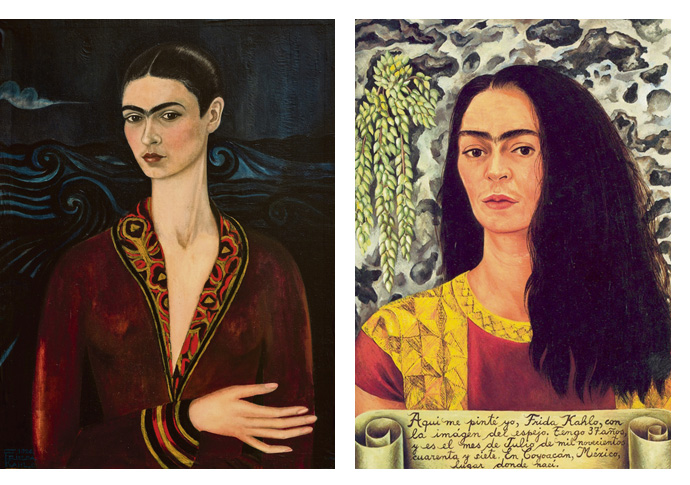
Left: Frida Kahlo, Self-Portrait (With Velvet Dress), 1926, private collection. Right: Frida Kahlo, Self-Portrait with Loose Hair, 1946, private collection
THE inevitability of gallery shops being filled with cheap – and not so cheap – ephemeral merchandise to accompany a major exhibition grows show by show.
So what next?
Well, with Tate Modern’s blockbuster on Frida Kahlo (1907-1954)* there’s both an examination of the artist and the marketplace surrounding her work and legacy.
The clue is in the title and, for once, the use of the “icon” seems less out of place than usual, as can be seen by what is included.
The Tate say it’s an extraordinary story how Mexico City-born Magdalena Carmen Frida Kahlo y Calderón “…became one of the most influential artists of all time, a cultural phenomenon, and an internationally recognised commercial icon”.
This show features more than 30 of her works, alongside personal photographs and archives, but also more than 200 by her contemporaries and “…the artists she inspired from later generations, celebrating her lasting impact on those who continue to reimagine and reclaim her remarkable story”.
Although Kahlo’s name first came to notice in US artistic circles in the early 1930s, widespread recognition did not follow for some years.
The exhibition covers Kahlo’s early years, including contraction of polio at the age of six, and a serious bus accident in 1925, which left her with permanent disabilities and lifelong health problems, and put an end to her pursuit of a career in medicine.
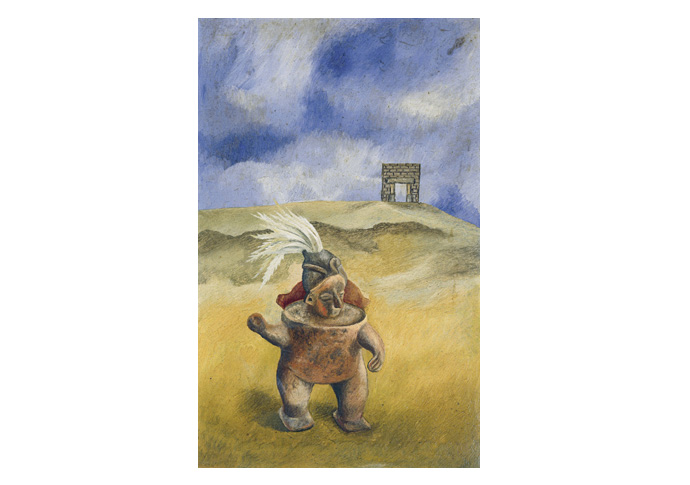
Inspired by a ceramic warrior sculpture from an ancient burial site in Colima, Mexico: Frida Kahlo, Survivor, 1938, Colección Pérez Simón
A small but powerful piece by Kahlo here is an undated photograph of a model, Representation of the Accident, with a cart and a leaping horse and stricken figure on the ground.
Indeed, central to her own works are self-portraits which explore a variety of guises.
Shortly after her accident there is one “with velvet dress” a gift for her then boyfriend, showing a woman who aims to be free of social constraints. There’s another with “loose” hair and with her wearing a traditional huipil blouse. There’s a 1932 lithograph Frida and the Miscarriage; and there’s a late self-portrait depicting her in a wheelchair, palette in hand, painting her doctor.
It’s all about picking identities, reinvention and offering messages to her audience while challenging norms. As she does this there’s often more than a hint of surrealism involved, though this was a label she did not adopt.
In addition to the exploration of Kahlo’s “many selves”, whether concerning sexuality, politics, feminism, or spirituality, the Tate show looks beyond that to the development of her legacy of inspiration and as a global brand.
According to the protagonists this can vary from individuals, artists, and groups pursuing their legitimate aims – with Kahlo in mind – to those who care only for the money.
A room here looks at “Fridamania” and the use of the artist’s image and persona, whether on T-shirts, branded tequila or perfumes.
Then, in 2018, we ere given the Frida Barbie doll!
• Frida: The Making of an Icon, organised in collaboration with the Museum of Fine Arts, Houston, is at Tate Modern, Bankside, SE1 9TG until January 3. Tickets: tate.org.uk and 020 7887 8888.
Light work of the mountains

Ferdinand Georg Waldmüller, The Dachstein from the Sophien-Doppelblick near Ischl, 1835, oil on wood, 31 x 26cm [© Belvedere, Vienna]
THE latest in the National Gallery’s “Room 1” niche free exhibitions programme* is a collaboration with the Belvedere in Vienna and includes a portrait of the artist “as a young man”, where he sets himself against the woods of the west of the city but also includes a peony in the foreground to show off the range of his talents.
But the focus here is the first ever exhibition dedicated to the landscapes of Ferdinand Georg Waldmüller (1793-1865), from Austria and further afield. From the ruins of an ancient temple in Sicily to children gathering violets in Vienna Woods, these paintings spring from a desire to paint accurately, directly from nature, and to capture the subtleties of light.

Ferdinand Georg Waldmüller, View of the Dachstein with Lake Hallstättersee seen from the Hötteneckalpe near Ischl, 1838, oil on wood, 45.5 x 57.5cm [© Wien Museum Karlplatz, Vienna]
From 1833 he spent many summers in and around the mountains and lakes east of Salzburg and his ability to capture the essence of these is powerfully demonstrated.
His view of the Dachstein glacier (above), is a fine example. The “Sophie’s double view” in the title refers to a favourite villa retreat of the archduchess Sophie (1805-72).
*Waldmüller: Landscapes, The HJ Hyams Room (Room 1), National Gallery, Trafalgar Square, until September 20.
