Towner prized: out-of-towner artist who found fresh inspiration in Hampstead
Dan Carrier previews a new exhibition of Donald Towner’s work at Burgh House
Friday, 27th February — By Dan Carrier
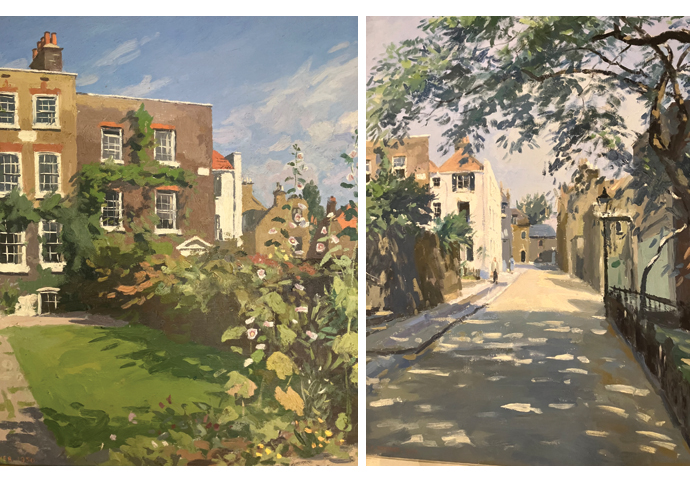
Left: The Mount, detail, 1950. Right: The Mount, Heath Street, 1956 [Collection Burgh House]
DONALD Towner’s art captured a rapidly changing English countryside and London on the cusp of Modernism.
His skill saw his work come to depict a certain sensibility. It was an art that speaks to a sense of heritage, and his Hampstead works – he lived there for six decades – are a reminder of an NW3 much changed.
A new exhibition – Amongst the Trees and Terraces: Donald Towner (1903–1985) – at Burgh House celebrates the painter’s output and spans work created from the interwar and postwar period. Donald wrote an autobiography in the 1970s, using “winter evenings or when the daylight was too poor in my studio for me to paint”.
Born in Eastbourne in 1903, he recalled a “wide stretch of countryside with sea beyond curving in a great bay towards Hastings,” and a childhood home with a garden “intersected by innumerable streams where purple-loosestrife grew, half in and half out of the water. Beyond the marshes was the beautiful blue, blue bay with its gold fringe of beach fading away into the distance.”
The third of four siblings, Donald grew up in a family of keen naturalists. A childhood saw him walk over the South Downs, noting “innumerable flowers and grasses”.
Edwardian England was both gentle and dangerous: he caught whooping cough, recalling how “I was saved by being held upside down by my ankles till I regained my breath.” His father would later contract the illness and die.
He recalled, aged five, he began capturing the world.
“Armed with a pad of paper and chalks I set forth,” he recalled.
“Poppies growing in the corn attracted me and I soon set to work. The sun beat down and my chalks, which were of wax, began to melt. Undaunted, I executed my first painting with a finger and molten wax of various colours.”
Similarly to his art work, his autobiography is full of lyricism of a pre-war England.
“I had early formed a habit of wandering alone,” he writes. “This was no doubt brought about not only by my temperament, but by my habits of painting and searching for butterflies.”
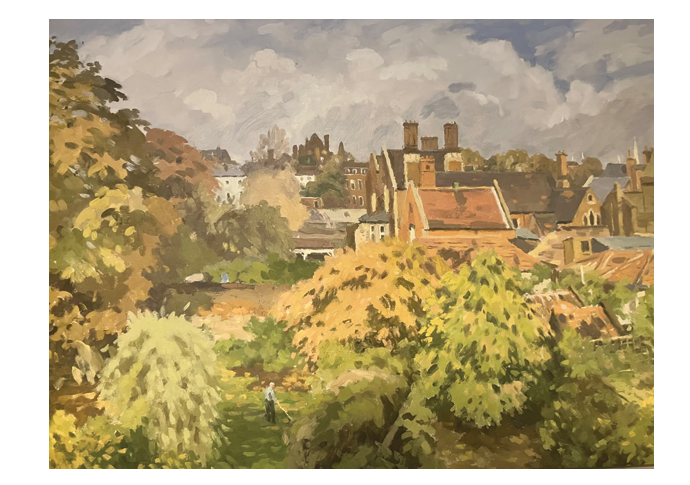
From My Studio Window, 1976 [Collection Burgh House]
One such walk saw him cross a brook and gaze across a field towards woods. He was struck at the sound of nature.
“Such experiences became more frequent. I was unable to frame them in words, but I am convinced that this, together with a natural talent, made me a landscape painter,” he reflected.
Donald enrolled at the Eastbourne School of Art, where he met Eric Ravilious. They would later share digs at the Royal College of Art.
“We tramped the Downs and spent long holidays together, always with our watercolors. Here began my training of hand and eye,” remembered Donald.
In 1923, he and Ravilious began as first year RCA students and he moved from rural to urban settings and from watercolour to oils.
“We had to take a course in architecture – this I have never regretted,” he mused.
After graduating, Donald took on a Mornington Crescent studio.
“It had been used as a carpenter’s workshop,” he added. “The chief piece of furniture was a full-size studio easel. I was dependent on selling my work, which was very difficult to do. I managed a few commissions. One was that of a young woman who served me breakfasts in a scruffy little restaurant around the corner.”
A letter from his mother, living alone in Eastbourne after younger brother Leslie had gone to Cambridge, prompted a move to NW3.
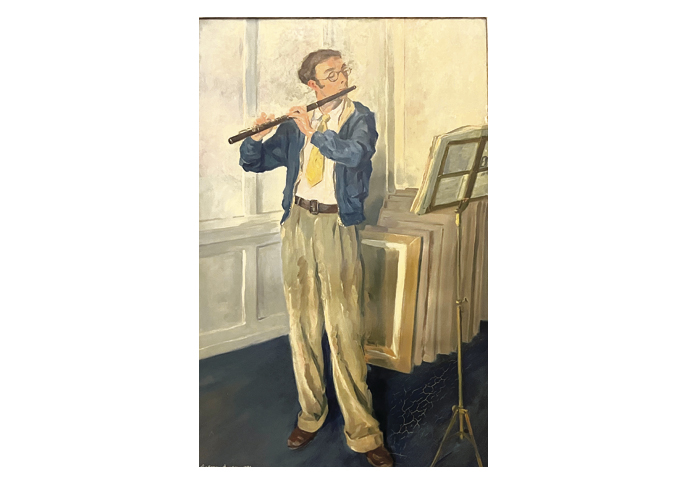
Donald Towner playing the flute by Anthony Ayrton, 1938 [Collection Caroline Johnson]
“She had heard of a little village outside London called Hampstead, which sounded nice and if I should ever be that way, would I see if there was a little house that would suit us both?,” he writes.
He was shown No 4 Holly Hill and bought it for £1,750, and found a Heath Street studio, with cartoonist David Low working on the floor below.
“I found him friendly, very witty and a delightful neighbour,” he said.
Donald started painting the city in earnest.
“I enjoyed this enormously, but the difficulty was to find a secluded spot away from people and traffic, where there was a good subject,” he writes.
“I used to get permission to paint from roof tops and other inaccessible places such as windows of empty buildings.”
Covent Garden Market was painted from a window of the National Sporting Club. Similar views were found to capture St Bride’s in Fleet Street and The Seven Seas, a three-mast barge on the Thames.
As his mother got older, she found the steps at Holly Hill hard going and wanted to find somewhere flat – but where in Hampstead could this be found?
They moved to Church Row, where Donald would remain until his death in 1985. In the back garden was a magnolia tree: Donald had a thing for growing old English strains of roses and at one point he thought of taking out the magnolia.
During a visit to Sissinghurst, he suggested this course to Vita Sackville West – she retorted: “One must never destroy a magnolia.” The plan was shelved. Two pear trees thrived and market men from Camden Town would come each autumn to take barrowloads away. The well-tended garden would become the subject of many paintings.
More commissions came in and sometimes from unlikely places.
“For many years I had bought my bread from Louis’s Patisserie on Heath Street,” he said.
“One morning the proprietor suddenly turned to me and said – “Will you paint me a picture?’
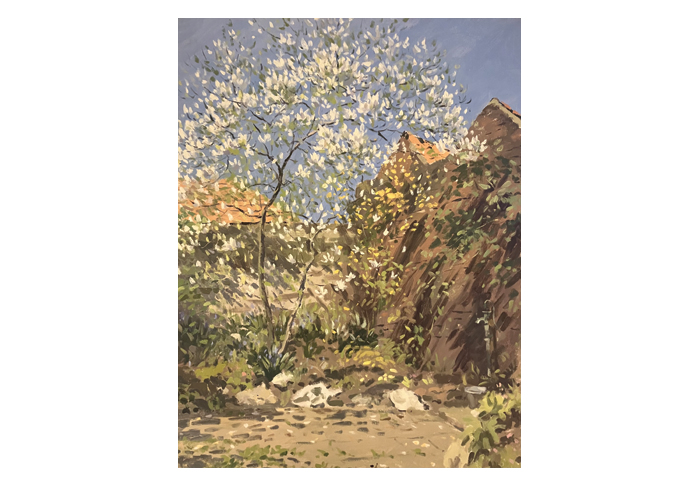
Magnolia [Collection Burgh House]
“I was naturally surprised and enquired what kind of picture he wanted, to which he replied that he wanted a large painting of Hampstead to completely fill the wall of his shop.
“He would like a Hampstead scene with buildings, water, trees, grass and people. It was early February and very bad weather so the painting would have to be a studio picture from studies already done.
“After a good deal of thought and rummaging I pulled out two paintings I had done quite a number of years before.
“One was of the Vale of Health pond with the old Valley of Health hotel and a disused chapel.
“Both had been pulled down some years previously. The second was part of the Heath almost adjoining the scene of the first.”
He used them as a base, added anglers and this composite was happily accepted.
In his autobiography’s epilogue, he looks back on a 20th-century life, calling it “the most momentous three quarters of a century man has ever known”.
“Painting, for instance, underwent innumerable changes of style, with one ‘ism’ following another till today most of it bears little or no relationship to tradition or nature,” he reflects.
“Yet the sweep of the Downs, the green water meadows and the sea and the sky remain the same as ever, while the great pulse-beat of nature – spring, summer, autumn and winter are constant in the changes they bring to earth – the bud, the leaf, the fall of the leaf and the bare bough.
“Such things are eternal and the love of such things makes for untold joy and is perhaps one of the greatest blessings that we possess, and both the changefulness of material things and the changelessness of nature have been the background of the life I have depicted.”
• Amongst the Trees and Terraces: Donald Towner (1903-1985). Burgh House, New End Square, NW3 1LT, March 5-Dec 13. Open Wed, Thu, Fri & Sun, 10am-4pm. Free entry
