Town Hall backs anti-Semitism definition amid free speech warnings
Rabbi Shlomo Levin says drunk man took a swing at him - but missed
Thursday, 27th April 2017 — By Richard Osley
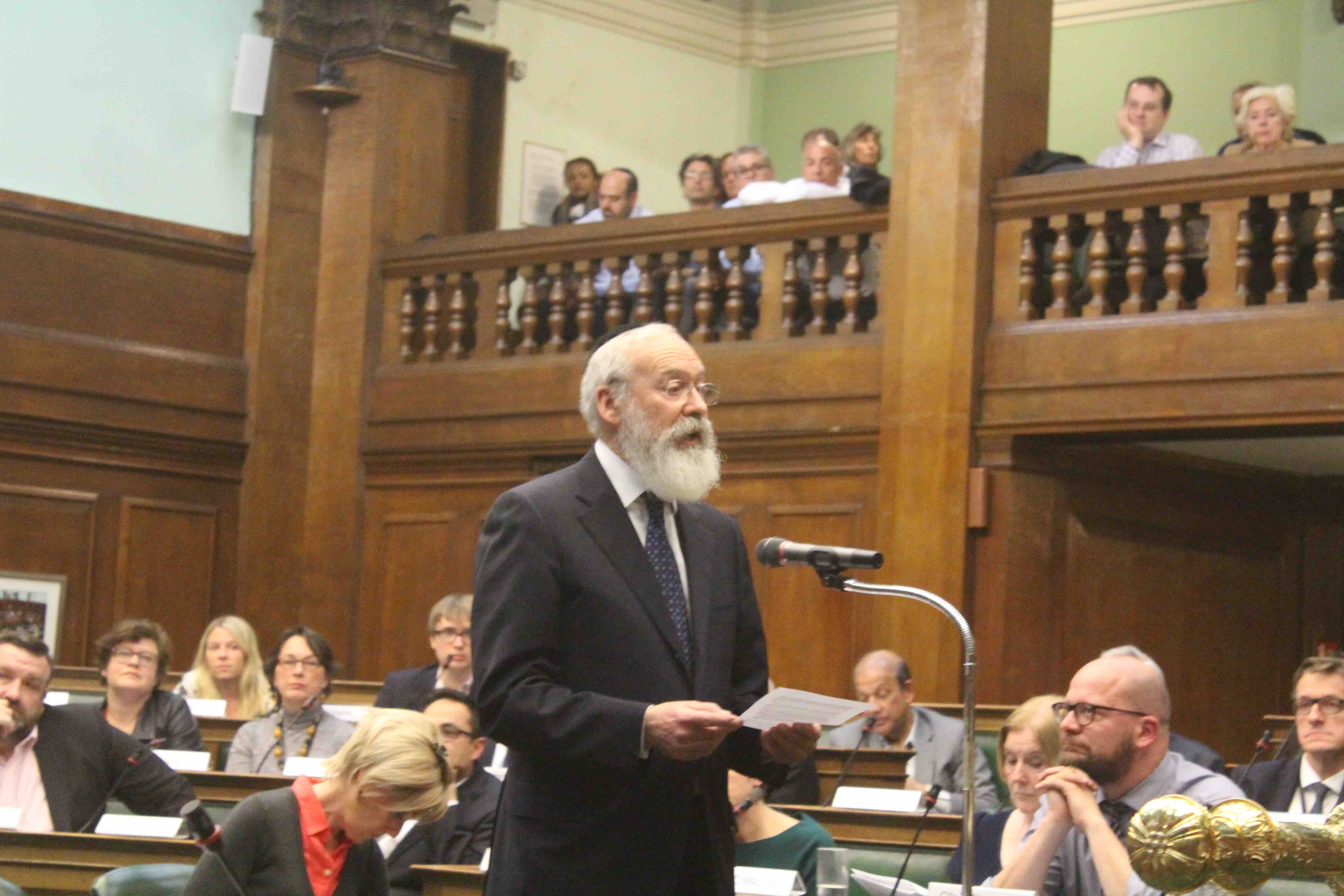
Rabbi Shlomo Levin speaking at Monday’s full council meeting
COUNCILLORS have unanimously voted to approve a definition of anti-Semitism amid reports that abuse against Jewish people is on the rise across north London.
Rabbi Shlomo Levin, from the South Hampstead Synagogue, was among supporters of the move at Monday’s full council meeting.
But groups critical of Israel said the definition would curtail free speech and lead to events being cancelled for fear of breaking the rules.
An event at Kentish Town Community Centre, organised by the Camden Abu Dis Friendship Association, was cancelled earlier this year after it emerged Baroness Jenny Tonge was due to speak. She was suspended by Liberal Democrats over comments about Israel and anti-Semitism.
The definition approved by councillors – written by the International Holocaust Remembrance Alliance – has already been adopted by the London Assembly and Theresa May on behalf of the UK government. Guidance issued with the definition has a list of examples of anti-Semitism, including “accusing Jewish people or the state of Israel of exaggerating the Holocaust, accusing Jewish citizens of being more loyal to Israel than to the interest of their own nations and denying Jewish people their right to self determination, for example by claiming the existence of a State of Israel is a racist endeavour”.
Rabbi Shlomo said statistics showed there had been a growing increase in anti-Semitic attacks and damage to property. “In south Hampstead, we have had children on the way to and from school abused on buses and in the streets,” he said. “I can tell you that just last Friday night walking home from a synagogue, a drunk man tried to take a swipe at me and I’m very pleased to say he missed.”
Asked whether he thought criticising Israel was anti-Semitic, he said: “Criticism of Israel is an entirely legitimate activity in the same way it is legitimate to challenge or criticise any other government in this world, including our own. The problem arises when it is no longer a question of criticism per se or its policies and when it’s about the legitimisation of Israel and its right to exist. No other country is ever criticised in the same way as Israel, suggesting it does not have a right to be there.”
Councillor Abdul Hai, who moved the motion approving the definition, added: “This isn’t about the rights and wrongs of Israel. It’s about anti-Semitism and the pain and suffering of Jewish people across the world and here in the UK.”
Conservative councillor Andrew Mennear said he was concerned free speech was at risk, but joined the vote in favour of approving the definition.
Councillors agreed to review how the definition was being applied after six months.
Dr Les Levidow, a member of CADFA and Free Speech Israel, had told the meeting: “The definition conflates anti-Semitism and criticism of the state of Israel. This facilitates false accusations of anti-Semitism, as a means to divert or deter debate on the Israel-Palestine conflict.” He added: “Weaponising ‘anti-Semitism’ accusations against the Palestine Solidarity Movement, thus chilling or intimidating debate, has been a prominent use of the definition.”
And Nandita Dawson, also of CADFA, added: “The issue is not Jenny Tonge. Events on Palestine have been being closed across the country and there seems to be a pattern. Often there is a smear and this is linked to this new definition of anti-Semitism… Anti-Semitism that is racism must be resisted. Hate speech should not be given public space. But we should not use a definition of anti-Semitism that gives people with a political axe to grind scope to attack freedom of speech.”
