The playwright and the blonde bombshell: ‘They were genuinely in love'
‘It’s like David Hare marrying Taylor Swift’ says the author of a new play about Arthur Miller and Marilyn Monroe. Dan Carrier reports
Friday, 20th March — By Dan Carrier
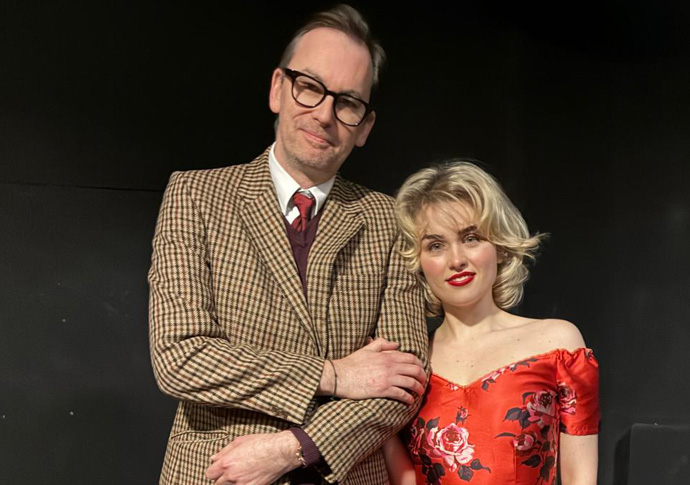
Marcus Churchill and Daisy Snelson as Arthur and Marilyn
MARILYN Monroe was at the height of her fame, an actor who personified Hollywood.
Arthur Miller had enjoyed a run of successes as a playwright.
In the public’s mind, they were two very different people – the blonde bombshell, with sex appeal exploited by film studios, and the cerebral writer whose works chronicled the real America.
The couple’s five-year marriage was an endless source of public fascination – and now a new play by writer Steve Barker, running this week at Kentish Town’s Lion and Unicorn, unpicks their story together.
Steve, who has previously written screenplays, was drawn to the story of how Miller and Monroe met, fell in love and parted just 18 months before Monroe died.
“They were wildly different,” he says. “One was this serious playwright, whose plays are full of deep social and moral concerns. The other was a comedic actor who had a public persona of being a dumb blonde, ditzy – though she was very intelligent. When Miller married her, people thought: what is going on? It would be like David Hare marrying Taylor Swift.
“That attracted me to the story. What was it about their relationship that made it tick? How did they get together and what happened? That was intriguing.”
Director Sarah Paterson has a background in theatre education – she was the head of drama at Haberdashers’ girls school and taught at Hampstead Fine Arts.
“She was Miller’s complete opposite, but that’s what attracted her,” she points out.
“He sees something in her beyond the facade. Her intelligence was really attractive. They were genuinely in love for the first couple of years, before she became more and more difficult.
“Alcohol became a problem she could not control and she would say and do horrible things – but he was always trying to protect her. He started to withdraw by the end of their relationship.”
The play is a two-hander starring Daisy Snelson and Marcus Churchill. Sarah has designed a minimal set, allowing the play to be character focused.
“We did not want it to be an impersonation and we try not to stereotype,” she reflects.
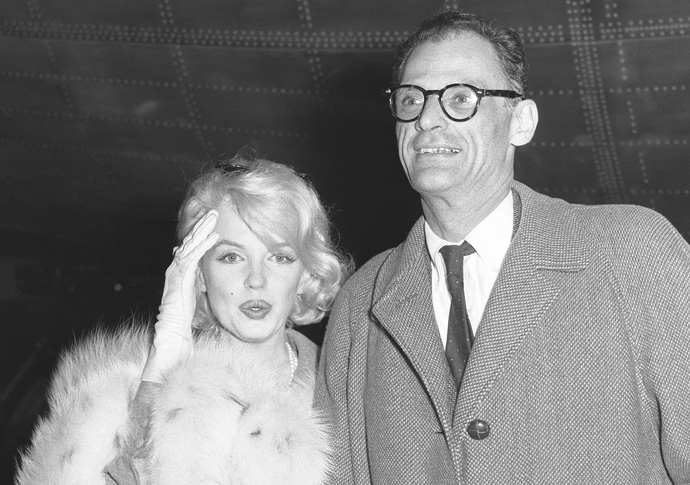
Arthur Miller and Marilyn Monroe in 1959 [Los Angeles Times_CC BY 4.0]
Monroe’s public and private characters were very different, giving the director plenty to work with.
“When you see her as Marilyn, it is when she is in front of the press and there is this public persona – otherwise, she is Norma Jean,” says Sarah.
“When you cast an actor to be Monroe in a play, the expectation is she must look like Marilyn as much as possible. We needed to get someone who was close. With Daisy, we were struck immediately how she could become Marilyn.”
By the time the couple married in 1956, Miller had a string of hits including Death of a Salesman and View From the Bridge behind him.
Marilyn had become the best female comedian in Hollywood.
“She was a terrific actor,” reflects Sarah.
“She stole the show from Lauren Bacall and Betty Grable in How To Marry a Millionaire. But she wanted to be taken more seriously, and was one of the reasons she was attracted to Miller.
“Arthur did not chase her. He just talked to her when they first met. They got on well. Other men made a move on her within five minutes. For the couple, it was a question of respect.”
The play follows how they fell in and out of love.
“It lasted five years and was the longest marriage she had,” says Steve.
“They obviously clicked and they genuinely loved each other – until it went wrong.
“Cracks began to show because she was drinking and taking pills. She became something of a diva and a nightmare to work with.
“I did a lot of research to create snapshots of their married life. I wanted to consider how they spoke to each other and use situations that are historic fact. I wanted to humanise them, ask what they would have said to each other – giving them their voice was really important.”
The couple met in Hollywood when Miller had flown in from New York to meet studio bosses for a potential film. They saw each other at the studio and went to the same parties. The couple clicked, though Miller was married so had to seek a divorce before the relationship could blossom.
Sadly, Monroe would die just 18 months after they split, aged just 36.
Monroe had a troubled childhood, living in an orphanage and having 15 foster homes. Miller offered security and a protective, non-judgemental life. But it was not a one-way relationship.
When Miller was accused by Senator Joe McCarthy of “Un-American activities” as part of his anti-Communist witchhunts, Monroe risked her career to stand by him.
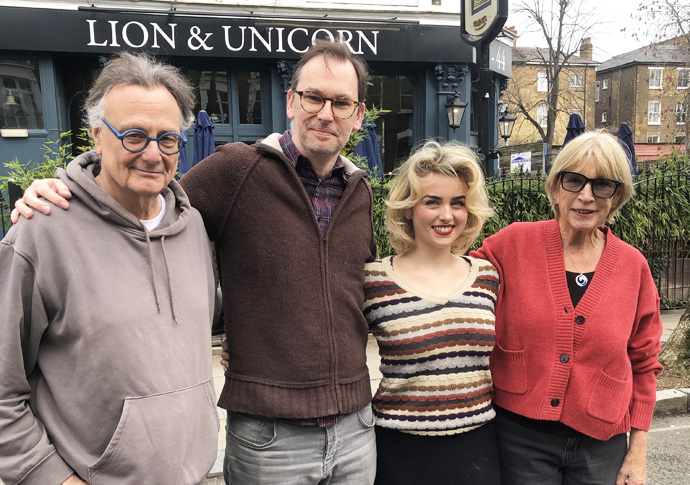
Writer Steve Barker and director Sarah Paterson with the actors
“He told her not to, not to get in trouble, not to risk her work, but she insisted,” says Sarah.
“And being Marilyn, she got away with it. Everything she said to the press about it went down really well. She was very supportive.”
Making a global face a person again was an important aspect of the show.
“I think honestly she comes over as a person and not an icon,” says Steve.
“We also wanted to make sure Miller had a voice because he could be a shadowy figure. We wanted to show his personality. The play is very even-handed in that regard. It is very much 50/50 – it is not the Marilyn show. He comes over as this very real person.”
For Steve, the love and tension between the pair is a fascinating plot driver.
“I wanted to bring out the relationship and make it as real and natural as possible. The narrative shows them at first being silly, being happy and having fun together. Then things start to go wrong, and by the end they are on opposite sides of the stage.”
Daisy and Marcus have the challenge of making the audience put away preconceptions.
Daisy trained at the Royal Academy of Music while Marcus began acting in his 30s.
“The important thing was to be inquisitive about her as an individual, and to try and find that essence of her,” says Daisy.
“I have always had a love for her and been curious about who she really was. I focused on the fact there are two characters – Marilyn, and then Norma Jean. There is an element of physicality about her and getting that right, but it is about how she thought and felt. She was known to be vulnerable, childlike.
“I wanted to consider what had come before this period in her life and how that influenced what happened in their marriage, and her response to situations come from this idea of abandonment. She had a childlike wish to be seen and heard.”
While Daisy has plenty of footage to draw on to help her inhabit Norma Jean, there is less out there of Miller, though his autobiography, Timebends, lays bare his interior character.
“He was not a big fan of the limelight,” adds Marcus.
“There is not as much footage you can find to get his physicality, so I read about his life. I wanted to consider how he would react, for example, when he was angry. I wanted to feel that. I did not want him to do a disservice.
“In the book he comes over as being pretty level-headed – the opposite to Marilyn,” he says.
“Arthur saw her for what she was, and she in turn was inspired by him, how seriously he took his writing. He pushed her to really understand her craft as an actor and hone her talents.”
• Arthur and Marilyn is at the Lion and Unicorn Theatre, Gaisford Street NW5, until March 21. See www.thelionandunicorntheatre.com
