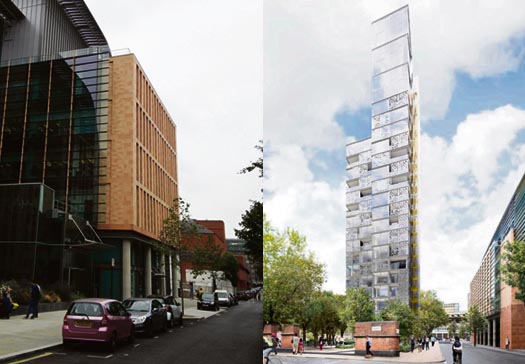
The new Francis Crick Institute looming over Somers Town, and a drawing of the tower set to join it
THE new Francis Crick Institute now dominating Somers Town brings a legacy of questions overlooked in the debate so far.
A first reaction to the institute (right), next to the British Library, is its size and shape. This, and its predominantly industrial use, on a site previously earmarked for offices shops and housing, breaches every planning rule on size (1,000,000 sq ft) and use (industrial in an area crying out for new housing). After a small and unsuccessful local campaign in 2011 objecting to the scheme, a single room was earmarked for local health issues.
Representing a tiny fraction of 1 per cent of the total £650million cost, this is less a gesture, more an insult to Camden’s most deprived ward with its worst health problems.
To ask the question should we welcome this huge kettle-like (some have suggested slug-like) building seems futile. It’s there and we’re stuck with it. There are three grounds for tilting at this particular windmill. The first is a question of honesty. This new addition to Somers Town’s skyline serves as an allegory for the abuse of commercial and academic power.
The deal to build it was stitched up behind closed doors. It was rationalised by its proximity to University College and the Wellcome Institute in a spurious argument about “synergy”, suggesting that its Somers Town site alone could provide the claimed benefits, when this was patently absurd. And for the narrow medical interests involved (UCL, Wellcome & Cancer Research UK), planning permission and local interests were irrelevant.
Estimated benefits of the proposal were assumed to be identical to those of the local population without any investigation. It was as if the planning system did not exist. Second, the institute necessarily inherits the various conflicts and contradictions of its conception. These include the Medical Research Council, driven into the arms of UCL and Wellcome by lack of direction and inadequate leadership, and the differing priorities of its constituent organisations (hospital, drug company, three universities and a fund-raiser).
There does not appear to have been any discussion of what happens when differing agendas come into conflict. Finally, will its location prove a handicap in the longer term? And to what extent does that location already inhibit some of its operations? If commercially successful, where does it expand to and at whose expense?
Within a wider planning context has it created a precedent whose effect will be to rubber-stamp other schemes. Would it have been possible, for example, to give planning permission for a 25-storey block of luxury flats next door (twice the height of the Crick) as Camden has just done? At present all the talk is of scientific discovery, evidence-based research and new treatments for cancer, heart disease, strokes and degenerative conditions such as motor neuron disease.
There are few crumbs of comfort in this for its neighbours, Camden’s poorest ward with its worst health record. There has been no mention of social science in the public relations hype. Instead, we have the single utilitarian goal of reducing the time it takes to get new drugs to the market. If Crick is to hold its own with existing facilities in the US, China and Singapore, it must do better than this. Is it competing with these other centres to get drugs to the market or co-operating to advance medicine on the widest possible front? This is the Crick’s challenge.
For Camden, the question is how far will it use bad planning decisions as precedents to dismember its own estates? This may be too late for Somers Town, large chunks of which have already been handed over to student accommodation, ill-fated sports halls and HS2. All this has been done (with more to follow) without any overall plan including, as it must, the social needs of the area.
