‘Some new developments in Camden have been built for three or four years, and have never been occupied’
Experts tell City Hall that getting empty homes used should be party of wider housing crisis strategy
Sunday, 9th August — By Caitlin Maskell
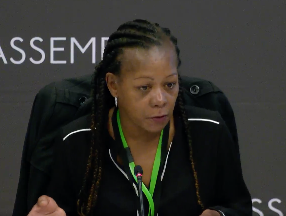
Camden’s Empty Homes Coordinator Joyce Amoateng addressing City Hall
BRINGING empty properties back into use will not solve London’s housing crisis alone, but campaigners and experts say it should form part of a wider effort to tackle the shortage of affordable homes.
At a debate held at City Hall, housing experts were quizzed by City Hall assembly members during a housing committee meeting discussing empty homes in London.
Sam Bloomer, a policy officer at Shelter said: “The problem is much bigger than empty homes, while we want to see a focus on acquiring and converting empty homes it’s not a silver bullet in any sense, its really important to see more work on this and we need to see that ramping up of direct delivery of construction.
“There is no better time to retrofit a home than one that is empty. Any action to address empty homes whether it’s bringing it into private use or social use is extremely welcome and desperately needed but the most effective lever the government can pull to tackle the housing emergency is bringing those empty homes back to use as social rent.
“London’s housing crisis is a result of successive governments’ failure to invest in social housing alongside the right to buy, alongside freezing of local housing allowance.”
In 2025 there were 105,138 empty homes in London. Around 12 per cent of these empty homes are owned by local authorities directly.
Chris Bailey, Director of Policy and Campaigns Action on Empty Homes told the discussion in June: “We can’t meet the need for social housing purely by converting empty homes – it’s a matter of pulling all the levers available and empty homes are one of those levers.
“Empty homes on their own are not a silver bullet but they can be a contribution and we also have to look at the factors that leave homes empty for long periods of time – housing in a way is a membership system and the question is how long do homes spend empty?
“If more homes spend more time empty then you have less supply, if less homes spend less time empty you have more supply its a dynamic system.”
He added: “Ultimately those things are in the hands of senior policy makers who can look at producing a new programme that would enhance council powers. And provide incentives to encourage more empty homes to come into use quicker.”

Camden’s Empty Homes Coordinator, Joyce Amoateng said the picture in the borough was “complex”, with many empty properties linked to new developments, probate cases and the length of time it takes for developments to be approved by the planning committee.
She said: “I’ve noticed in Camden that planning takes a really long time. It goes back and forth and the owners come to me and complain and I say I cannot do anything. All I can do is talk to the planners.
“That is something that is holding up developers. Probate properties are a problem – disputes with siblings, whether they want to hang onto the property or sell the property.”
She added: “The other problem we have is there are a lot of new developments that go up in Camden some of them have been built three four years and never been occupied – I suspect they are being used as short term lets and Airbnbs.”
Ms Amoateng said that the impact of empty homes in estates was less visible as they were within blocks, and less obviously unused, or derelict.
“If they are in derelict condition internally you don’t see them because they are in a block. The ones [empty properties] that are in the posh areas like Hampstead, big properties that we probably wouldn’t be able to do any enforcement on because we don’t have the money to spend on that.
“We will go to the owners and get on their case to get something done.”
