Seeing Joseph Wright in a whole new light
John Evans views an enlightening exhibition of the artist’s work
Thursday, 26th March — By John Evans
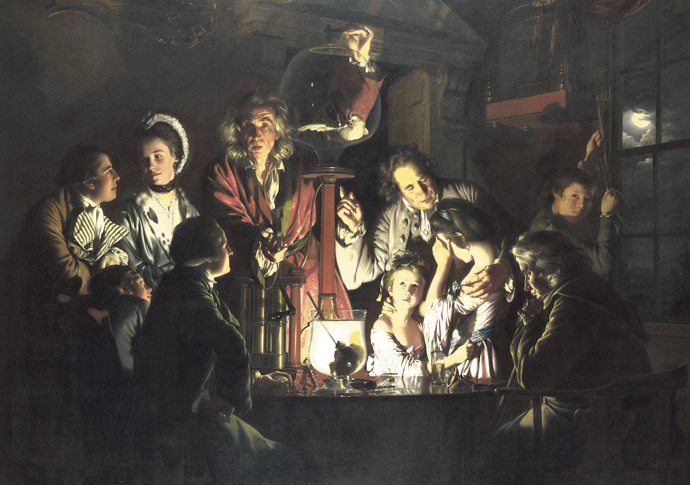
Joseph Wright of Derby, An Experiment on a Bird in the Air Pump, 1768, oil on canvas, 183 x 244cm © The National Gallery, London
AS a child Joseph Wright learnt to draw by copying mezzotints of other artists’ work.
Now experts believe he produced his spectacular candlelight pictures with “mezzotint reproduction in mind”. The tonal contrasts he achieved “would be integral to his fame”, with his commissioning engravers to produce versions of his paintings for wider circulation at a time of a burgeoning interest in public art, new academies, and exhibiting.
A successful portrait artist, Wright (1734-1797) would produce works that have come to symbolise an era. Traditionally viewed as a figurehead of the Enlightenment, a new show aims to challenge this view, adding to a re-evaluation of Wright not merely as a “painter of light” but as one who explores the night-time “to engage with deeper and more sombre themes, including death, melancholy, morality, scepticism and the sublime”.
The context is everything with its focus the period between 1765 and 1773. More than 20 works, prints, paintings, and drawings can be seen; and an orrery!
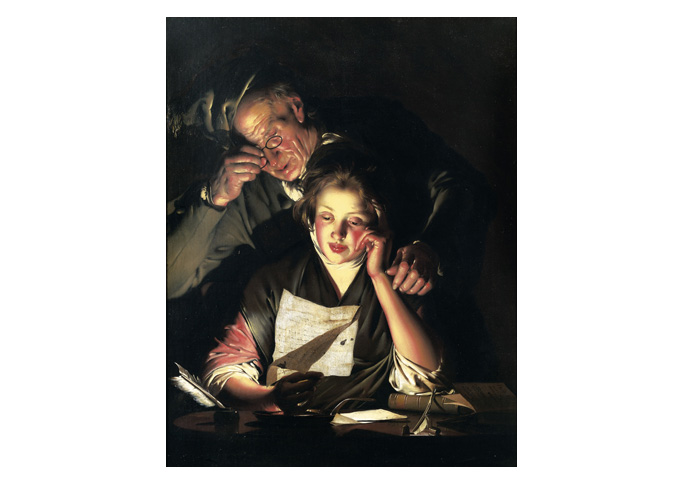
Joseph Wright of Derby, A Girl Reading a Letter with an Old Man Reading Over her Shoulder, about 1767-70, oil on canvas, 91.5 x 71.2cm, private collection, care of Omnia Art Ltd © Omnia Art Ltd
Wright, “of Derby” after his birthplace, the son of a lawyer, did have among his patrons Josiah Wedgwood and Richard Arkwright. Yet, although some of his works have been associated with the Industrial Revolution, says Christine Riding, National Gallery director of collections and research, Wright’s principal interest was in the dramatic rendering of light and shade. He used these “candlelights” or “night pieces” for a range of subjects, compositions, and on different scales.
Notable examples include A Philosopher giving that Lecture on the Orrery in Which a Lamp is Put in Place of the Sun (1766, Derby Museums); the National’s own An Experiment on a Bird in the Air Pump from 1768; and there is a rare chance to see An Academy by Lamplight, 1769, from the Yale Center for British Art, USA.
There’s the scientific inquiry; will the “Air Pump” trapped bird live or die? What can a model of the solar system show us? There’s also a powerful narrative.
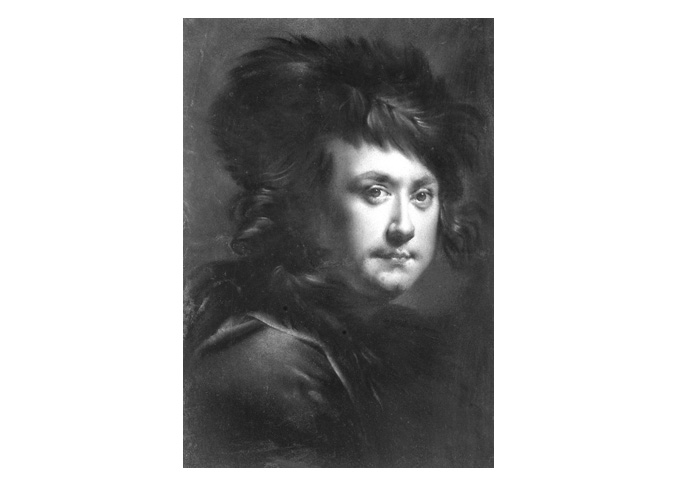
Joseph Wright of Derby, Self-Portrait in a Black Feathered Hat, about 1767-70, charcoal heightened with white chalk on paper, 53.3 x 36.8cm, Derby Museum & Art Gallery (1953-186) © Derby Museums
Riding says his distinctive use of tenebrism, “made darkness a central component of the picture”.
Whether with scientific inquiry, children at play, or working-class labour (as with the dramatic A Blacksmith’s Shop, 1771, from Derby Museums), Wright’s individual style exudes both innovative power and heightened realism.
Derby’s museum and art gallery is currently exhibiting 50 works on paper by Wright.
This Shadows show can be seen there from June 13.
• Wright of Derby: From the Shadows is at the National Gallery, Trafalgar Square WC2N 5DN until May 10, organised with Derby Museums. www.nationalgallery.org.uk
