Review: Under the Shadow, at Almeida Theatre
Gripping production set during Iran’s conflict with Iraq in the 1980s is a stark account of how quickly war and tyranny can unmoor us
Thursday, 18th June — By Lucy Popescu
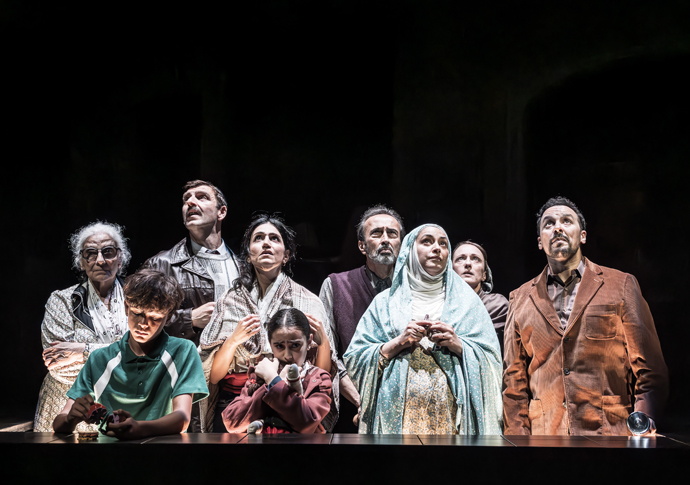
The cast of Under the Shadow [Marc Brenner]
HOW would any of us respond if we were under constant bombardment, or forced to sacrifice our career because of our political beliefs? Carmen Nasr’s adaptation of Babak Anvari’s 2016 Farsi film is about the human cost of war and state repression.
Set during Iran’s conflict with Iraq in the 1980s, Shideh (Leila Farzad) is left alone with her young daughter Dorsa (Esma Akar) in Tehran after her doctor husband Iraj (Nicholas Karimi) is conscripted to the frontline. Shideh is desperate to resume her medical studies, having been barred because of her involvement with leftist groups.
As the bombing intensifies, mother and daughter are thrown together with their neighbours in the basement. When the apartment block is hit, pressure mounts and talk of djinns takes on a disturbing force. Dorsa develops a fever after losing her doll, Kimia, which she believes protects her, and Shideh becomes increasingly unsure what or whom to believe.
Under The Shadow is a stark account of how quickly war and tyranny can unmoor us.
Nasr’s adaptation captures the banality of conflict – the waiting, attempts at normality, shortages and lack of freedom – as well as the horror of missile strikes.
The sense of lives controlled by an authoritarian regime is vividly conveyed in the personal: Shideh’s illicit glass of wine, the Jane Fonda exercise tapes stashed in a cupboard alongside her daughter’s banned cartoons, and the scarf she adopts whenever there’s a knock at the door.
Even if you don’t believe in djinns, the chador-wearing manifestation works as a credible projection of Shideh’s psyche. War, after all, is a horror story. Ben Stones’ meticulous set impresses, the cartoon missile adding to the surreality. I was gripped throughout by Nadia Latif’s taut production and the nuanced performances.
Until July 4
almeida.co.uk/
