Review: Freedom, Rhythm & Sound – Revolutionary Jazz Original Cover Art
Collector Gilles Peterson explains the appeal of ‘private press’ album covers that reflect the raw energy of the music
Thursday, 11th December 2025 — By Dan Carrier
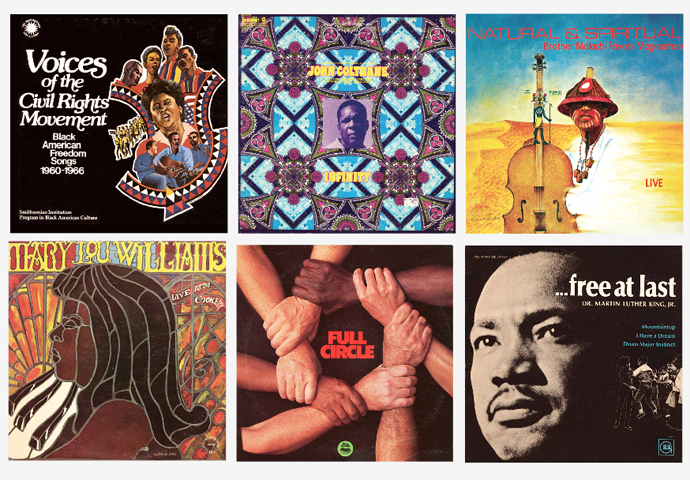
Dozens of album covers are featured in the book
THEY are beautiful, striking, and above all, radical – album covers that not only implore the listener to put a needle on the record, but illustrate a movement that represents the link between art and politics.
Freedom Rhythm & Sound is the second volume of a collection of far-out jazz record covers, put together by DJ and producer Gilles Peterson and his colleague Stuart Baker. It reveals developments in jazz music through the 1960s to the 1980s, and all outside the borders of the music industry.
Focusing on private press records made in small quantities and sold at gigs or friendly record stores, they are artistic, not commercial, and this gave the musicians creative freedom.
Gilles says the words “private press” have always held a fascination for him. “Typically used to denote records self-released – and self-funded – they are limited in quantity, rather than by a large music company,” he says. “What makes them more interesting is why they were made in the first place, and what they represent as artefacts – like a time capsule that might contain clues and codes about a moment and place.”
Because of the independent nature of the production, it means the slick A&R (artist and repertoire) job done by big labels is missing. These are not produced with the bottom line of commercialism in mind.
“Often both the quality of the recording and the artwork – and to be honest, sometimes the music itself – can be of variable quality, but the one consistent attribute is the raw energy of unfiltered creativity,” he adds. “There is also a delivery of artistic intent independent of any market logic, and in the spirit of self-expression and self-determination. I think the true power of these recordings is often the lack of any editorial A&R voice telling the music what it should or shouldn’t be.”
By taking on the production and design, artists guided the work.
“DIY is a much-used term these days – private press records are the ultimate expression of that spirit,” he says.
“It is a throw back to a pre-digital age where scarcity, rather than unlimited access, was the thing. It teaches us about some of the values we may have misplaced in the current era – independence and pure creativity as a moral, spiritual and political act.”
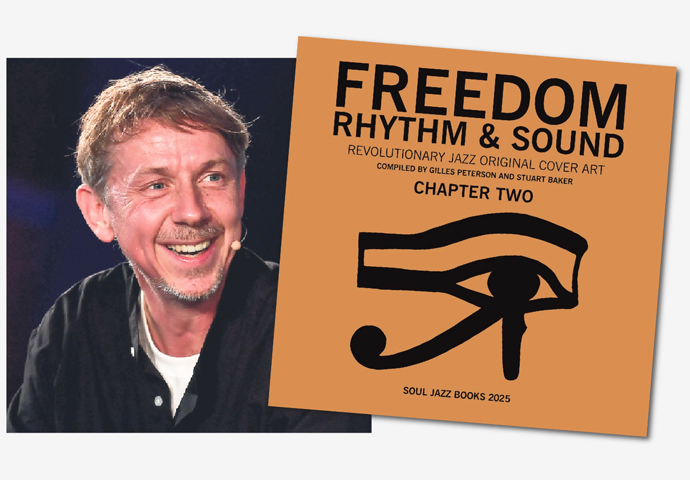
Gilles Peterson and the cover of the second volume of Freedom Rhythm & Sound
The records reveal the political climate. Many US jazz musicians crossed the Atlantic in the 1960s, frustrated with the perceived failure of the civil rights movement to make a material difference.
“In Europe, they found a willing audience ready to hear their radical music,” he writes.
The book illustrates how this empowered them and how this creative milieu helped musicians as they returned to the US.
“The transatlantic movement had a lot to do with the less hostile environment Europe provided for black American musicians combined with an open-mindedness towards a freer music,” writes Gilles. “And inevitably that will have fed back into European art styles and approaches mixing in with American ones. No doubt the more mainstream labels were not immune to exploiting a ‘radical chic’ aesthetic to capitalise on the politicisation of youth particularly post-68.”
The extraordinary range of covers – and the common theme of mixing politics with music – is writ large. There are recordings of Maya Angelou’s poetry and Martin Luther King’s “I Have A Dream” speech. But it also illustrates the schism between those who saw MLK’s civil rights action as not radical enough, and saw the civil rights issues also through a Marxist prism.
Non-violent direct action may have had a moral basis, but others recognised both the reality of daily physical violence meted out by a racist state, and the economic violence inflicted by a system that had graduated from an economy built on slavery to a capitalist exploitation that committed people to entrenched poverty.
More radical albums – such as Free Angela by Larry Saunders – illustrate the rise of the Black Power movement. “The impact the civil rights and Black Power movements had on the evolution of jazz music from the 1960s onwards cannot be overstated,” adds Gilles.
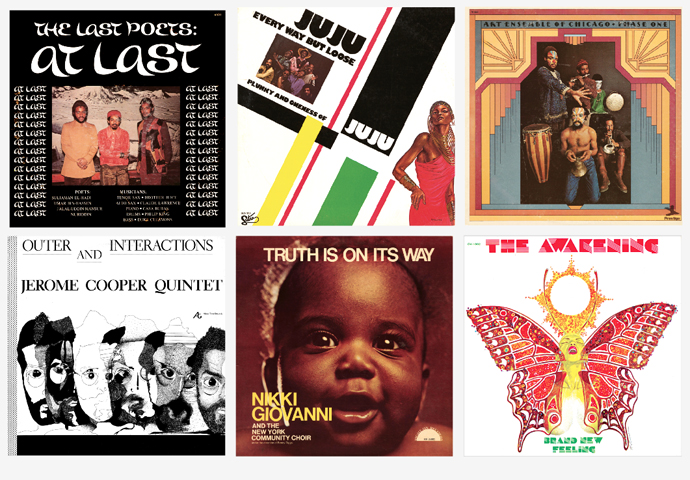
The Black Power movement also gave rise to the Black Arts Movement, aiming to crystallise art as a tool for social and political change. It highlighted identity, history and culture, creating a particular culture space for black people.
Jazz musicians saw their work as part of a wider landscape that drew in dance, poetry and theatre. It illustrates a line of evolution that saw musicians work with poets, leading to the works of Gil Scott-Heron and The Last Poets.
The importance of the link between the jazz movement and the political atmosphere that shaped it is vital, adds Gilles. “Any independent act that sits outside of a structured and established economic model is a political act by definition,” he states.
“At the heart of it many of these records are the symbol of a creative class seizing the means of production for themselves and documenting a cultural moment free of commercial constraints and in search of a deeper way of being against the backdrop of difficult times.”
The records do not themselves easily slip into common ideas of a genre.
“I am not sure this is about genre, per se, which is in itself another economic construct created by record labels to rack and sell records,” he adds. “The lineage that binds a lot of these albums is the intention behind them, driving pure outsider acts of creativity aligned with various struggles such as civil rights, economic self-determination, the fight against oppression and a quest for true meaning within a capitalist system that thrives on alienation and exploitation as a driver of profit.”
Gilles says for him collecting records has never been along set lines – and the same applies to the covers included.
“I’ve always looked at my records as a living collection – there isn’t an overall curatorial approach, beyond finding and gathering all sorts of sounds often united by spirit rather than by genre,” he says.
“In a way this approach/non-approach is how I went about compiling these two volumes with Stuart. We had an idea of the essence represented by DIY and independent labels. After you’ve looked at enough records, you kind of know what that essence is – a mixture of raw and unfiltered imagery that serves as a perfect signpost for the intention behind the music within.”
For a record collector like Gilles, these rare discs inspire. “This neverending search for those moments – it makes private press and deep independent records so enduringly fascinating,” he adds.
“In a world where anything can theoretically be found at the click of a button, there is still the possibility of being an intrepid explorer discovering a gem. The dopamine hit of the best new music you’ve not heard yet is rreplaceable.”
• Freedom, Rhythm and Sound: Revolutionary Jazz Original Cover Art – Chapter Two. By Gilles Peterson and Stuart Baker. Published by Soul Jazz Records, £35.
• Join Gilles Peterson + Stuart Baker (Soul Jazz Records) + special guests for a special night of conversation about jazz on December 18, 7.30-10pm, at The American International Church, 79A Tottenham Court Road, W1T 4TD. Tickets £17.50. From www.soundsoftheuniverse.com
