Prime minister insists that he still feels like he lives in Kentish Town – and sees people’s everyday problems
CNJ asks Sir Keir Starmer: why do so many people feel like they're lives haven't got better under Labour?
Friday, 23rd January — By Richard Osley

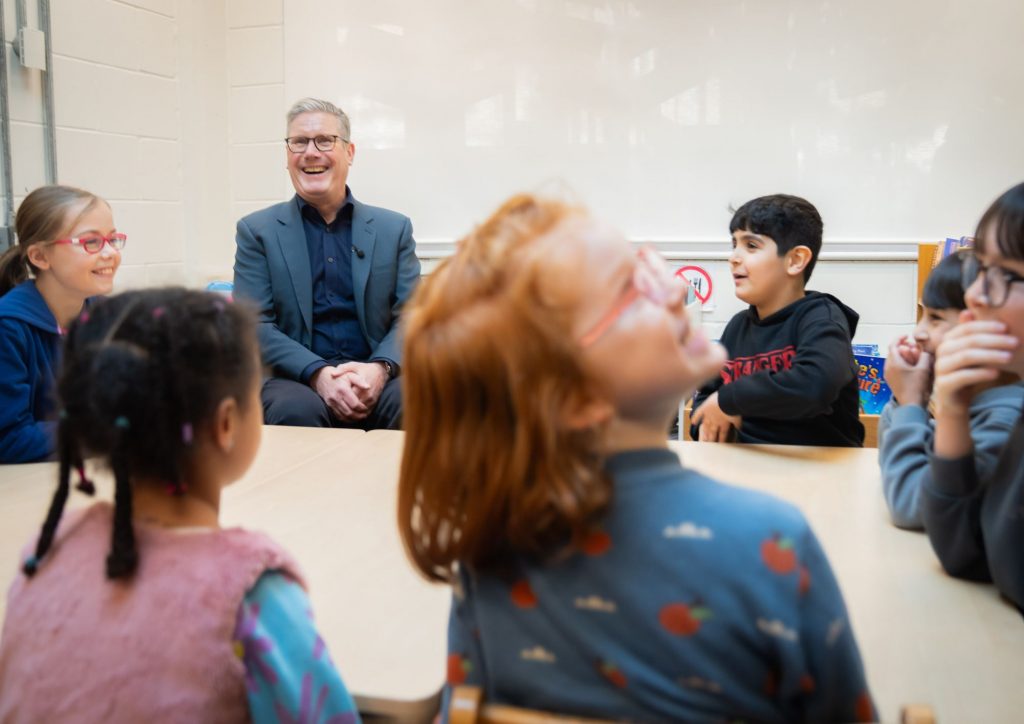
Sir Keir Starmer meeting staff at Hawley School in Camden Town

PRIME minister Sir Keir Starmer said he was well aware that people were “frustrated” at the pace of change – but that his government was “slowly but surely” making lives better for people weighed down by the cost of living.
In an exclusive interview with the New Journal on Friday, he was asked why many people felt that nothing had changed for them since Labour was voted back into power last May, and if he had personally seen the day to day poverty in his home constituency and elsewhere.
Despite north London’s reputation as an affluent haven for the “metropolitan elite”, around 40 per cent of children here are officially growing up in poverty.
Mr Starmer said: “I understand the frustration because people want change and they want change delivered quickly. I completely understand that. After 14 years of the last government, it does take a bit of time, but that doesn’t take away the frustration that people have that things aren’t moving quickly enough.
“I’m also deeply conscious that, whatever else is going on in the world or across the country, in Camden, if you ask most people, what’s the issue that matters to you most – it’s the cost of living.”
The Holborn and St Pancras MP was working in his local constituency with a day of meetings and visits, followed by a surgery for residents. This still happens regularly, although it is by appointment only.
His government has faced accusations in its first year of worsening people’s finances by removing the winter fuel allowance – later reinstated – attempting to cut some disability benefits and delaying the removal of the two-child benefit cap.
The latter happened in the most recent budget, but poverty campaigners said it should have been the first thing Mr Starmer’s government did after winning the election.
He said: “The good news is that 2026 is the year when we begin to turn the corner, because when you come into government, you’ve got to clear up a mess, you’ve got to pass legislation, you’ve got to make the financial provision. A lot of last year we were saying these are the things we are going to do – now this year, month on month, people will begin to see what that looks like.
“We invested in the NHS and in Holborn and St Pancras, A&E has got better. GP satisfaction has gone up, ambulance waits have gone down, so there’s already some improvement.
“On the cost of living this year, the two-child limit will be lifted. That means a thousand children in Camden, actually in Holborn and St Pancras, will be lifted out of poverty.
“There’s £150 off people’s energy bills for every household in Camden. For the poorest households in Camden, that’s on top of the £150 that’s already in place – so that’ll be £300 off their bills.
“Rail fares are being frozen, prescription charges are being frozen – and anybody on the national minimum wage, national living wage, will see a pay rise in April as well.”
He added in new statutory sick pay and paternity leave protection as other benefits.
This big sell is Labour’s answer to claims that people’s lives haven’t been made any better by Mr Starmer’s move to Downing Street.
He insisted being locked away at Number 10 did not mean he was blind to the problems the people in this area face.
“I see it every day. I mean Camden – Kentish Town is my home. It’s my heart,” Mr Starmer said.
“It’s where we’re based as a family. I still consider myself living in Kentish Town. This is my community and I care about it hugely. I’m acutely aware that we were elected into government to fight for and deliver for the people who need it most.”
He added: “Very often people say to me, ‘Well, you were the first in your family to go to university – that’s a great thing’. But my brother and sister didn’t go to university. Most people don’t get the chance to do what they want to do, and that’s the people that we’re fighting for.
“And they’re the people in my constituency that I have in my mind’s eye when it comes to what we’re doing.”
AD: YOU CAN GET FREE ACCESS TO AUDIOBOOKS WITH A SIMPLE-TO CANCEL 30-DAY TRIAL OF AUDIBLE

That list of pledges and promises, and assurances that things will start to get better even if they haven’t already, for those counting the pennies and pounds is on the clipboards of local Labour members who are already in the thick of an election battle.
In May, every resident in Camden will get the chance to vote on who they think should run the council for the next four years.
While voting is meant to be on local issues, history shows that national performance is a huge factor for people at the polling station.
Labour lost control of Camden in 2006 amid the Iraq War, while the Liberal Democrats lost ground locally in 2014 after its national leaders had served in a pact with the Conservatives.
Richard Olszewski, the Labour leader of the council, has already warned that the national picture is a challenge for the local effort after a landslide defeat to the Lib Dems in last year’s West Hampstead by-election.
He himself has switched wards – traversing the entire borough from Fortune Green to Holborn and Covent Garden in search of safer territory.
It’s not just the Lib Dems who will be looking to advance with the Greens and independents scouting out new ground too.
Issues such as Mr Starmer’s handling of Gaza are coming up on the doorstep as all the parties begin more focused door-knocking.
So is Mr Starmer feeling the pressure that underwhelming opinion polls around his first 18 months as prime minister could lead to some familiar Labour councillors – some he calls friends – losing their seats in 15 weeks’ time?
“I do need to pay tribute to our fantastic Labour councillors on the council,” he said.
“When it comes to May, the question obviously is whether people want to carry on with this good Labour council or not. I think they should, but we’ve got to fight for every vote. We’ve got to earn every vote.”
Would people use the elections to judge him or the council?
“It’s a bit of both,” he said.
“Yes, there’s always the overlay between the two, but that’s why it’s really important that we deliver as a government during the course of this year. I mean, whether we have elections or not, that’s important. We’re humble about what we’re doing. We don’t overclaim.
“I do know how tough it is for people and therefore we are turning this around. I said it would take time. I always said this was a long project to take our country from decline into renewal.”
Maybe they should lower vote age to 8
IT is clear that there are many people who have developed an intense allergic reaction to Sir Keir Starmer since he took over the Labour Party.
Each week, his office sees condemnation of policies on welfare, immigration and Gaza – and that’s just the New Journal’s readers’ letters pages.
But no spin doctor could have so perfectly staged the reaction the children at Hawley School in Camden Town gave him on Friday.
Teachers had been slightly worried that the promise of a “special guest” might fall slightly flat if the young pupils weren’t actually sure who he was.
Perhaps they’d be disappointed that it was not actually Ariana Grande popping through those doors.
But, as it was, nearly all of them wanted to shake his hand and he was rather mobbed as he tried to leave.
I haven’t always seen that with politicians visiting schools over the many years of doing this gig.
“You should lower the voting age again, to eight,” I joked.
“Not a bad idea,” he said – before facing a room full of children who seemed clued up about their ambitions for the future.
One girl had read 48 books since the start of the school year, which flabbergasted the prime minister.
It made you wonder – as he explained his busy job – whether he even had time to read one novel these days.
They smiled when he told them that in his world he couldn’t go for a walk without reporters, photographers and security following him around.
He is often accused of being robotic in TV interviews, struggling to generate a bouncing energy and enthusiasm for his government.
In contrast he seems to revel in these moments of warmth, meeting people, talking about Arsenal’s chances of winning the quadruple with a nine-year-old fan and whether he’d get in trouble again if he did “the six seven” with their teacher.
