‘People were looking at the world in a more intelligent way, asking how things worked and why’
John Harrison’s name may not be familiar but his work helped shrink the world. Dan Carrier learns how from horologist Jonathan Betts
Thursday, 2nd April — By Dan Carrier
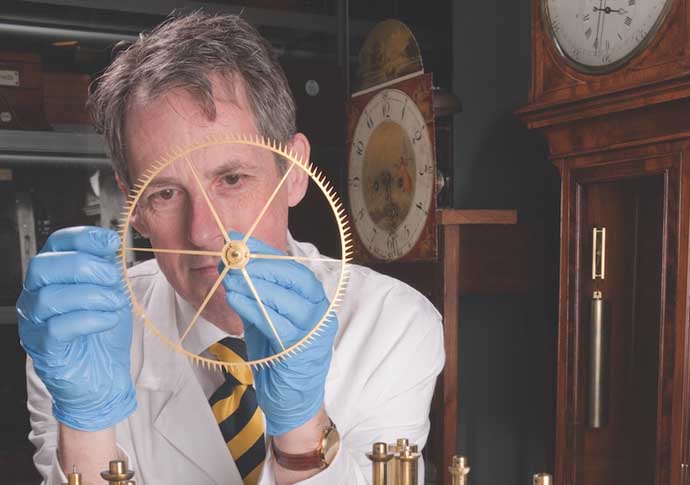
Horologist Jonathan Betts
IT was more than just a knotty mathematical problem – it was a matter of life and death, and the person who could find an answer would make the world that much smaller.
How to measure a ship’s position using longitude alongside latitude plagued 18th-century navigators. The answer would be solved by clockmaker John Harrison.
Harrison, who lived in Red Lion Square, Holborn, died 250 years ago this week – and horologist Jonathan Betts was joined by historian Lester Hillman at the Hampstead Community Centre on Thursday to convey just how important Harrison’s work in developing an accurate timepiece was.
Harrison, a cabinet maker, turned his attention to solving the problem of calculating longitude – the means to determine a ship’s east-west position. The answer was a marine chronometer, a clock that could accurately keep time and allow sailors to compare noon at any given point on their voyage with the time back at their home port.
Jonathan is an expert on the life and works of Harrison, who is buried in the St John’s Parish churchyard in Hampstead.
His posts include a 35-year stint at the National Maritime Museum at Greenwich’s Royal Observatory, and his fascination with clocks began as a child. His family ran a watch firm.
“Aged 10, I started working as a runner, carrying gold watches to the repair shop,” he recalls. “I’d hang about, watching people in the workshops and I fell in love with it. I was fascinated by the clocks and watches they were working on, fiddling with all these little mechanisms, a world in a small box.
“I set up my own workshop at home. I took old watches apart and played about with them, seeing how they worked. I went on to a technical college to study horology.”
After a spell restoring and repairing clocks, he was appointed at Greenwich observatory as the curator of time-keeping. “I had to learn an awful lot on a wide range of subjects,” he says. “It is, of course, about navigation, astronomy and scientific endeavour, but I challenge you to think of any occupation that does not involve time-keeping in some form or other. To make the point, think of a most unlikely example – say a barber: they might consider how long it takes different people’s hair to grow, how long it takes to cut, arranging timed appointments in their calendar and how much they need to charge for their time. Time is related to just about everything we do.”
At the observatory, visitors would ply him with diverse questions. “‘Why, for example, do we have 24 hours in a day?’ A question like that would take you back to ancient Egypt,” he says. “And why do we have 60 minutes in an hour and 60 seconds in a minute? That is because of the ancient Babylonians, who used a sexagesimal system, based on units of 60.”
“It [the observatory] was founded by Charles II in 1675. I served the organisation for one tenth of its existence. It was part of the zeitgeist of the Age of Reason.
“People were looking at the world in a more intelligent way, asking how things worked and why. Part of this were questions of astronomy and navigation. We had a rapidly growing navy. Safe navigation was a significant issue.”
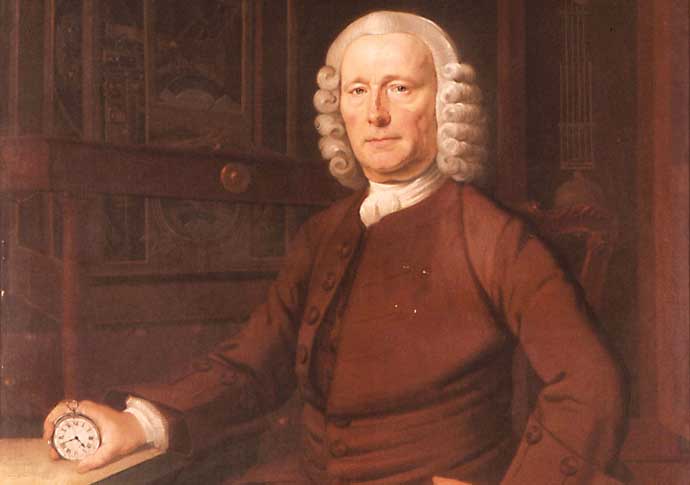
John Harrison made solving the longitude problem his life’s work
As European nations set out to explore new worlds, better navigation was crucial. While they could judge their latitude – their point in terms of north to south – they had to find a way of determining their longitude: without that, they could not accurately gauge how far they’d travelled or how far they had to go. Solving this question became Harrison’s life’s work.
“The need began with Columbus,” says Jonathan. “Ships used to sail close to the coastlines to guide them, but when explorers lost sight of land, and all you could see was the horizon, they needed a new way to know where they were.
“You could find out your latitude quite easily when the Sun reached its height at noon. That was not a problem. To know how far they had travelled east-west, they had a series of clues they could look at, but it wasn’t accurate.”
In theory, the answer lay in accurately establishing the time difference between where you were at sea and the time at home.
“For example, you know New York is five hours behind Greenwich Meantime. Judging how far west you are is the same as time difference. You could tell when the Sun was at its height and know it was noon. But how could you know what time it was at home? You couldn’t call home and ask.
“The obvious answer was to have a special clock. Before you leave, you set it running and take it with you. But clocks were not accurate. They were affected by the motion of the seas and the temperature.”
Another answer lay in creating charts of the movement of the moon against the stars – the moon takes a predictable path across the sky, and could act like a clock hand with the stars as numbers.
“You could look up and find your longitude that way, but no one had made these tables. They spent years recording positions – that was a reason the Royal Observatory was founded – but they were getting desperate by the early 1700s. Valuable cargo was being lost and people were dying.”
A series of disasters at sea saw the government found the Board of Longitude to fund research on longitude. The answer was to offer rewards to research longitude – and it was a challenge Harrison set out to tackle.
“This gave people the chance to experiment,” says Jonathan. “Harrison was a highly skilled cabinet-maker. He was interested in making clocks. He used well-seasoned oak, and they performed really well.
“The Board supported Harrison over two decades to develop his ideas. “His first design, H1, was trialled on a ship to Portugal. It told him that it was possible to make a clock that could put up with the rocking of the ship and the variations in temperature. It was not accurate enough, but he was making progress.”
Challenges included materials to use and how to lubricate moving parts. One innovation was to create a “bimetal” using steel and brass – the precursor to thermostats. When the temperature rose or fell, his clock would adjust accordingly. Harrison also worked out how to create anti-friction bearings, another system used today in all manner of machinery.
“By 1750, he started looking at watches,” says Jonathan. “They had been dismissed, as no one thought they could work well enough. The pendulum clock kept good time but clocks of size were not portable, so he started improving the watch. He looked at how the watch was designed and worked out how to make its timekeeping element, ‘the beating heart’ of the watch, better. He found that by making it beat faster it would be more accurate.”
By 1759, he had invented H4 and on voyages to the Caribbean sailors were impressed with their accuracy.
“The British government made the work public and shared it with other countries,” adds Jonathan. “It went all around the world. Harrison dedicated his life to developing these time keeping devices. He was recognised as a great innovator and it was improved on by others.”
Harrison’s work, a key step to modern navigation, opened up a new world of technological advances.
