Our area is being cut off with no consultation
Thursday, 18th June 2020
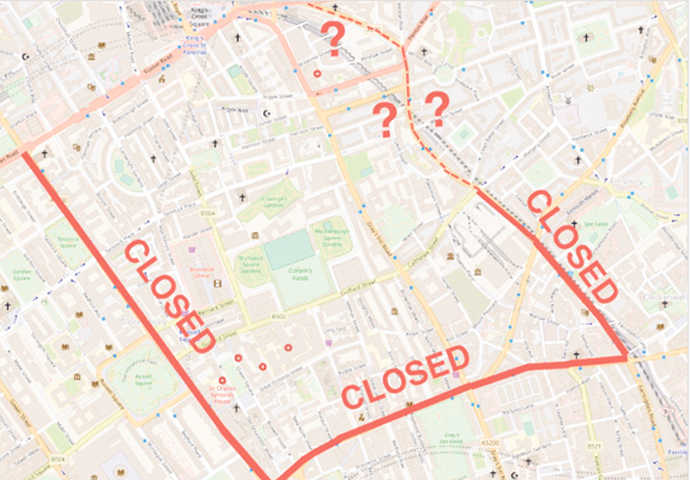
Series of vehicle-free streets in Bloomsbury
• IT is important for residents and businesses to know that all major roads bordering the south, east and west sides of the Bloomsbury area are being closed to cars and all motor vehicles, apart from buses and emergency vehicles.
This is happening now and there is no consultation. The changes will be completed by the end of June.
The ostensible purpose is to promote social distancing and stop post-lockdown congestion. Transport for London announced new “car-free zones” in London in this May 15 press release.
TfL is introducing is a series of vehicle-free streets, which cuts off most vehicle access to the Bloomsbury area – the residential area south of Euston Road.
TfL’s explanation is sketchy and no comprehensive detailed map is provided. We have asked for more information. Residents and businesses in the area have not been informed.
The local impact will be that the following routes will be closed to all vehicles except buses and emergency vehicles.
The entire north-south route (Upper Woburn Place / Southampton Row / Kingsway / Aldwych), between Euston Road and Waterloo Bridge.
The entire east-west route of Theobalds Road and Clerkenwell Road, between Southampton Row and Farringdon Road.
Most or all (the press release is unclear) of the Farringdon Road / King’s Cross Road, between Clerkenwell Road and King’s Cross.
So entry points to the area will be severely reduced, with all vehicles being forcibly diverted to some very narrow streets, including Dukes Road and Sidmouth Street.
And the closures spread wider than this – extending to Old Street roundabout and Waterloo and Blackfriars bridges.
This will have a huge impact on the residential area south of Euston Road, which will be bordered by the closed roads. Vehicles will have to drive further to find entry and exit points, causing more pollution both within and outside the enclosed area.
The major issues about how people with restricted mobility will manage to live their lives; and how large construction vehicles for the multiple development sites in the area will enter and exit are among the many questions to be answered.
But what TfL and Camden Council will achieve is a series of flagship streets with little traffic, to be used for photo opportunities, and the consequential increased congestion and pollution on nearby residential streets – and the stress and problems caused for local people – will be swept under the carpet.
The 2017 public inquiry about Tavistock-Torrington Place, which relied on independent experts and proper scrutiny of council data, blew out of the water the myth that closing roads decreases congestion and traffic volumes.
But, like many politicians the world over, TfL and the council forge ahead with changes based on magical thinking rather than proven facts.
We in BRAG are keen to promote walking and cycling and to reduce unnecessary vehicles and pollution. But we want action which will be effective. And for that it must be based on sound evidence and local consultation, which this is not.
NICKY COATES
Co-Chair, Bloomsbury Residents’ Action Group
