Original landscape rivalry
John Evans views Tate Britain’s celebration of two revered artists born some 250 years ago
Friday, 5th December 2025 — By John Evans
![John Constable The White Horse 1819 © The Frick Collection New York [Joseph Coscia Jr]](/media/2025/12/John-Constable-The-White-Horse-1819-©-The-Frick-Collection-New-York-Joseph-Coscia-Jr.jpg "Original landscape rivalry")
John Constable, The White Horse, 1819,© The Frick Collection, New York [Joseph Coscia Jr]
FOLLOWING the National Gallery’s rehang earlier this year, famous works by two men born within a year of each other were placed in the same room and the experts noted: “British artists JMW Turner (1775-1851) and John Constable (1776-1837) sought to represent the truth of nature. In distinct ways they captured fleeting light effects and weather conditions.”
And then some, one might add, about these two who now feature in Tate Britain’s new show Turner and Constable: Rivals and Originals*, billed as “the first major exhibition to explore the intertwined lives and legacies of Britain’s most revered landscape artists”.
With 190-plus works by the two men featured and a fine catalogue edited by senior curator Amy Concannon, stories of their different fortunes are precisely documented and explored from the start of the show. The older, Joseph Mallord William, London-born, unmarried with two children, began training at the Royal Academy aged 14, elected Academician at 27, lived until he was 76; the younger, John, Suffolk-born, married with seven children, began training at the Royal Academy aged 23, Academician at 52, lived until he was 60.
With encouragement, opportunity, temperament, travel, and more, to be taken into consideration when comparing and contrasting their different styles, among the inspirations for the current exhibition was what contemporaries noted in the 1830s. As the Tate says: “The stark differences between their work spurred art critics to pit them against one another and to cast them as rivals.”
So we see together here Turner’s Caligula’s Palace and Bridge and Constable’s Salisbury Cathedral from the Meadows which, when shown at the same RA annual exhibition, led one critic to describe the moment as a clash of “fire and water”.
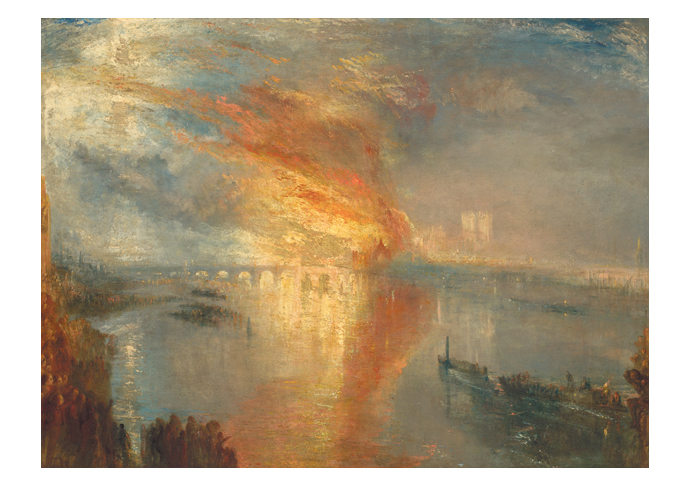
JMW Turner, The Burning of the Houses of Lords and Commons, 16 October 1834, 1835, Cleveland Museum of Art [Bequest of John L. Severance 1942.647]
Tate Britain director Alex Farquharson refers in his catalogue foreword to “Constable’s intense and persistent focus on his native landscape…” and Turner’s “far more stylised approach to his geographically and historically expansive subjects”.
Indeed, we see Constable works from in and around the Stour valley and Suffolk and Essex, Wales, the Lake District, Brighton and, of course, Hampstead to where he first moved in 1819. There are his detailed cloud studies – a favourite subject – and many rare examples from private collections; and notably a late, large, black-lead drawing on paper, Fir Trees at Hampstead, c1833, on loan from The Higgins Bedford art gallery and museum.
Turner, as we know, travelled far more widely and scenes of Venice and the Alps and more, as well as those from across Britain, feature.
The Clore Gallery at Tate Britain houses nearly 300 oil paintings and around 37,000 sketches and watercolours, part of the Turner Bequest.
In 1888 Constable’s daughter Isabel made a bequest of his works to the Victoria and Albert Museum and it has loaned 17 for this exhibition.
In fact Rivals and Originals is a stand-out for the outstanding loans.
Highlights include: Turner’s The Burning of the Houses of Lords and Commons, 1835, from Cleveland; Fifth Plague of Egypt from Indianapolis; and his first known exhibited oil The Rising Squall, Hot Wells from St Vincent’s Rock, Bristol, 1793, recently rediscovered and now from a private collection.
And for Constable there’s his first “six-footer” oil painting, made after friends encouraged him to work on a larger scale, The White Horse, 1819, a loan from the Frick Collection New York; Dedham Vale, 1828, is from the National Galleries Scotland; and The Wheatfield, 1816, from the Clark Art Institute in Massachusetts.
Other rare works from private collections include many oil sketches by Constable and perhaps the most intriguing of the show, Turner’s Juliet and Her Nurse, exhibited in 1836, where he has used Venice not Verona as an updated, almost contemporary, setting for his Shakespearean characters. It’s a painting not seen in this country since 1836.
Add to this poignant early self-portraits by both artists, sketchbooks, and even their paintboxes and other kit, and it all becomes irresistible as a double anniversaries show.
• At Tate Britain, Millbank, SW1P 4RG until April 12 (tate.org.uk 020 7887 8730)
