OBITUARY: Innovative Violet Philpott, the puppeteer behind Rainbow's ‘Zippy’
Thursday, 10th January 2013
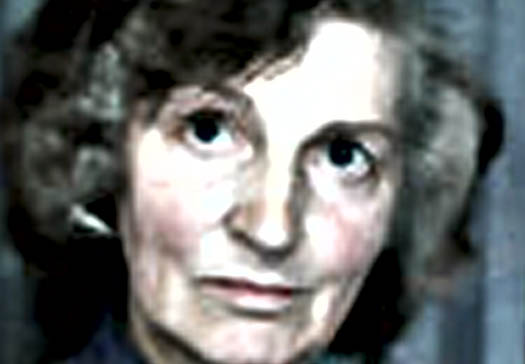
Violet Philpott, who was born in Kentish Town
Published: 10 January, 2013
by CATHERINE MARCH
VIOLET Philpott, who has died aged 90, was one of the handful of puppeteers who brought new life and language both to British puppetry and children’s theatre in the 1960s and 1970s.
Performer, writer, and maker, Violet was constantly experimenting with new materials and techniques, as well as devising original plays, often through a process of workshop and improvisation.
From the early 1950s, working with the then innovative products of polymer science – polystyrene, polythene, plastics, and resins – Violet’s ingenuity and continuously experimental approach won her widespread recognition. When the BBC found a television outlet for the surreal radio humour of The Goon Show in 1963, they needed figures to go with the voices of Peter Sellers, Harry Secombe and Spike Milligan, and Violet was involved in bringing The Telegoons to life, her talent for producing various voices applied to a number of characters such as Major Bloodnok and Bluebottle.
Extensively involved in the making of many of the puppets, Violet worked with the Telegoons for 15 episodes, working with different puppets and varying mechanisms, until the introduction of automatic lip-sync emphasised the disparity between the ad-libbing voices of the Goons themselves, and the puppets and puppeteers giving expression to them. Believing that human warmth and energy purposefully channeled made for convincing puppetry, she was a distinct and different force from the supermarionation style of Gerry Anderson.
In 1972, she found her biggest audience by creating Zippy, the know-all star with a zipper for a mouth on Thames TV’s pre-school children’s show Rainbow. Although the series continued for more than 20 years, Violet’s involvement ended after the first season because of a back injury sustained through having to adopt an awkward position every time Zippy appeared through a window.
Together with Mary Jean McNeil, she produced a simple guide, The KnowHow Book of Puppets (1975), still available today, with lively illustrations aiming to show children how to produce puppet shows.
Whenever and wherever she could, she toured shows and workshops, making junk puppets with children at the annual Punch and Judy festivals in St. Paul’s Church, Covent Garden, and gave the young Emma and Sophie Thompson a vehicle for expressing their puppet selves in The Highbottom Hauntings, a Childrens’ Theatre Workshop production in the village of Dittisham, Devon (a production that also featured the talents of Goldfrapp’s Will Gregory).
Born in Kentish Town, Violet was the only child of Lilian and Robert Yeomans, who divorced when she was seven years old. Violet spent two years living with her father, a pub entertainer and jack-of-all-trades, but then went to live with her mother, adopting her maiden name. During her time at St Martin’s School of Art she discovered her métier and future husband AR Philpott, better known as Pantopuck the Puppet Man, or Panto (1904-1978).
Violet sometimes performed as Boo the Clown, a persona she developed in the early 1970s, and continued performing until at least 1993. She founded the Charivari Puppets, and later the Cap and Bells Puppet Theatre in 1971. Many of her live shows featured the adventures of the baby Bandicoot, an endearing marsupial with an inimitable voice.
Her adaptations of The Ugly Duckling and The Elves and the Shoemaker remain in the repertoire of the Little Angel Theatre in Islington, where she was a regular visiting artist.
A great advocate of the therapeutic uses of puppetry, and a dedicated subscriber to the work of the Educational Puppetry Association (founded by Panto in 1943 and amalgamated with the Puppet Centre Trust in 1978), she regularly ran workshops and gave performances for all manner of disabled and disadvantaged people.
The transmission of hope, confidence and fun through creativity is Violet’s continuing legacy, evident in the work of the Oily Cart company, for example.
