Notes on a life: how Edna was a first-hand witness to a century of change
When Edna Barfoot died aged 96, her children came across her notes and diaries that told a rich, detailed and wonderful story of life in Somers Town
Thursday, 16th July — By Dan Carrier
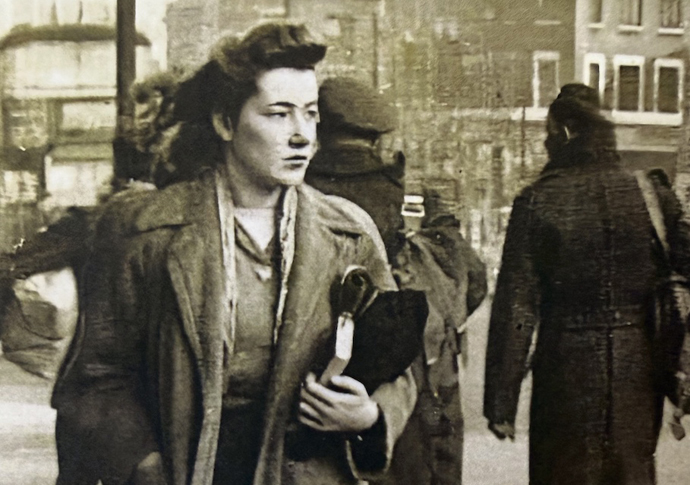
Edna Barfoot during the war
THE notes and diaries were written in no real order, and were not prepared for possible publication.
Instead, the writings of Edna Barfoot were recollections that traced a long life raised on the streets of Somers Town.
After Edna died aged 96 in 2022, her children Sue and Mike discovered she had committed her memories to paper – and they told a rich, detailed and wonderful story of life in the borough of St Pancras in the 20th century.
The result was a book, originally pulled together by her daughter as a present to Edna’s relatives, that is far too good to be kept just among those who knew and loved Edna.
It is a brilliant piece of first-person social history, a document with genuine historic value and above all simply wonderful to read: now published as A Somers Town Girl, it brings to life an era in London now vanishing in living memories.
“Mum’s notes were not written chronologically, and some were in notebooks or jotted down on scraps of paper, while others were stored on her computer,” writes her daughter, Susan.
Born in 1926, Edna had a childhood blighted by the Depression and then the war. She recalls her family – a grandfather who was a costermonger and the pearly king of St Pancras – and reveals in rich detail what life was like in NW1 in the first half of the 20th century.
The story’s roots begin in the Victorian period. Edna’s maternal grandmother, Nellie, was born in 1878 and earned a living with a milliner – she would be sent to well-to-do houses with a selection of adornments and decorations to attach to customers’ hats.
Nellie was beautiful and a customer’s son made advances: when she was pregnant, she returned to house to inform them and was paid £100 to go away and not come back.
Nellie’s family were supportive – Nellie gave birth to a boy, named Walter Pretoria, due to a patriotic moment prompted by the Boer War – and when her childhood sweetheart, William, returned from fighting they married.
Nellie had grown up in Bedfordshire but the couple moved to Somers Town.
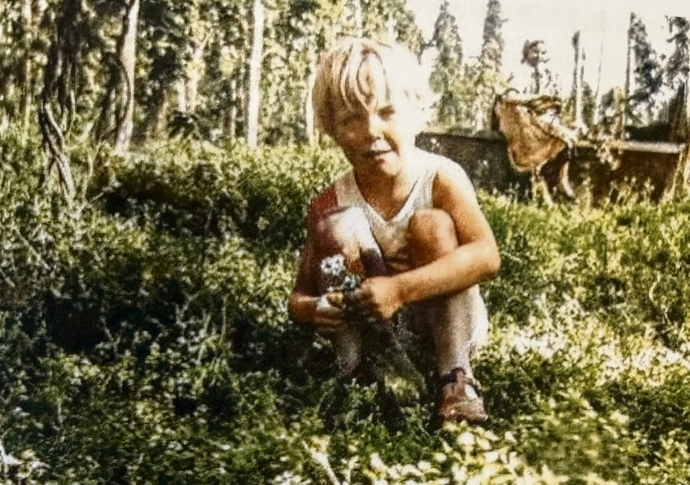
Edna hop picking as a child
Her paternal grandparents had been born in Somers Town. George Dole and Emma Baker ran a fruit and veg shop in Chalton Street and lived upstairs.
George also had a winkles and shrimp stall,which he would park up outside the Neptune pub at weekends.
George was one of the original pearly kings. He had been born in a Victorian workhouse and worked as a street sweeper and rat catcher as a child
Edna recalled how the pearly king founder Henry Croft was a close friend and George followed the pearly tradition of sewing pearl buttons on to his suit: he’d put it on for Saturday nights and then do a tour of Somers Town pubs, collecting funds for the local orphanage and entertaining the drinkers with London songs.
Edna’s mother Annie Dole was born in Somers Town in 1898.
“She had a lovely voice and was often asked to sing at parties,” her daughter would recollect.
“Give us a song, Annie, they’d say – and without hesitation, she would step up to the piano and sing and perform. She knew all the lyrics to the popular songs and standards of the time and could go on for horse. A human jukebox!”
Her father, Walter Pretoria Barfoot, was born in 1900. He lied about his age to enlist during the Great War and then was sent to Ireland as a Black and Tan.
He returned in the early 1920s and had a job for a bookmaker, as a clerk and a race course “tic-tac” man, writing up odds and taking bets. He would eventually graduate to become a licensed bookie.
His daughter recalls another job – working as a bouncer at a club in Soho. He would return home at 6am armed with a freshly baked loaf of French bread, baked by a Soho bakery.
“During the summer, when there were plenty of race meetings, my father earned a good income and we lived high on the hog,” writes Edna. “We had new clothes and money to spend. I remember being bought a beautiful pink chiffon dress to wear to Ascot.”
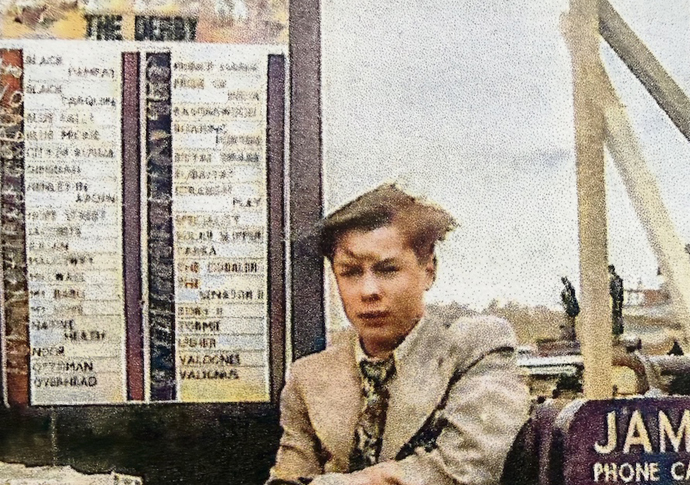
Edna’s dad George working as a tic-tac man
She describes childhood summers with a nostalgia for those halcyon days: vendors selling ice creams and pineapples, the racing tipster Prince Monolulu with his flamboyant dress sense and catchphrases selling tips in Chapel Market, Gypsies offering heather and wooden pegs, and jockeys in colourful silks.
The 1921 census has Edna’s mother recorded as working as a bottle washer for RP Culleys, Midland Railway. Culleys made Worthington’s Pale Ale and Guinness’s Stout.
Edna arrived in March, 1926. “My mother used to say ‘only Jesus was born in poorer circumstances,’” she writes.
“My crib was a drawer and my bedclothes were torn-up sheets.”
Her early memories begin with the family living in Arlington Road, Camden Town, and the hardships caused by the Depression.
The family looked forward to a holiday that paid for itself as they decamped with thousands of other Londoners every September to live on a farm in Kent and help get the hop harvest in. George’s work as a bookie was consistent but the winter months were much harder. She recalled visits to the pawn shop and the families who had no one in work.
She writes with love about her grandmother on her mother’s side. She sold newspapers on a street corner and would also walk from London to Epsom – a six-hour journey – to sell racing programmes.
“She was a fearless lady who had been actively involved in the Suffragette movement, participating in marches and demonstrations,” Edna wrote.
“She had once taken part in a march with a carrot and two onions tied around her waist, carrying a sign that read: this is the only difference.”
Edna’s detailed descriptions of street life capture the trades that working-class people relied on. She writes of a canary in a cage that told your fortune by selecting pieces of paper from the bottom of a cage with its beak, the Apple Fritter man who had five iron moulds with an apple and batter mix which he would dip into hot fat. There was Mickey Gold’s sweet shop, and the newspaper boys shouting out “Standard or Chronicle”, a crumpet seller with a tray balanced on his head, a knife grinder on a bicycle, a rag man who exchanged rags for goldfish and an Indian trader who sold candy floss.
She traces her childhood from one rented home to another, of spending the Blitz in Goldington Crescent and the various animals her family took in – including a baby goat her brother brought home which chewed the furniture. Edna talks of the war work she did – ranging from working in armaments to making aircraft condensers, and then a wartime wedding to her sweetheart Joe, who was serving in the Royal Navy.
And the family story also follows that of so many Londoners in the immediate postwar period – they were offered a new council home outside London, and made the switch to Borehamwood in 1955.
Edna was a first-hand witness to a century of great change, a city shaped by industry, by trade and tragically, by war. Her first-person account, written as much for herself as for her family, has now found a wider audience – and it recreates a world that we all can recognise, in a language everyone can understand.
• A Somers Town Girl – Mum’s Story. By Susan Dilworth, KDP Publishing, £19.99
