‘Nineteen Eighty-Four illustrates where we are living now in Europe and the US’
How did the world get into this mess? Who saw it coming? Well, George Orwell did, according to film-maker Raoul Peck. Dan Carrier talked to him
Thursday, 26th March — By Dan Carrier
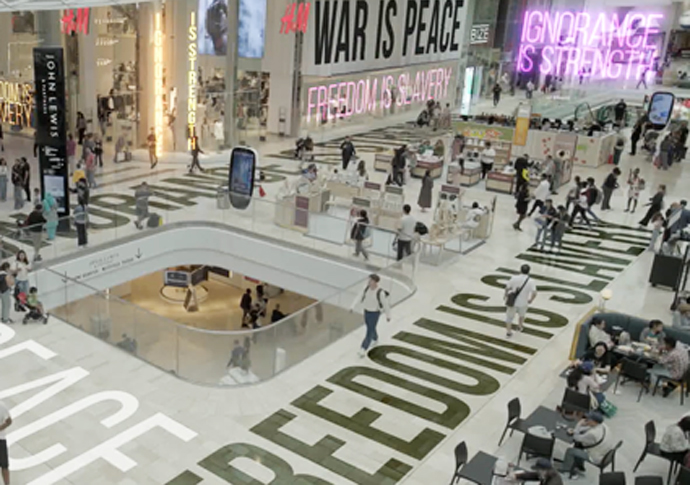
WE have been warned – a world of constant war fought over resources and religions, where our existence as a species is under dire threat but profiteering fossil fuel capitalists say it should be business as usual.
A world where technology advances at pace with little or no regulation – yet we are told trying to build a framework of rules is against human nature.
Film-maker Raoul Peck, whose documentary Orwell 2=2=5 is out this week, isn’t so much a canary in the mine. The truth about where we are today and how we got here has been there in plain sight for decades – obscured by smokescreens created by oppressive interests who have nefarious aims to fulfil. Peck’s new film takes the works of George Orwell, who warned us repeatedly how elites would take over the world for their own ends, and sets them in contemporary times.
Orwell wrote: “The very concept of objective truth is fading out of this world. Totalitarianism demands the continuous alteration of the past and in the long run probably demands a disbelief in the very existence of objective truth.”
As Raoul outlines, Orwell’s political wisdom resonates today. He has used the writer to craft a contemporary narrative and it underlines how prescient the author, who died in 1948, really was.
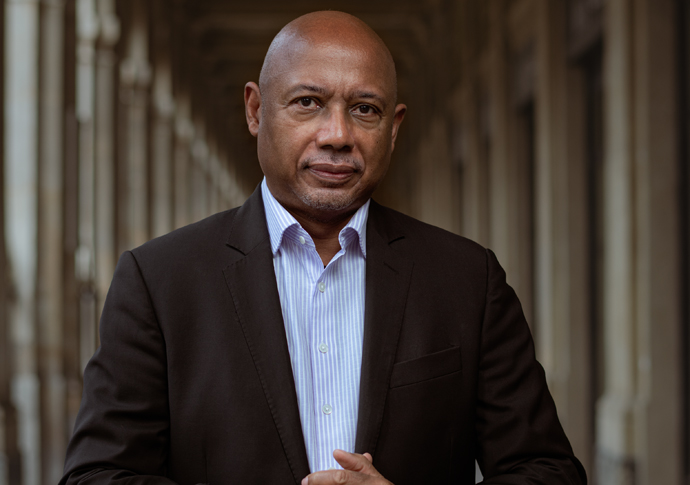
Raoul Peck [Matthew Avignone]
Raoul has experience of a totalitarianism. As a child he fled the Papa Doc Duvalier dictatorship in Haiti. Here, he has delved into Orwell to consider a world where truth is twisted, history rewritten and powerful, sinister forces show how Orwell’s concepts of Big Brother are frighteningly real.
While Orwell’s novels, essays and polemics are well known, for Raoul, taking a deep dive into the archives was revealing.
“I had a misconception of Orwell before I began,” he says. “He was sold to me as a dystopian or sci-fi writer. I didn’t consider him to have an urgent message.”
Universal Films had negotiated access to the Orwell archive. A starting point was to review Orwell’s writing, especially Why I Write, “which is key – an entry into everything Orwell is”.
“He explains the motivations of a writer. When you have that, it allows you to go back to the rest of his work and find what you need to tell the story.”
Narrated by Tufnell Park-based actor Damian Lewis, the film uses Orwell’s words with a backdrop of contemporary events.
“This is a story, not a biography, of a writer in the 1940s, trying to finish his last novel as he struggled with sickness and after a huge world catastrophe where more than 70 million people were killed. It allows me to go everywhere, his journalism, his correspondence and his fiction of course, in Nineteen Eighty-Four and Animal Farm.”
The chilling tale of Winston Smith, living in a Britain renamed Airstrip One and ruled by the all-seeing Big Brother, the endless wars between three competing continents, with history re-written each day and truth is malleable is frightening in its relevance.
“Nineteen Eighty-Four illustrates where we are living now in Europe and the US,” reflects Raoul.
Orwell was born in India – his father worked as a British government opium agent – and was part of the colonial machine. Educated at Eton, he joined the Imperial Service, heading to Burma as a policeman.
“He came back a changed man, with an idea of being a writer, but also a better idea of class, oppression, empire and politics,” reflects Raoul.
Orwell developed as a writer in the 1930s, moving from novels reflecting on his frustrations as a struggling author in Keep The Aspidistra Flying to Down and Out In London and Paris and The Road To Wigan Pier – which saw him leave privilege behind and see first hand poverty during the Depression.
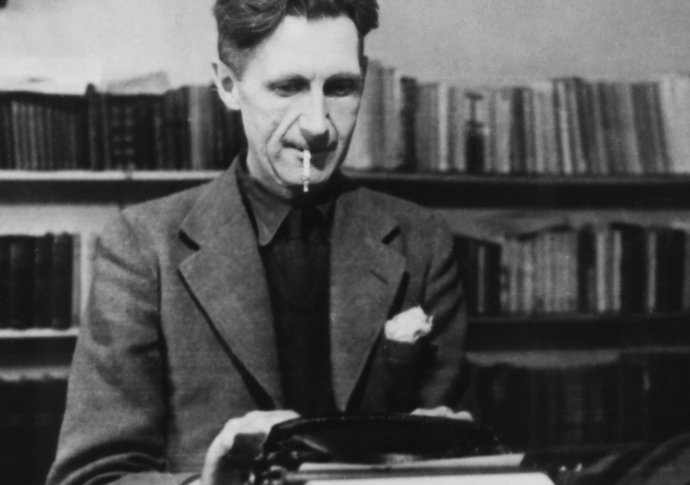
George Orwell [photo courtesy of Neon]
Orwell’s frightening Nineteen Eighty-Four creation, Newspeak, which bends the use of language, is amply illustrated by the footage Raoul has chosen to show how a twisting of words is used today.
The film uses imagery of Secretary of State Colin Powell in 2003 claiming Iraq had weapons of mass destruction – with echoes of the current war against Iran, Russian president Vladimir Putin calling his invasion of Ukraine a “special military operation to stop Nazis”, to the storming of the Capitol by Trump supporters after they were fed lies about who won the Presidential election.
“Orwell talks about how to use words, change their meanings and use them for their opposite purpose. That’s a major instrument in the oppressor’s tool box: the denigration of democracy is the denigration of language,” says Raoul.
“The attack on history and adapting history to goals that you want to impose on people creates what Orwell called Memory Holes. We can see how Trump is using them.”
His campaign is a case in point of how words can be twisted to have no real meaning.
“Make America Great Again – what do they mean?,” asks Raoul. “I am willing to learn. Tell me when it was great – and that’s the strength of such slogans. You put it down as if it were the truth. It is 2+2=5.
“We have seen it through Boris Johnson and we are seeing it through Nigel Farage. It has been proven they have been lying to the British people and we continue to let them carry on. Orwell sought truth – whether it was good or bad for him, it was more important for him to say 2+2=4 – that’s why some on the left called him a traitor.”
The road to a Trumpian world has been a long time coming, he adds. It is not new – it has been a slow deconstruction. “Tony Blair and Bill Clinton from the centre left let us believe they were good social democrats but they were making it sweeter, so we would swallow the poison further down, after what Thatcher and Reagan had done.
“Orwell saw through it. I was able to illustrate these points using just Orwell’s words with images of today.
“He saw it, and said it.”
• Orwell: 2+2=5 is in UK cinemas from March 27
