My romance with Leonard Cohen
He would wake me up each morning with the strings of his guitar and a new stanza, Kentish Town writer recalls
Thursday, 17th November 2016 — By Céline La Frenière
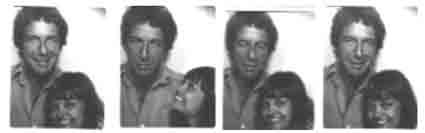
Céline La Frenière with Leonard Cohen
LEONARD Cohen died on November 7 in Los Angeles at the age of 82.
Leonard, and his poems and songs touched a wide variety of people throughout the world. He did that for me too, and more. I first met him in the late 1970s during a particularly troubling time, romantically. I had of course heard of Cohen, a fellow Canadian, but out of the blue I started receiving a strange and persistent message: “Get to know Leonard Cohen’s work.”
I was living in Los Angeles, and finding Cohen’s albums and books was not straightforward. But I persevered not knowing why I was instructed to do as I did. Soon, however, all would be revealed.
Some two months later, I walked into an English-style pub across from the Château Marmont in Sunset Boulevard and encountered Leonard. It felt as though I was being reunited with an old friend. He sensed that too. We were meant to meet at that particular time and place and apparently soothe each other’s broken hearts. His partner Susan Elrod had left him, much to his regret, while my lover Howard Sackler and I had parted company, also much to my chagrin. Leonard immediately related to my French Canadian background and went out of his way to befriend me. He even stopped smoking on my account… at least while the romance lasted.

Leonard Cohen. Photo: Takahiro Kyono
Initially, Leonard brought laughter, which was healing. I still remember his witty approach to romancing.
He inspired the unlikely character of Lee Jaccson in my novel Glaston Town. A black rebel with an IQ of 152, Lee took on Leonard’s persona, especially when dealing with women.
Leonard had a reputation as a ladies man, which he tried to dispel by offering me a copy of his new book Death of a Ladies Man. Landing a job to write City on Fire, a feature film, which was to be shot in Montreal, Leonard and I were brought closer to each other. Until then, by necessity, the relationship had been carried out via letters from me to him and phone calls from him to me.
He longed to receive my letters, which I admit flattered me. He even wrote a song for me, not a popular one, but nevertheless a beautiful one. It didn’t speak of great passion as he often wrote about other women. His was a more subdued, almost spiritual message.
While visiting him in his house overlooking Le Carré Vallières, he would wake me up each morning with the strings of his guitar and a new stanza: “Why do you stand by the window abandoned to beauty and pride. The thorn of the night in your bosom…”
It was hardly the stuff of great desire, but the words fitted my melancholy mood. And yes, I often stood at the window taking in Montreal in the snow, the Montreal that had been abruptly taken away from me at the age of 16, when my family moved westward. It did not worry me that I was not the inspiration for a more passionate embrace.
When Leonard visited me in Los Angeles several years later and presented me with a cassette of his new album, it contained the song. When he played it for me, I was moved to tears. He was offering respect and friendship, which was what was needed at the time. Rest in peace, dear friend. You have not been forgotten.
• Actress and writer Céline La Frenière’s latest novel, Glaston Town, is based on Kentish Town where she lives.
