‘Joan was lively, adventurous, feisty and rebellious’
Artist Joan Hodes was a mistress of media – be it oils, etchings, watercolours or print-making. As an exhibition of her work opens, Dan Carrier considers her remarkable career
Friday, 30th January — By Dan Carrier
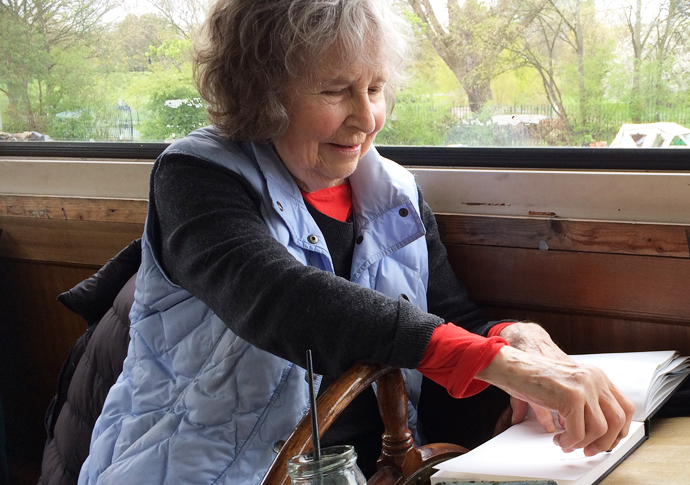
Joan Hodes at work
THE work of artist Joan Hodes spanned eight decades. Today her paintings and drawings are recognised as the work of a fascinating mid-20th century artist.
A new exhibition at the Highgate Gallery reveals a range of media – and shows the artist’s journey from sketches through to oil and watercolour canvases.
And Joan moved through media, her work including etchings and print-making. With a growing interest in her work, the show includes pieces for sale – with the proceeds funding a new arts prize at the college where her career began, the celebrated Slade School of Art.
Joan, whose work can be found in collections at the British Museum, the V&A and the Royal Free Hospital, and whose archives are held at Women’s Art Library, Goldsmiths and University of London, reflects a hope artistic movements develop and evolve.
She was born in Hampstead in 1925. Her father was an antique dealer.
“She did not come from an artistic family, “ recalls her daughter, Charlotte. “But they did have friends in the art world who she met.”
And her immersion in art would span 80 years – from winning a drawing competition at school to studying at the Slade, through to painting into her 90s.
Joan studied at St Paul’s school and in 1940, as the Blitz hit London, moved to Wales and then New York, where she stayed for three years.
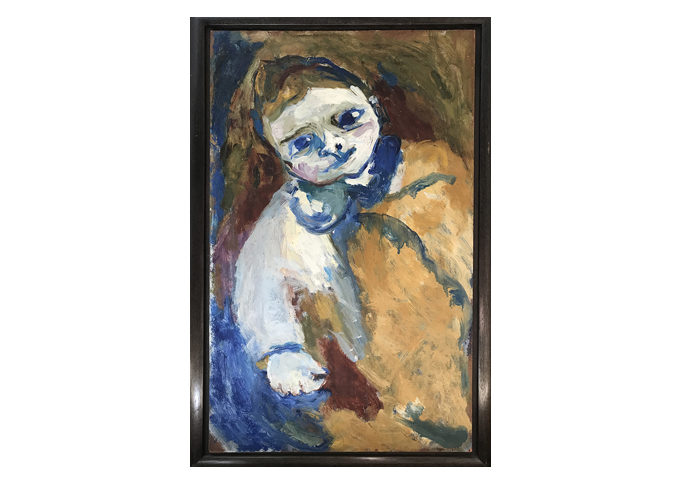
Charlotte, 1959
The family had an antiques shop in Llandudno, north Wales, and she had childhood memories of the dramatic Welsh mountains. They would later inspire her art.
“That was where she really developed a love of mountains and that is apparent through her art,” adds Charlotte.
“Her subject matter was a direct response to the genre of landscape, the figure and still life.
“She wasn’t an imaginative painter in that respect, everything was ‘within her grasp’. She loved paint and also carried that through into her love of ink when it came to her working in print – monoprint and aquatint in etching, linocut lent itself to working with strong colour.
“She worked within the conventions of oils, watercolour and pastel but all this was subordinate to an investigation of the motif. In terms of landscape, she travelled a lot with her husband and as a family; to Wales, Ireland, Scotland and Europe especially, as well as further afield – China and Egypt.”
Despite being so far from home, New York was a positive experience.
“She loved New York and wanted to stay to study at art school, but her father wanted home,” adds Charlotte. “Her father was quite strict and Joan was lively, adventurous, feisty and rebellious.”
She returned in 1943 and worked as an animator.
Despite her father’s wishes that she follow a more formal route into work for women at the time, Joan earned a place at the Slade School of Art in 1945 and studied there for three years.
During this time she honed her techniques. The Slade had students draw from plaster-cast models of figures from Greek and Roman antiquity. She also enjoyed life drawing classes where she met and befriended a male model by the name of Quentin Crisp. Some of her drawings of the celebrated raconteur would later be added to the UCL’s museum collection.
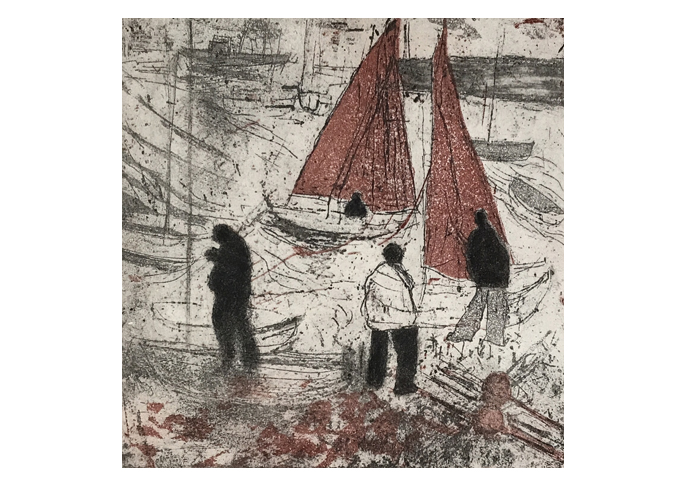
The Red Sail
“The Slade was groundbreaking in terms of offering an art education to both men and women,” adds Charlotte.
It also gave Joan a technical grounding.
“The Slade’s founders were forward-thinking, but training was formal and rigid,” says Charlotte.
After graduating, Joan spent a year in Paris. She wanted to experience the Left Bank’s artistic world and enjoy some travel away from the upper-middle-class atmosphere of home.
She would find work in a picture restorer’s studio and studied at two prestigious art academies. Post-war Paris was full of migrants after the upheaval of war. She met people from across the continent and became enmeshed in Parisian bohemia.
On her return to London, she would meet a key figure in mid-century European art – Oskar Kokoschka. The Austrian emigre was living in London and Joan recalled their first introduction at a party. Kokoschka had a small group of pupils and Joan was brought into his inner circle.
“She loved working with him – she enjoyed his directness as a teacher,” says Charlotte.
“Much was directly opposite to what she had been taught by the Slade. Kokoschka was interested in how an artist responds to what they see. The Slade was about classical drawing, Kokoschka was about emotion and feeling
“Her early paintings could be quite restrained but after Kokoschka she channeled her artistic energy.”
She was with Kokoschka’s studio for five years and it was during her time there that she met Charles Hodes. The pair married in 1951 and moved to Elstree, Hertfordshire, where she settled into the busy role as the wife of a country GP and the mother to three children.
A coal shed in the back garden was converted into a studio and despite the demands made on her via her husband’s GP surgery and motherhood, she always found time to paint and draw.
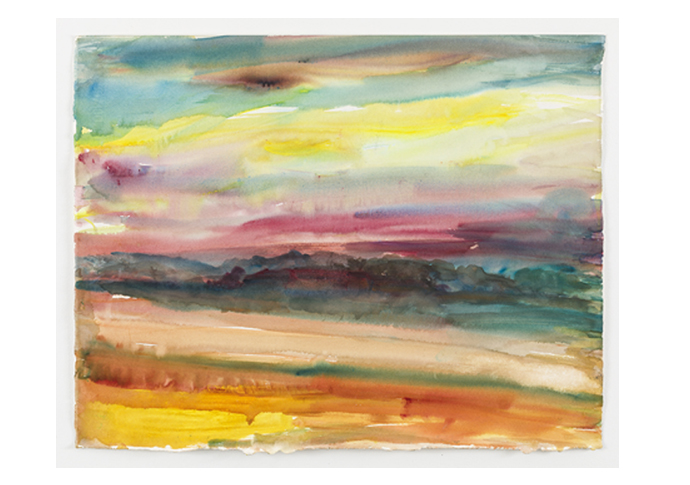
Evening View from the Studio
Her first solo show came in 1962 at the Everyman in Hampstead and in the 1970s she was introduced to the Women’s International Art Club by her friend Christiane Kubrick, who had married the film director, Stanley Kubrick.
“She was a modest person but her work was coveted by key galleries,” recalls Charlotte.
Joan moved back to London in the early 1980s, living first in Murray Mews and then Keats Grove, Hampstead.
Her Keats Grove home had an art studio at its centre – a physical expression of how important art was to her life.
“She was very cultured – a voracious reader, and was always aware of what was happening in terms of theatre, opera and exhibitions,” adds Charlotte.
“The house was full of cultural artifacts from across the world, paintings, rugs and stripped pine furniture which was quite radical to have at the time. The Hampstead cultural intelligentsia was not part of her experience growing up – but her friendship group as an adult was increasingly linked to it and was somewhat the reason that she moved in the early 80s from provincial Hertfordshire to Camden and subsequently Hampstead.”
She would join arts group Camden Printmakers, based in Holmes Road, Kentish Town, creating linocuts and etchings. The group was also involved in the “Art for Hospitals” movement at the Royal Free Hospital and University College Hospital and she continued to draw right up to her passing aged 96.
“She was always keen on drawing – and that is why we want to create a drawing prize at the Slade,” adds Charlotte.
“She was always using sketchbooks and drawing directly from landscapes.
“Her work was about direct response to what she had seen.”
• The Joan Hodes exhibition is at the Highgate Gallery, 11 South Grove, N6 6BS, from February 6-19. See https://hlsi.org.uk/highgate-gallery/
