‘It was not just a place to wash your clothes but a chance to meet up, have a chat and unburden your problems’
The old washhouse in Kentish Town is at the centre of Joy Fraser’s debut novel. Angela Cobbinah talked to her
Thursday, 17th September — By Angela Cobbinah

Author Joy Fraser [Angela Cobbinah]
IT was the talk of the neighbourhood after police were called following a fracas between warring black and white women at the Kentish Town washhouse over a single towel occupying a whole dryer.
The incident of some 50 years ago, which led to three unrepentant black women being bound over to keep the peace, was recounted with great humour by Joy Fraser during a reading of her debut novel looking back at life for early Caribbean migrants in a small corner of Camden.
Described as a love letter to the community she grew up in, The Susu Keeper tells the story of the interlocking lives of six women across three generations, originating from Grenada but rooted in the streets of Queen’s Crescent.
Part of Kentish Town swimming baths in Prince of Wales Road and boasting a creche and a café, the washhouse was considered a haven – despite the fights that frequently broke out. “It was not just a place to wash and iron your clothes but a chance to meet up, have a chat and unburden your problems. But sometimes you just had to stand your ground,” Joy told a gathering of some 70 people chaired by Nicole-Rachelle Moore, the British Library’s Curator for Caribbean Collections, last Wednesday.
“I would help my mother with her weekly laundry there every Saturday and it is one of my fondest memories.”
Three years ago The Susu Keeper was nominated for the Discoveries Prize, an award for an unpublished novel written by a woman, and was one of 16 to reach the longlist out of 3,000 entrants. This won her a place on the development programme run by leading literary agents Curtis Brown, one of the prize’s main sponsors, and she is now in talks with a publisher.
As a result of local interest, Joy gave an advance reading at the event, which was hosted by Camden Black British History at the Civil Action Lab in Prince of Wales Road, coincidentally just a brief walk away from the famous washhouse.
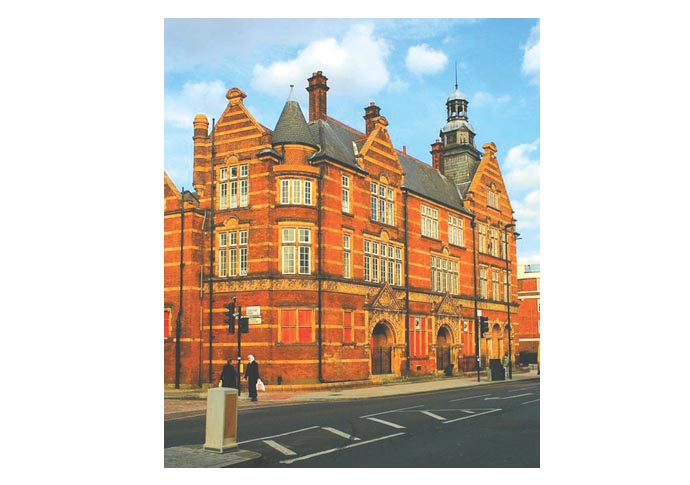
Public baths building in Prince of Wales Road [Julian Osley]
The susu keeper of the title is Pearline, a respected elder who binds the community together. Susu is an informal savings scheme carried over from West Africa to the Caribbean that came into its own in the UK back in the day, enabling migrants to save enough money to make big purchases like a house at a time when banks refused to give black people loans.
“In those days susu wasn’t just a savings scheme, it created a community,” said Joy, a retired teacher. “It was totally based on trust and as such the susu keeper was a highly respected member of the community.
“Apart from being a banker, she was a relationship counsellor, directory and priest. She would know all your secrets but would never give them up to anyone.”
Pearline is based on a real person, the legendary “Aunt Faith”, aka Ann Faithlyn Williams, who kept susu from her home in Herbert Street for some 40 years, known for having “a bad mouth” but possessing a heart of gold.
Joy arrived from Grenada as a 10 year old in the 1960s to join her parents, who had settled in Marsden Street a few years earlier. The culture shock she experienced was enormous but it was people like Aunt Faith who served as a healing balm.
“I would have to take my mother’s susu payment to Aunt Faith’s house every Saturday and it was as if I was back in Grenada. People would be cussing bad words, Mighty Sparrow would be playing and there’d be a pot of food cooking if anyone wanted to eat,” she laughed. “It was a difficult time but it was like living in a village where you knew everyone and everyone had your back.”
It was memories like these that inspired her to put pen to paper: “I had the idea for it about 30 years ago but it never got further than writing little notes. When I got down to writing the actual book I couldn’t turn back. I would start at 9pm and when I looked at the clock it would be 2am. It was an amazing experience.”
She added: “My book is not about the Windrush generation or some other made up narrative used to describe us. I wanted to write about something I knew about, to write something that was true, and to bear witness to the fact that people from the Caribbean and Africa were part of this area, not just for the history books but for my children and grandchildren.”
Racism is present in the novel but only as faint background noise: “That is how our parents saw it – they had to get on with their lives and did not get up in the morning crying about racism.”
Among those in the audience were Aunt Faith’s daughter, Sharon, and several elders, remnants of a community that has passed away or passed on, like Joy herself who now lives in Hampstead Garden Suburb. Nostalgia lay heavy in the air. In the reading, 74-year-old Pearline takes a walk around her manor, noting how important institutions like the washhouse and North London Poly have been turned into fancy apartments and Victorian terraces knocked down to make way for “unsightly blocks of flats”.
So much had changed and it wasn’t always for the better. Susu still goes on, we’re told – only now it is done online.
