‘I was worried about cultural appropriation, but people have the right to write about whatever they want’
Crime writer Paul Waters tells Dan Carrier how the setting for his latest book series reflects his love of India
Thursday, 9th April — By Dan Carrier
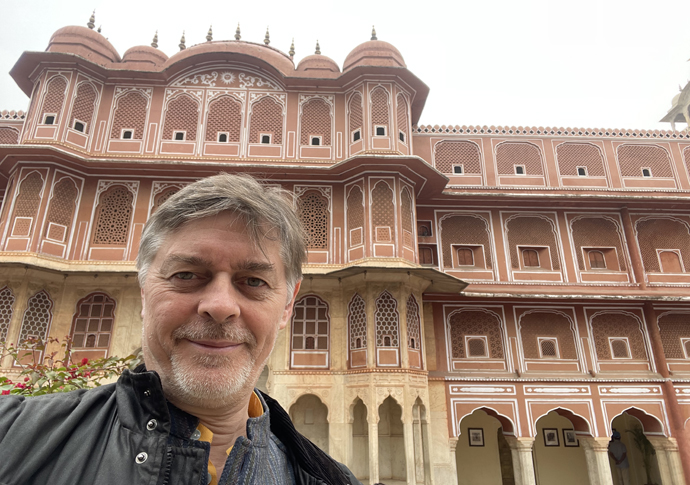
Paul Waters outside the hotel that inspired his book
SISTER Agatha Murphy of the Sisters of the Amazing Grace convent, Delhi, has an habit she wants to keep secret.
She can’t resist a cigarette – and to ensure she doesn’t embarrass herself or her order, she seeks out quiet spots in the bustle of Delhi to sneak a crafty smoke.
From this simple starting premise comes a rip-roaring whodunnit adventure from crime writer and journalist Paul Waters.
Sister Agatha meets hotel owner Avtar Mehta as they both salve their nicotine need – and this chance encounter leads to a brazen street robbery of a Delhi police officer, a dead body in one of Avtar’s rooms, a missing pilgrim and a mystery for the pair to solve.
Murder in Moonlit Square is the first novel in a series featuring the pair, and draws on Paul’s love of the Indian city.
Paul, who teaches broadcast journalism at the City University in Clerkenwell, is a regular visitor to India, where his wife is from.
“I met my wife Aneysha and through her I fell in love with India,” he reflects. “She grew up in Delhi and she introduced me to the city, to Punjab and the north, the mountains.
“Some people visiting can find it tough going – it is very busy and loud, with no personal space – but it is just fantastic.
“I had been going to Delhi and spending a lot of time there – my wife’s family are there and she suggested I set a book in Delhi. Now – an author can write about whatever they want, wherever their imagination takes them. I had spoken to writers in Zimbabwe, for example, and they didn’t feel they had to only write about one country. I realised I could set a book wherever I wanted. Writers in India do the same thing.”
He drew on his family’s background to create his lead character, an streetwise nun – and in doing so discovered a marvellous coincidence.
“I had this Aunt Agatha, who was a nun in India,” he says. “She was from a farming background – a strong woman.
“In the 1950s, she travelled to India and taught across the country. She became the principal of the Jesus and Mary College in Delhi. She was very tall and forceful. She would walk around accompanied by a big dog. I have seen photographs of her and heard testimonies from other nuns and her students.”
Incredibly, his mother-in-law and her sisters had been educated by his Aunt Agatha, who had become something of a public figure in Delhi.
He has also drawn on other people he has met through his travels.
“The character of Avtar is based on a hotelier I know in Delhi,” he adds.
“He would tell me all about the challenges of running a business. He was always very honest about it and a good person to get insights from.”
A story Paul heard from his hotelier friend was the genesis of the series – the second is out later this year and the third currently being written.
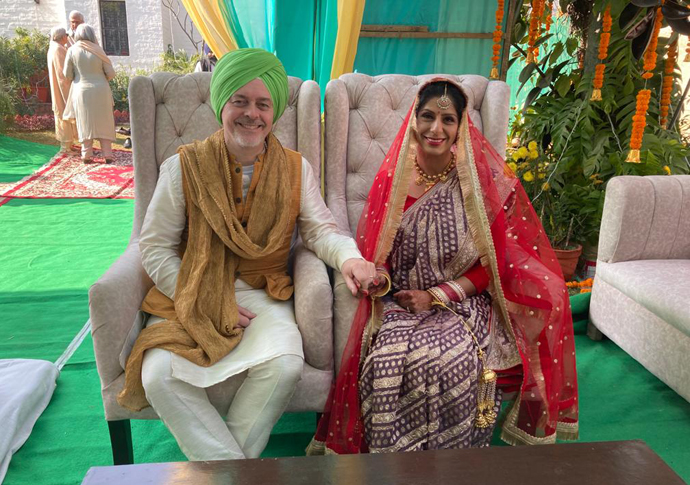
Paul and Aneysha’s wedding photo
“My friend was telling me one day how they had lots of pilgrims from Pakistan – and then one day, one of them disappeared. The police came down heavy on him – somebody needed to be blamed, and that got me thinking.”
And the area of Delhi where he has set the book is a character in its own right – an enthralling district built in the 17th century known as Chandni Chowk, or Moonlit Square.
“Everyone is crowded in, there are smells, noise, bustle and crowds, crowds and more crowds,” he says. “India is increasingly segregated but Chandni Chowk is mixed – mosques, temples, churches. It is a lovely place, with places of tranquility among the hustle. And it is a great place for stories.
“Much of it is falling into dereliction, while some buildings are being rescued and restored – and in the area is a hotel, like the one I have written about.”
Realism matters, he says. “If I want Indian readers to pick it up and not ridicule it, you have to be realistic: if I said this part of Delhi was perfect, no one would take the book seriously. I wanted to be able to reflect the tensions in the city.”
Paul’s book has become a bestseller in India – and having an international audience is another challenge for a writer, he says.
“You cannot assume the reader has a certain level of knowledge or an attitude – and it is a good thing to be reminded,” he explains. “How do you gauge what you write? If you put too much detail in to explain an Irish thing to an Irish reader, they’d soon get bored.
“The same obviously applies when writing about Delhi for an Indian audience. It has to work for both an Indian and Irish readership. You also have to be mindful of people’s assumptions.”
Paul has had a career in both print and broadcast journalism – jobs include a staffer for Radio 4, 5 Live and the World Service – and it has taken him all over the world, giving him an observer’s seat to cultures.
“I got into journalism as I always wanted to know what was really going on,” he says. “Growing up in Belfast, this had extra importance – to know your surroundings, know if somewhere was safe or not, know where to avoid.”
Covering news around the world has given him both an ear for a story and the ability to sit back, blend in and take note.
“I want to set the books in places I have been,” he says. “I don’t want them to just pop up somewhere I haven’t experienced myself. That is important in terms of research and getting the atmosphere right. I sit around, soak it up, take it all in. I am an observer.”
With Chandni Chowk an enthralling setting for a murder plot, Paul has the stage for Agatha and Avatar to get entangled in a mystery.
“Someone said to me – ‘you wouldn’t have an elderly nun with no sporting experience coaching a hockey team, would you?’ Perhaps not, but also perhaps you wouldn’t have a nun outwitting the Indian Secret Service and police forces. It is unusual people doing unusual things that make stories worth telling.”
The market for murder mysteries in India is vast.
“I have written it for three audiences – British, Irish and Indian readers,” he reflects. “And people in India really like it. I was worried about cultural appropriation, but people have the right to write about whatever they want. I do not just have to write about Belfast.”
India and the UK’s shared history has influenced the popularity of British authors.
“They love Agatha Christie, PG Wodehouse and Jeffrey Archer,” he says. “Wodehouse is more popular in India than anywhere else in the world. Indian people are great readers. They are a very literary society, and their book festivals are absolutely rammed.
“And it is not a question of age. Lots of younger people are big readers – and there is a huge market in India for crime fiction.”
• Murder in Moonlit Square. By Paul Waters. No Exit Books, £9.99
