How ‘formidable rebellions and conspiracies’ helped to end slavery
A new book puts to bed the myth that it was a benevolent British state that put an end to slavery. Angela Cobbinah reports
Friday, 22nd May — By Angela Cobbinah
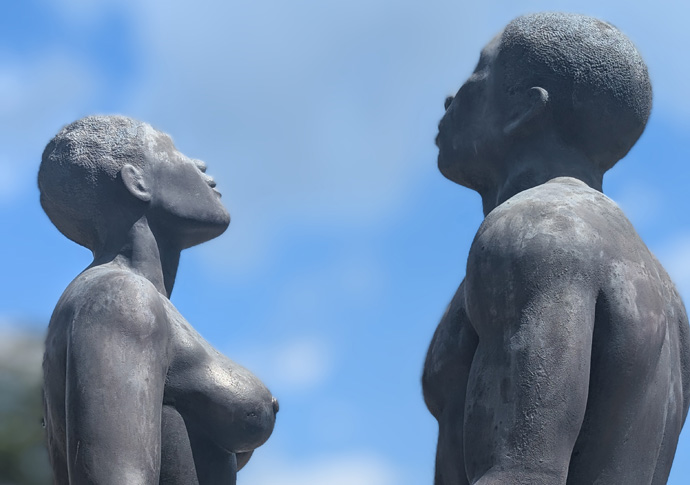
The Redemption Song statue in Kingston’s Emancipation Park [Angela Cobbinah]
THE man and the woman gaze expectantly towards the skies in the form of a three-metre bronze sculpture rising dramatically out of a domed water fountain.
Erected at the entrance of Emancipation Park in uptown Kingston, Redemption Song represents a pivotal moment in Jamaica’s history when slavery was abolished in 1838, the water symbolically washing away the pains of the past as freedom beckons.
Along the park’s central path leading up to the statue is a parade of bronze busts in honour of those who advanced emancipation. They include Sam Sharpe, a Baptist preacher who in 1831 led 60,000 men and women in what has become known as the Christmas Rebellion, which started as a refusal to begin the sugar harvest. Although the insurrection was brutally suppressed and Sharpe hanged, it hastened the end of slavery.
Another bust is that of Nanny of the Maroons, the legendary female warrior who spearheaded a long-running but successful armed revolt of runaway slaves against the British at the beginning of the 18th century.
All over the Caribbean, there are similar public monuments commemorating leaders like Cuffy, who headed an almost year-long war in Guyana in 1763, and Bussa, whose Barbados rebellion spread like wildfire in 1816 and was only crushed by a massive military mobilisation on the part of planters and British troops.
These and many more feature in Rebellion in the British West Indies, a new publication telling the story of how enslaved Africans continually fought for their freedom.
Penned by Asher and Martin Hoyles, the book is a corrective to the view that it was the enlightened benevolence of the British state that brought about the abolition of slavery.
Quoting Jamaican historian Richard Hart, they write: “Revelling in Britain’s liberal image earned by the abolition of the slave trade and slavery, most historians have paid little or no attention to the frequent and formidable rebellions and conspiracies of enslaved people, or the extent to which these events influenced the British decision.”
It is the latest title the Gospel Oak-based couple have published over the past two decades on aspects of black history and underlines how uprisings took place amid a regime of physical and psychological cruelty that made the plantation owners fabulously rich and bankrolled Britain’s industrial revolution.
Richard Pennant MP is a case in point. After inheriting a plantation in Jamaica in the 17th century, he invested his ill-gotten wealth in a slate mine in Penryhn, Wales, which by the 1850s had become the biggest in the world.
The most successful slave revolt in the Caribbean took place in Saint-Domingue, where the defeat of the French, British and Spanish armies led to the establishment of the independent state of Haiti in 1804, a seemingly impossible feat that horrified the plantocracy across the Americas.
For their study, though, the Hoyles focus on the British settler islands of Barbados, Jamaica, Guyana, Grenada and St Kitts & Nevis, with potted histories of each and an examination of the major plantation owners as well as the legacy of slavery and empire.
Resistance didn’t just mean taking up arms, they point out. Runaways hid in the bush to form militant Maroon communities in islands like Jamaica and Grenada where large tracts of mountainous forests remained undisturbed by economic encroachment, while other slaves resorted to murdering or poisoning planters and setting fire to plantations.
As a further way of disrupting the slave economy, women practised prolonged lactation to suppress fertility or used herbs to induce abortions and even committed infanticide. It was an existential struggle.
The book delivers some unpalatable facts: How enslaved people themselves often betrayed insurgents; how the 30,000-strong Tacky’s Rebellion of 1760, one of 22 revolts to take place in Jamaica, was defeated with the support of the Maroons, who’d made a deal with the British to capture rebels in return for leaving them alone in the hills; and how the 15-month uprising in Grenada led by Julien Fédon at the end of the 18th century was finally subdued with the help of the Corps of Loyal Black Rangers, made up of 300 slaves who tracked the refuseniks down.
Generously illustrated and featuring poems by Asher Hoyles, a performance poet who worked with the Clean Break Theatre Company in Kentish Town, this is an ideal introduction to a subject that continues to cast its malign shadow over society. Interestingly, the book concludes with an interview with David Lascelles, a scion of the Harewood family who went from modest Yorkshire farmers to wealthy aristocrats as a result of their plantation loot. A second cousin of King Charles, Lascelles has lent his voice to the campaign for reparations via a group representing the descendants of families who profited from British slavery.
• Rebellion in the British West Indies. By Asher and Martin Hoyles, Hansib, £16.99
