Hockney and me – the naked truth
Xandra Bingley recalls her friend, the celebrated artist David Hockney, who died last week
Thursday, 18th June — By Xandra Bingley
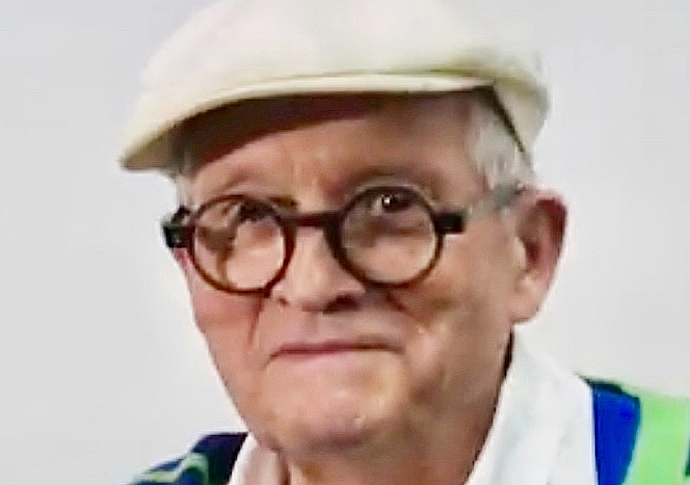
David Hockney in 2017 [Connaissance des Arts]
I KNEW David Hockney in the 1960s, when his extraordinary wonderful early drawings started to be on show. I loved his bleached blond hair, his different-coloured socks and his huge white-rim circular specs. I wanted to be him. To look like him. He changed what I wore then to bright colours that I’ve worn ever since. And his art changed the ways I saw the world.
I overheard Hockney and Kitaj, his artist friend, grumbling about how figurative drawing had become so unfashionable in England you had to go to Paris in the 1970s to find a good figurative drawing class.
He said: “The teaching of drawing is the teaching of looking, that’s what it is about, to teach you to look hard at things. The most complicated and interesting thing we look at is another human being. That’s the hardest thing to draw.”
So I asked them to do an interview about figurative drawing. We three sat in my kitchen by Primrose Hill and then I took the interview to Kitaj’s studio to see if they were happy with it and I asked them for a photo of the two of them together. They had one but they kept saying: “No, we can’t show her that photo”. “No, no, not that one.” The photo was of them standing side by side naked… except Kitaj had his socks on.”
I said: “We’ll put it on the cover,” though I only had a very lowly job at the New Review literary magazine and was in no position to decide a cover.
The photo did go on the cover.
The day it was on sale my telephone rang in my tiny office up above a strip club in Soho and a man with a Yorkshire voice said: “This is the Mayor of Bradford and I think your magazine is disgusting and it should be banned.” He ranted on and on till I said nervously “David?” and he said “Oh, I thought you wouldn’t remember my brother is the Mayor of Bradford” and he laughed uproariously.
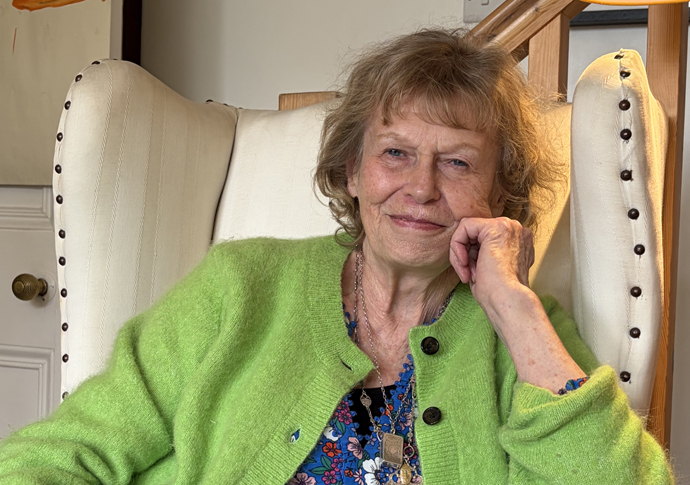
Xandra Bingley
That issue sold more copies than any other New Review issue. It’s a great photo!
Hockney was a phenomenal worker. His great – in every sense – painting Bigger Trees At Warter is 40ft by15ft and is 50 canvases joined together. He said: “I’d sit there for three hours at a time just looking” and he prepared for the painting by doing many drawings. The painting was essentially done in one breathless three-week sprint. “Once I started, I had to carry on until it was finished. The deadline was not the Royal Academy exhibition, it was the arrival of spring, which changes things”. Hockney was both exhilarated and exhausted by the end.
He faxed me a big black and white picture of his breakfast table in California. Page after page of black lines and no words came out of my fax machine. I was very busy running a literary agency from home. My daughter, Charlotte, came in from St Paul’s Primary School and I said to her: “Can you look at this, I’ve no idea what it is.” She laid the pages out on the floor next door in the sitting room and called out: ‘Mum, it’s a picture.’ We were so happy. It hangs in my kitchen. I’m very proud to have it.
He said “Van Gogh could draw anything and make it enthralling… a rundown bathroom or a frayed carpet.” And talking about painting still life pictures, he said: “I get very excited because I look at something and say there are a thousand things here I can see. Which will I choose? It’s fantastic. These simple little things are unbelievably rich. A lot of people have forgotten that. But you can remind them, make it exciting.”
How to paint time interested him enormously. His photo collages came from him looking at Chinese scroll paintings, where the viewer walks along and travels through time like the artist did while painting.
Hockney said: “It takes a long time to paint a picture, the time in the top corner is different to the time in the bottom corner.”
It is sad for us who loved the so many ways David Hockney showed us how to celebrate life that his time in this world is over. In his lovely 80-metre frieze painting at the Serpentine Gallery he takes us through the four seasons he saw outside his house in Normandy.
Maybe now he is painting somewhere in another time. He did say “For all I know, there might be another adventure.” I hope so.
• Xandra Bingley is an author. Her latest collection of essays, Ways Of Telling, with an introduction by Margaret Atwood, is published by Notting Hill Editions
