Frank's farewell: How MP told his Labour Party colleagues of his decision to retire
Thursday, 24th July 2014
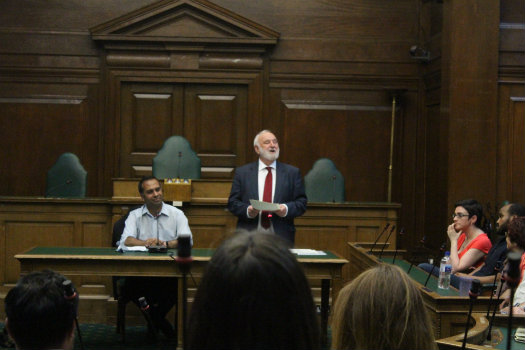
FOR a man known to love a joke and a naughty anecdote, Frank Dobson kept things simple when the moment came.
He rose to his feet inside the council chamber on Tuesday night, the room filled with political colleagues who over three decades had become friends, and said: “No surprises, I’ve decided not to stand again at the next general election.”
He was right. He was hardly delivering breaking news.
But it was still a landmark moment for many of the Labour Party members gathered in the room. Some of them are too young to remember anybody else and have happily grown to adulthood with Mr Dobson as their MP. Others, older, have been lulled into contentment by his continuous service over 35 years.
“Since the Camden New Journal started carrying suggestions that I was considering retiring, I have been both flattered and surprised by the number of people who have stopped me in the street, on the bus, at meetings to say they hope it’s not true,” said Mr Dobson. “But as my wife Janet has pointed out, this must be the time to go rather than waiting until people stop me to say it’s time I went.”
He added: “I have always tried to be straight with people about where I stand on any issues while usually trying to respect the opinions of the people with a different point of view. For me sticking up for local people is the main job of an MP.”
Mr Dobson was sanguine about his likely ability to represent the Holborn and St Pancras constituency with the same gusto after the next general election when he will have passed his 75th birthday – another term would take him to 80. But there were activists clearly churned up by a milestone moment, and not relishing the selection bunfight his retirement will inevitably trigger.
However bruising that contest may be – indeed it has already kicked off behind the scenes– what was clear from this special meeting is that Mr Dobson has earned a rare affection from those who have campaigned alongside him in the south of Camden.
There is a certain fandom to it all. Samata Khatoon, now a councillor in Somers Town, who was aged one when Mr Dobson first entered the Commons, told the room how she had told friends for weeks after being hugged by the MP on their first meeting.
A migrant to the borough from the Yorkshire of his childhood, his skill has been to combine a lively Commons career – he is known well beyond the constituency boundaries and for that matter London – with an omnipresent link to the Camden community.
He was, after all, delivering this retirement speech in the same chamber where he led the council in the 1970s, the role he held before replacing Lena Jeger MP in 1979 in a selection race won from John Mills and Chris Mullin.
He said in his speech that Labour needed to get back in government next year and show it could convince people that it could have a positive impact, recalling an anecdote he has well rehearsed over the years: “We need to remember the timeless lesson of Lena Jeger’s canvassing in Crowndale Road in 1953. She goes to the top of a block and when Mrs Smith comes to the door, Lena launches into the great left-wing issue of the day – German rearmament and its threat to international peace. Lena paused for breath and the woman asks: ‘Can you stop ’em pissing in the lift?’ Lena replies: ‘No, I don't think I can’, to which Mrs Smith says: ‘Well, if you can't stop them pissing in our lift, how can you expect me to believe you can stop the Germans rearming.’ ”
Twice the room, including his wife Janet, rose to give a standing ovation.
Then there was an insatiable clamour inside the room to heap praise on him, perhaps reaching its pinnacle with former director of public prosecutions Sir Keir Starmer’s assessment that Mr Dobson was “one of the greatest parliament-arians of our time”.
One by one, admirers took turns, often in more parochial terms, to describe how he had inspired them, until he was so drenched in adulation that he looked quite bashful about it all, looking down at his hands and finding an imaginary itch to scratch as the tributes flowed. It was as if he did not know where to fix his eyes.
He himself had tried to condense a 35-year political career into those 20 minutes but it was a bit of a whistlestop dash, thanking voters who had given him the privilege to take on Margaret Thatcher, improve the NHS and meet Nelson Mandela in Camden Town, years after campaigning for his release.
He glided over the moment to forget, the run for the London mayoralty in 2000, for which he had left his job at the Department of Health. This, he conceded, was “foolish”, although most in the room understood how he had been bounced into the assignment.
Returning to the backbenches, he admitted that he found the need to rebel against Labour Party leadership, notably the Iraq War. It was Mr Dobson who sat next to Robin Cook during the foreign secretary’s famous resignation speech.
Yet, while Tony Blair found only unpleasant things to say about Mr Dobson in his autobiography, he did not reply in kind in this speech. Instead, he said the government at that time deserved credit at least for forging the Good Friday Agreement in Northern Ireland.
“It’s been an honour and a privilege to be chosen by you all and through you to be re-elected,” he added. “What more could a democrat want?”
And then came all of those thank-yous back at him.
Raj Chada, chairman of the Holborn and St Pancras branch, told him: “It was to the pride of the local party that you were one of the leading opponents of the Iraq War, for which we are eternally grateful – that you stood with us.
“My personal memory is your accounts of the apartheid campaigns you were involved in which remind us to fight even when the odds seem so overwhelming. It will always send shivers down my spine.”
Tom Copley, the London Assembly member, said: “You sometimes get good ministers. You sometimes get good constituency MPs. But you rarely get both, like we have had in Frank.”
Others praised him for his campaigns on council housing and for speaking up recently for Palestinian families in Gaza.
Three times mayor Barbara Hughes, another former senior Camden councillor, admitted she felt “a bit teary” at the occasion as she said: “We felt proud as you stood up for us in Parliament on the issues that were worrying us all.”
Bernard Miller, son of former council leader Millie Miller, said: “My mother said to me, watching you as leader of the council: ‘He’s good, watch him, he’s going a long way.’ Now, she’s not here to say that she’s pleased with you, because she died in 1977, but I’ve watched since and have become very, very disillusioned over the years with some of the leaders of the Labour Party and in particular with some of the policies they have adopted. But I haven’t become disillusioned with you.”
Sue Vincent, a councillor in Holborn, piled further praise on Mr Dobson before adding that his loyal assistant at the Commons, Barbara Collins, should also get a tribute for her work. She then squeezed in a request for his successor to be chosen in a “comradely” fashion, but for someone with a similar “maverick” touch in the Commons.
Outside the meeting, the love-in continued with Conservative candidate in Holborn and St Pancras Will Blair and Green Party leader Natalie Bennett, who will also run here next year, sending out respectful press statements acknowledging his service and popularity.
And Labour Party leader Ed Miliband, one of Mr Dobson’s constituents in Dartmouth Park, said: “Frank is one of Parliament’s finest and he will be sorely missed. On behalf of the Labour Party I would like to thank him for his dedication, strong sense of social justice and his years of service to our party and our country.”
By the end, Mr Dobson appeared quite relieved that it was all over, bearing an expression of a man glad to have got through his farewell without being made to sing My Way.
If it had been a wrench to finally do the deed – speculated upon in these pages now for more
than a year – it will have been soothed by the many warm words.
“You’ve been lovely to me tonight,” he said, the Yorkshire tones quivering for only a moment. “I’ve been very moved. And by and large the party has been lovely to me.”
He escaped in a taxi cab with his wife, while his still glowing fans headed for the pub.
