Drawn to unity
An exhibition of the work of the Artists International Association, Comrades in Art, aims to celebrate the work of its anti-fascist members. But, says Conrad Landin, is it a bit too ambitious?
Friday, 7th August — By Conrad Landin
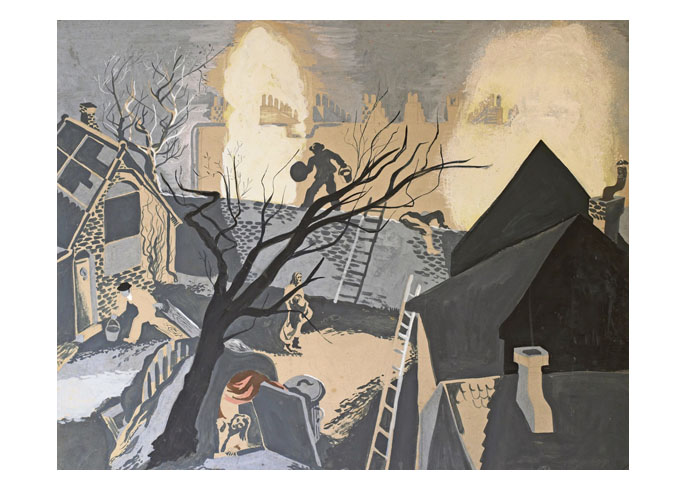
Edith Simon’s Incendiary Bombs on Old Camden Studios, 1942 [The Artist’s Estate Image courtesy Antonia Reeve Photography]
IN an artist’s studio in Seven Dials, a dozen men and women plotted the revolution. The year was 1933, and the attendees neither famous nor well-to-do.
They talked by candlelight. Not out of choice, but because their leader, the designer Misha Black, was moving out the next day, and the electricity board had already cut the supply.
This was the first meeting of the Artists International Association (AIA).
It would later proclaim that it “stands for unity of artists against fascism and war and the suppression of culture”.
Its members were communists – or at least fellow travellers. Some had spent time in the Soviet Union, and held the faith to varying degrees.
They were, needless to say, subject to heavy surveillance from the British state. Later, less radical artists would join, as the horrors of fascism swept across Europe, and the appeal of solidarity grew stronger.
With the far right once again on the march, a new exhibition at Eastbourne’s Towner gallery attempts to tell the story in full. Comrades in Art does so largely through the works of the association’s members, and stuns in its sheer stylistic range: from the Bloomsbury Group’s Vanessa Bell to the neoromanticist Ceri Richards, the emigre László Moholy-Nagy – resident at the Isokon in Lawn Road – and the many less remembered who made up its rank and file.
Camden features big. Camden Studios, a collection of 13 buildings off Camden Street, was home to the sculptor Peter László Peri, the painter Peggy Angus and the designer and watercolourist Eric Ravilious.
We see it on fire during the Blitz in a 1942 painting by another resident, Edith Simon, who was invited to the AIA’s first meeting “for her typing skills”, a label helpfully informs us.
Her striking vision is a mass of ladders and silhouetted figures with buckets, resembling collage more than the gouache in which she paints.
Each of the more established artists brought their own baggage, styles and networks of influence.
Lucien Pissarro, son of the painter and anarcho-syndicalist painter Camille, provided a living link to both impressionism and the early 20th century Camden Town Group.
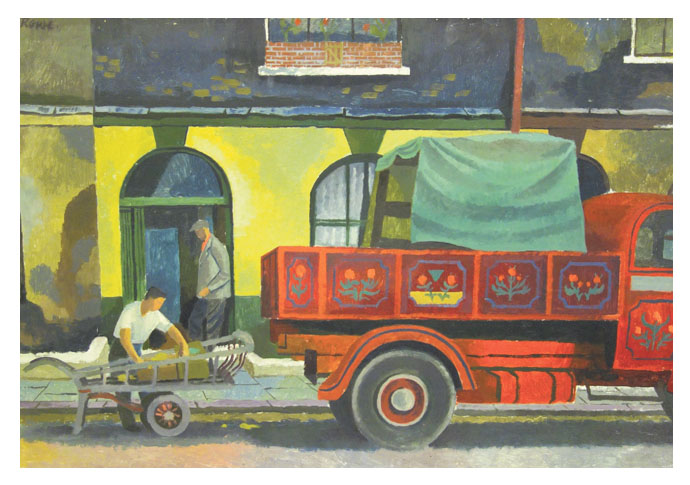
Cliff Rowe’s Removalists c.1937 [Cliff Rowe Estate Courtesy of the People’s History Museum]
Oskar Kokoschka brought the most intense forms of expressionism from Vienna, via Berlin. He is represented here with the allegorical The Crab (1939-40), which invokes Albrecht Dürer’s The Sea Monster (c1498) to hit back at Neville Chamberlain’s pursuit of refugees as enemy aliens. Clare Leighton’s woodcut of the poet Ernst Toller imports from Germany both the woodcut medium and the memory of lost revolutionary potential. Its subject was brutally punished for his leadership of the 1919 Bavarian Soviet.
The curators have perhaps been too ambitious – or not judicious enough in their selection. The sheer quantity of paintings, prints, pamphlets, posters and sculptures is overwhelming.
Some works here are remarkably unremarkable, and it’s easy to miss some that are quite spectacular.
The photography of the emigre and Soviet spy Edith Tudor-Hart is reproduced too small, and placed too marginally, to arrest the viewer with its stark perspective on class antagonism.
The artists’ selective embrace of contrasting styles is remarkable. Clifford Rowe’s Removalists (c1937), showing a house move in a Camden street, bears the hallmarks of his work in advertising and illustration.
The Fried Fish Shop (1936), could be a work of socialist realism, but in the exhibition’s accompanying book, Andy Friend makes the case that it quickly turns the tables. The figure on the right is Rowe himself, Friend suggests, scrutinising the table manners of the central figure, who on closer inspection should be perceived as Joseph Stalin. The woman disappearing upstairs, meanwhile, could be Clara Zetkin, the German communist leader who differed with Stalin over the relationship between art and politics.
Friend believes that the slogan above the counter, “Harry’s for Quality” refer to the British Communist chief Harry Pollitt. Piecing together the puzzle, he suggests the painting is in fact a critical allegory of Soviet communism.
But the central figure, if anything, looks more like Lenin. The scepticism that Friend reads into the painting is hard to establish visually – even if Rowe was growing disillusioned with actually existing socialism. If parody was what the artist was aiming for, then that of Patrick Hamilton, who named his pet parrot Pollitt, not without affection, hit the mark a little better.
László Peri was a Hungarian Jew who made his name as a constructivist – before embracing realism.
Here we see a series of concrete reliefs that he designed to be slotted into council housing projects. They show that the Russian avant garde school continued to haunt his work into the 1950s.
Then there’s Betty Rea, the privately educated sculptor whose metalwork emphasises the contortions of the human figure and soul alike. Alongside her work, we find the ephemera of the Huntingdon Anglo-Soviet Friendship Committee she co-founded – telling a fascinating story of wartime solidarity in a small Cambridgeshire town.
She would return to her sculpture work “only when social duty was done”, according to Misha Black.
That quote is on the wall, and for good reason. The AIA may not have been the reason that the Axis powers were defeated in the Second World War – but it’s safe to say its members played a significant part in convincing people they were fighting against fascism and not simply the Huns.
They were empowered to do so because among their number were dedicated fighters who recognised that organisation takes a lot of drudgery and paperwork – and not simply showboating and speechifying.
To anyone seeking to organise creative workers, or simply organise creatively, for the fights ahead: take note.
• Comrades in Art: Artists Against Fascism is at Towner Eastbourne until October 18. townereastbourne.org.uk
