Revealed: How Camden's dinner ladies are waiting for a living wage from company with champagne portfolio
Thursday, 12th March 2015
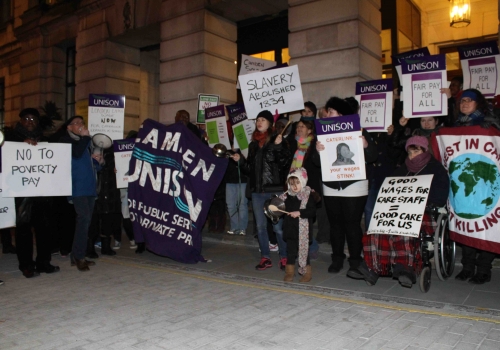
ON one side of Euston Road, Camden’s “poverty pay” school dinner ladies bashed pots and pans and told councillors they had nothing left to feed their families with but jacket potatoes.
On the other side, just a few hundred yards away, champagne was being sipped by customers at a bar where, for those more extravagant occasions, a single bottle of bubbly can cost up to £1,400.
The contrast between the desperation seen at the Town Hall last week and life at St Pancras International’s unashamedly opulent champagne counter could not be starker – but, as the New Journal reveals today, it potentially highlights the scale of the David-and-Goliath battle facing the borough’s school catering staff as they search for a living wage.
For the same parent company, Westbury Street Holdings (WSH), runs Caterlink, the firm in control of Camden’s school dinners contract, and, among other interests, Searcys, the company managing the bubbly bars at St Pancras and also at Paddington station.

The champagne bar at St Pancras, a few hundred yards from the Town Hall protests
The link, detailed in company documents and annual reports, has led to questions as to why Caterlink cannot afford a pay rise for 300 school kitchen staff who serve up 8,000 meals a day across the borough. Their current wage: £6.60 an hour. In comparison, the widely-supported London living wage rate, calculated by the Greater London Authority as the minimum salary needed to keep pace with the cost of living in the capital, stands at £9.15 an hour.
It is the gap between those two sums which led dinner ladies to the door of the Town Hall last week, with the demand for either Caterlink or the council to end the wait for a fair wage by covering the shortfall.
Labour councillors say they will not agree a contract next time without staff being paid the London living wage, but cannot, and this is a point of argument with opposition councillors and union members, do anything but “appeal to Caterlink’s better nature” until then.
Some sceptics say the council should be using its muscle in the last phase of its current agreement with the company to get tougher with the contractors.
Conservative group leader Claire-Louise Leyland said last week that there was a question over how the council negotiates. Unison, which represents the catering workers, has suggested that Camden could intervene, at least in the short term before a new deal is agreed. These views are echoed by Green councillor Sian Berry in a letter in today’s New Journal.
The council, however, says it is time for the private firm – not Camden – to pay up. Caterlink is paid £3.4m under its contract with the council but the row over low wages – described by protesters as “poverty pay” – has led to greater focus on how it fits into the multi-million pound set-up of WSH, a company which, despite the recession, has been growing steadily for more than a decade.
Its turnover grew by nearly 15 per cent in 2013 to £534.8million, with operating profits of £24.6million.
In contrast, unions are pointing to the fact it would take only £470,000 – paid by either Caterlink or the council – to ensure every dinner lady in Camden was paid the London living wage until new terms are agreed when the contract ends on March 31, 2016. Last year was the 13th year in a row the company reported growth of 10 per cent or more.
In August, WSH continued its expansion with the purchase of Searcys, controllers of that champagne bar at St Pancras Grand where a 750ml bottle of Krug from 1996 costs an eye-watering £1,400. The cost of the company buyout remains unknown, but it had been on the market with an asking price of £25-£30m.
Camden Unison secretary George Binette, who represents kitchen staff, said that sum “could easily pay for decades for a living wage for our members on the Caterlink contract”.
WSH’s portfolio does not stop there: it also owns firms Benugo, Holroyd Howe, Portico and BaxterStorey.
BaxterStorey, which partly takes the name of group chief executive Alastair Storey, reported profits of £20.9m in 2013. Mr Storey was named “the most powerful man in hospitality” in 2012, dethroning celebrity chef Jamie Oliver, who had held the title, handed out by trade magazine The Caterer, for the previous two years.
The company provides catering at the Barbican centre and British Airways first-class lounges. It paid a dividend to shareholders of £47million in 2012.
Benugo, meanwhile, runs the New York-style deli which serves up ethical coffees and lunches at the Wellcome Collection and British Museum as well as rail stations and high streets. It celebrates its commitment to a strict “green policy” and ethical sourcing.
The set-up as a whole makes WSH the third-biggest catering operator in the country.
Caterlink, meanwhile, insists that its “corporate social responsibility” means it aims to have “current and past employees recommending the company as a great place to work”, and that it believes in “doing well by doing good”.
To such statements, Mr Binette responds: “As so often, corporate social responsibility [CSR] appears to be whitewash for business as usual. Caterlink may indeed deliver very edible and nutritious school meals to pupils in Camden, though surely that reflects the work of staff who are often paid just 10p an hour above the legal minimum.
“If Caterlink wants to preach the gospel of CSR, then how does it justify its parent firm, Westbury Street Holdings, spending more than £20m on the acquisition of the upmarket catering company Searcys at the same time as categorically refusing to pay the London living wage to workers in Camden schools, which would currently cost just half a million or less?”
Town Hall leaders are insistent the blame does not lie with them as they move to get the last 3 per cent of council contracts under living wage conditions. They say they have spent months in negotiations urging Caterlink to increase its rate, but the calls have fallen on deaf ears.
Council leader Sarah Hayward said: “Caterlink’s last reported accounts for 2013, I think, demonstrate that they can afford to pay the living wage out of their profits and I would urge them to do so…
“There have been a number of letters from both me and officers and it’s raised in regular contract management contact, which takes all the forms you would expect. There is no way that any of the people that we contract services with cannot understand that we are a living wage borough and we want them to pay the living wage.”
The New Journal asked to speak to Caterlink and WSH directors on the issue. Reporters were repeatedly told all queries would have to go through the press office, which instead decided to simply issue a statement.
“We are continuing to work closely with the council and have proposed a number of options which are currently being considered,” the statement attributed to Caterlink managing director Neil Fuller said.
“Given that these discussions are ongoing, we cannot comment further at this stage. We’ve worked very closely with the council for many years, and we are pleased that our freshly-prepared lunches are being enjoyed by many more pupils now than when we first took over the contract in 2004.
“This has enabled us to employ more local residents as cooks and general assistants in school kitchens throughout Camden. Recently, we have enhanced the menu to the Soil Association’s Food For Life Catering Mark – Gold Standard and this has been achieved at no additional cost to schools, parents or the council.”
