Council worker in mayor’s parlour tells of his 12 years in prison – and the pain of an unlimited jail sentence
Dispute at Town Hall over 'hostile atmosphere'
Tuesday, 15th September — By Tom Foot

Andrew Morris now works for Camden Council after turning his life around
HE spent almost a decade longer in prison than he was expecting to thanks to a government injustice that prime minister Andy Burnham announced last week would finally be put right under his watch.
Andrew Morris spoke to the New Journal this week about how he rebuilt his life after being jailed for 12 years under an Imprisonment for Public Protection (IPP) sentence.
Mr Morris, who lived in the Arlington House hostel in Camden Town after finally being released from prison, was convicted of serious crimes including threats to kill, robbery and affray.
The 49-year-old who now works for Camden Council partly as a mayoral chauffeur has spoken openly of his troubled past including his use of drugs, alcohol and sex workers as a troubled young man.
After he was finally released he walked straight into a job with the Ministry of Justice thanks to a progressive scheme aimed at rehabilitation, and now sits on the board of the Howard League for Penal Reform charity.
He has for the past three years campaigned publicly for the abolition of IPP sentences while working at the Town Hall as a support worker in the mayoral parlour.
Mr Morris told the New Journal: “When the news came out from Andy Burnham I was jubilant. But after taking stock, I can see I will have to wait a bit to really celebrate as the substance is still to come and I really hope that we can manage people’s expectations. But I do have more hope now that I did for a long while.”
Mr Burnham has said he will “end the injustice” of IPP sentences that saw thousands of prisoners locked-up without a release date under New Labour and continues to cause problems to this day.
The IPP was a form of sentence in which those convicted of a set of offences, ranging from violent robbery to sexual assault, were jailed with a minimum but no maximum sentence.
Introduced in 2005 by David Blunkett in the New Labour “tough on crime” era, IPPs were designed for the indefinite detention of serious offenders who were perceived to be a risk to the public, but ended up being routinely issued for lower-level crimes.
IPPs were scrapped in 2012, but the abolition was not retrospective – and hundreds of people remain either stuck in prison today under them, or out on licence, with no idea when they may be fully freed.
Mr Morris has played a key role in the campaign against IPPs through his work with the Howard League, working on a major report last year that is credited with informing the recent government’s new announcement.
As the founder of the New Wave Trust, which works with victims of the IPP in criminal justice system, he has continually argued that while some offenders deserve an indeterminate sentence, the way in which IPPs were rolled out was wrong and their use has been abused.
Mr Morris grew up with his Caribbean grandparents in Angell Town, Brixton.
He said he became addicted to hard drugs and alcohol and paid for sex workers in what he described as a phase of his life governed by a “cocktail of moral turpitude”.
He said he faced racial discrimination as a young black man, regular stop and searches and was once brutalised in the back of a police van during an arrest.
Aged 23, he was charged with an armed robbery, and he was released after the case fell apart after spending months at Brixton HMP on remand in his first taste of the prison system.
He later faced five charges including false imprisonment of an ex-partner, threats to kill, robbery and affray.
“I’ve done what I’ve done and I have always been very open about it,” he said.
“I’m not proud of how I was. But I pled guilty without realising an IPP was on the cards. I don’t think my solicitor thought it was on the cards either.”
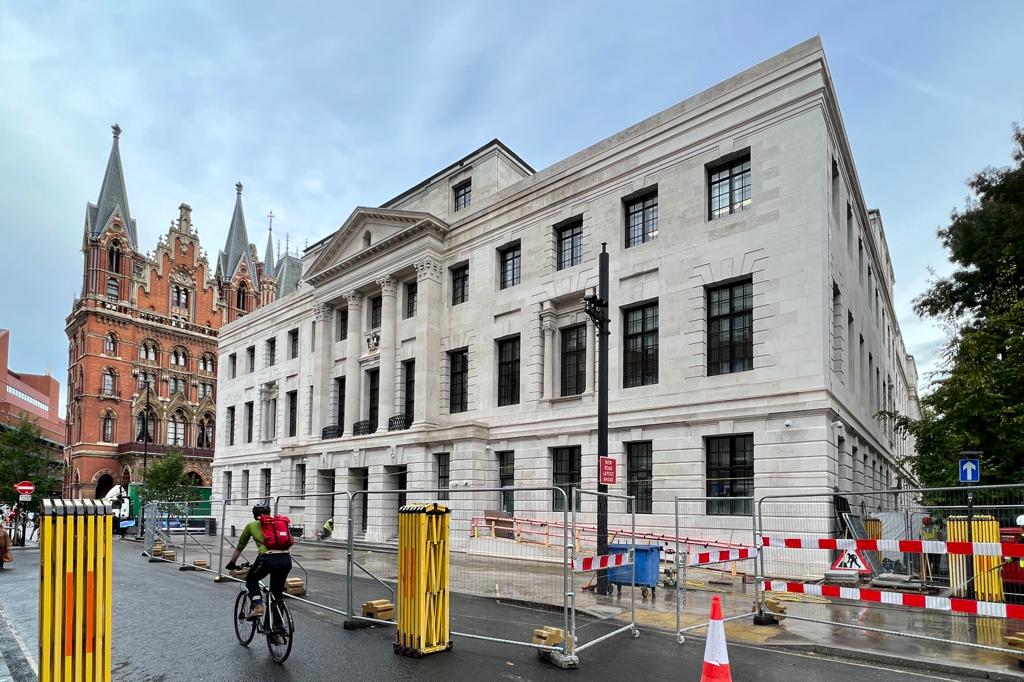
The Town Hall building in Judd Street
Mr Morris said he had been expecting to serve two-and-a-half years in prison for his offences, but ended up doing six years due to the IPP, before being let out and recalled to prison for another six years after breaching conditions of his release.
He recalled borrowing Archbold – the legal bible – from the inmates library.
He had not got to university as a young man, but three years ago began studied for a law degree with the Open University.
He is due to collect his scroll next week on the same day as his 20 year anniversary of being clean from drugs and drink.
He said it took him years to get his head round the legislation that was keeping him in prison and that he had spent years “praying for death” and “experienced suicidal ideation”.
Mr Morris spoke about how in a “bizarre” and “ironic” twist he walked out of prison and straight into a job at the Ministry of Justice, adding: “What happened was a guy came into prison talking about opportunities. The governor supported me and was insistent I should put in an application. I ended up working for the prison ombudsman. I was the communications lead and did some investigations for them.”
From there he went for a chauffeur job at Camden Council, and ended up being hired in a wider full time role as a support officer in the Mayor’s office.
He said: “One of the things I was told by the parole board was they thought I over-disclosed. I always thought I don’t want to be in a position where someone says you didn’t tell us that or this. So I have always been very open with my managers at the council.”
Mr Burnham has said the government will “bring the injustice of IPP sentences to an end during this Parliament” and Justice Secretary Alex Norris has said: “Protecting the public also means fixing the prison system for good. We will build the cells we need, put offenders under much tougher controls when they leave prison and end the historic injustice of IPP sentences.”
Dispute at Town Hall over time off for law reform campaign
AS Andrew Morris was celebrating a victory of sorts in his long battle against IPPs, he has found himself in the midst of a new battle against his employers at Camden Town Hall, writes Tom Foot.
For more than three years he has worked as a support worker in the Mayor’s office, sometimes driving the Mayor around in the council’s crested Ford Mondeo.
He said he had “really enjoyed” working at Camden Council but that the atmosphere had become hostile in the past year and he had consequently been signed off work by his GP for four months.
In April he lodged an official grievance over his treatment that is still outstanding and expected to end up in the tribunal court.
The New Journal understands the case centres on a dispute over Mr Morris’s leave for his work over prison reform.
He said the leave was around three days a month paid consultancy work that had been approved by previous managers with the consent of the borough solicitor.
“Most of my life I’ve had to be treading on eggshells. I do what I do and sometimes I hide who I am.
“But having experienced what I have, I feel like I am not going to keep quiet about my experience anymore. “I don’t expect rewards or special treatment. But they are not treating me nicely. I don’t expect to be bullied and harassed at the same time.”
He added: “What is frustrating is that I could see myself retiring in Camden. I enjoy civic life. I like working behind the scenes.
“I’ve loved it when people have come to me, and asked me to get the Mayor to their event, and then you sort it out and people are so grateful and thankful.
“They send their thanks and that’s a great feeling. But that dynamic has changed.”
A council spokesperson said: “Due to their confidential nature, we do not comment on individual staff matters.”
