Children’s blood samples to be carried by drones five days a week
Residents warn it's the 'thin end of the wedge'
Friday, 14th August — By Caitlin Maskell
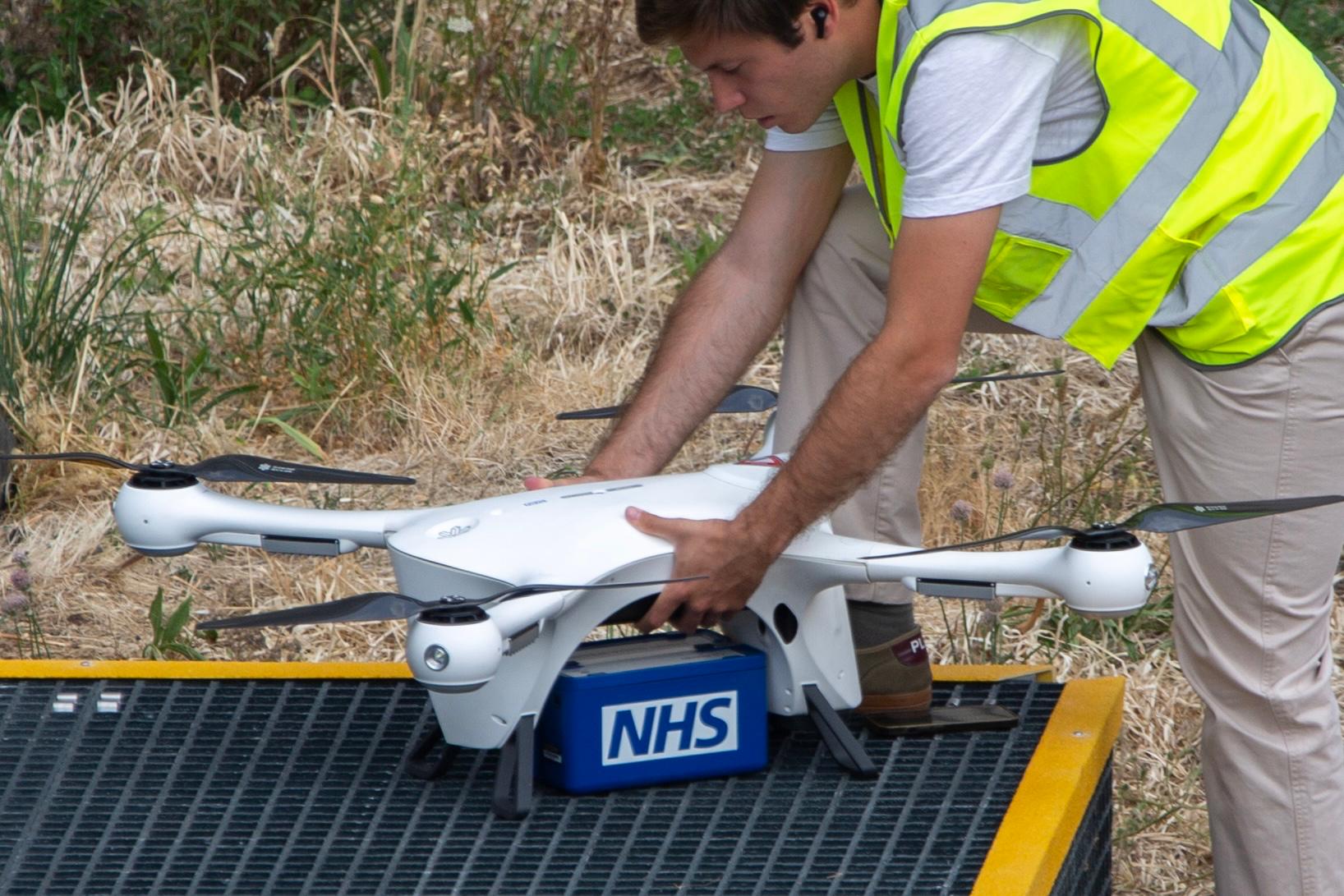
Drone testing in Mabledon Place [Simon Lamrock]
NHS blood samples from sick children are set to be flown over residential buildings to a testing lab five days a week – sparking concerns over who will control Camden’s airspace in a high-tech future.
Robotics company Apian is trialling an automated drone service for Great Ormond Street Hospital (GOSH) that will transport pathology samples to analysts at Health Services Laborato- ries’ (HSL) medical centre in King’s Cross.
Trial flights of the remotely- operated machines – built by a tech firm in the US – have already begun at the Halo building in Mabledon Place.
GOSH says the system is being introduced due to traffic congestion and that they will fly Monday to Friday from 8am-5pm at a height of 110 metres at around 35 miles per hour.
The area in Bloomsbury has been affected by the introduction of one-way systems and cycle-safety schemes in recent years.
Residents are warning that routine use of the system could disrupt their lives and have questioned whether the regulations governing the use of drones by businesses and organisations like the NHS are fit for purpose in an era when “the whole world may want to have drones delivering everything from their pizza to their medication”.
Trevor Shonfeld, co-chair of Bloomsbury Residents Action Group (BRAG), suggested the blood drones could be the “thin edge of the wedge”, adding: “The idea of them flying over residents carrying samples of maybe nasty stuff heading to be tested, you don’t know when there could be an accident and it’s just not the right place to do it.
“People have every cause to be concerned. The noise from the drone taking off and landing is noisy – it’s like a small moped that goes through your ear.”
He added: “I can’t see the sense of it anyway – you can walk it faster by the time you’ve packed it in the drone, got on the roof, launched it, picked it up. It’s a seven-minute walk.”
HSL is a joint venture company between University College London Hospitals, the Royal Free London and The Doctors Laboratory after the NHS pathology service was privatised more than 20 years ago.
Forty-nine per cent of the profits from the company’s contracts with the NHS go back to the two hospitals.
Currently, anything removed from a patient in Camden’s main hospitals and clinics – mainly bloods and tissues – are sent there for testing with results sent back to the hospital and GPs.
Debbie Radcliffe, co-chair of BRAG, said: “Local people don’t really know anything about the practicalities of drone deliveries or how it will actually affect residents’ quality of life.”
She said that the consultation into the use of the drones had consisted of an email asking local people to “get in touch if you have any questions”, adding: “That is not consultation.”
The group said the M2 drones, which are supplied by the California-based company Matternet, are the only drone delivery service to receive a standard Type Certificate from the Federal Aviation Administration, “the USA’s gold standard for airworthiness”.
The drones are 100 per cent electric and produce zero emissions during flight and can “replace courier trips that would normally require cars, vans or motorbikes”.
The drones will fly within airspace as approved by the Civil Aviation Authority.
The company behind the trial said: “For paediatric services, where acute illness can escalate rapidly, faster testing turnaround times are vital for timely diagnosis and treatment.
“By replacing courier journeys with zero-emission flights, this technology reduces air pollution and traffic, supporting cleaner air and safer streets for children and future generations.”
A spokesperson for GOSH said the sound of drones was significantly quieter than a car, adding: “Like other NHS hospitals, we are testing the use of drones to fly pathology samples to nearby laboratories, subject to risk assessment and approval from the UK’s aviation regulator, the Civil Aviation Authority.
“We hope these flights will help get quicker results for our patients, by avoiding traffic delays, as well as reducing emissions.
“Ahead of the trial flights, we contacted local residents and businesses under and adjacent to the initial flightpath to ask them to share any concerns.
“We are yet to receive any responses and remain happy to discuss the project as this trial progresses.”
DRONE RULES
THE rules around drones can seem like something of a grey area – particularly for deliveries over residential areas.
The UK Civil Aviation Authority (CAA) allows drones to be flown for work – for businesses, educational establishments or other organisations provided they comply with strict legal requirements and obtain the correct registration and insurance.
Any organisation, which the CAA say could be sole traders, businesses, schools, colleges, universities, voluntary organisations, clubs or charities must register their organisation as an operator with the CAA.
To gain an operator ID you also have to take a theory test to gain a Flyer ID.
There are a few exceptions for drones and model aircraft that weigh below 250g and that don’t have a camera.
In 2020 the UK moved to a new set of regulations for drones and model aircrafts which focus on the risks of the flight based on the aircraft weight and characteristics when in flight.
Children’s blood samples to be carried by drones
