Chants encounter: exploring music’s journey through history
Read Tom Service’s brilliant book with your laptop to hand – and then listen, says Michael Church
Friday, 13th February — By Michael Church

A humpback whale and her calf [Charles J Sharp_CC BY-SA 4.0]
DO we need yet more listicles of “great tunes we have loved”? Absolutely not – we could write them in our sleep. Tom Service may include a few familiar signposts like Haydn’s Messiah and Vaughan Williams’ The Lark Ascending, but in almost every other respect this book is blissfully unexpected, and never more so than in what Service calls “the pre-piece era”.
The Prologue to his 50 short chapters begins with the sound of the rotation of the Earth: we may only hear it with the aid of super-sensitive microphones, but we feel it vestigially through vibrations in our bodies.
Then Service gets down to business, discussing the rhythmic patterns created by the footsteps of two adults and a child imprinted in lava on a Tanzanian beach 3.7 million years ago.
Nearer the present – a mere 30,000 years ago – Service discusses the acoustics of some cave-painted dwellings in France, and points out that bone flutes in Germany at the same time tell us much about the music played on them.
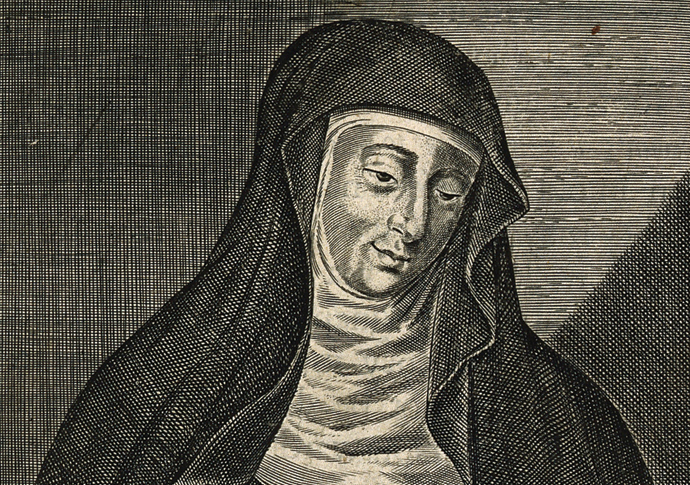
Hildegard von Bingen engraving by W Marshall [Wellcome Collection]
But the most eloquent indications of music made in prehistoric times are the Australian songlines, which created a chain in a 2,500-mile long piece of collectively composed music which is still alive today. One of this story’s key signposts was the discovery of some hymns on clay tablets sung by Enheduanna – high priestess of the Mesopotamian city of Ur in the 24th century BCE – and that gives us some purchase on where we are being genially led.
Service allows himself a very open-ended definition of what a “piece” may be: “It’s something whose transmission, either in oral cultures through the handing on of embodied tradition, or through symbolic representation as written notation, allows music both to be part of the time and place of its creation, and to be independent of it.”
For him, this can mean everything from symphonies to the beautifully structured song of the humpback whale.
The book may be done with a light and entertaining touch, but its chronological structure allows it to be read both as music history, and as the onward march of civilisations.
Service is good on cutting-edge scholarship. It’s often assumed, he says, that musical notation began in the European world in the 9th century. “Nobody has ever made head or tail of ancient Greek music, and nobody ever will,” opined one musicologist in 1932. “That way madness lies.” But 21st-century musicologists have discovered that the ancient Greeks had conventions to indicate not only rhythm and pitch, but also melody and expression.

Ancient Greek warrior playing the salpinx [Marie-Lan Nguyen / Wikimedia Commons]
Hildegard of Bingen, the 12th-century German abbess whose proto-feminist compositions are now in vogue, gets an illuminating chapter, as does her coeval the Comtessa de Dia, a French troubairitz (female troubadour). Again, the general assumption is that Occitanian travelling singers were all male, but Service focuses on the fact that the Comtessa wrote the first-ever love song for a woman to sing.
Service devotes a chapter to religious chant, which originated in Judaism but spread through both the Arabic world and Christendom. His chapter on Balinese gamelan kicks off with an ingenious explanatory metaphor: “In gamelan,” he writes, “musical time is made of a series of spirals that repeat in layers on top of one another. The patterns loop, and the time moves in loops as well, but not towards a single definitive goal, since the goal is an immersion in a state of being.” The book is not illustrated but this complex idea might be best illustrated by an engineering drawing.
One theme that runs through the book is the longevity of certain melodies. Purcell’s Dido’s Lament echoes hauntingly down through the ages, while the legal ownership in America of Happy Birthday To You makes a surprisingly tangled tale.
The melody of Dies Irae, dies illa plainchant – “day of wrath, that awful day” – was used in turn by Mozart, Verdi, Berlioz, and Rachmaninov (who built his career round it), as well as by the ghost in Phantom of the Opera.
Every work in this book gets its own miniature essay, with a strong bias towards underrated female composers: their cavalcade includes Francesca Caccini and Barbara Strozzi, and goes on to Lili Boulanger and the Ethiopian nun Emahoy Guébrou.
All the greats of European classical music get their pen portrait, as do the wilder experiments of modernist high priests. Can you imagine the sound of Yoko Ono inviting scissor-wielding strangers to snip pieces out of the clothes she’s wearing? That was clearly to be savoured visually as well as aurally.
Read this brilliant book with your laptop to hand, then listen: many of its 50 pieces are a revelation, and every single one of them is waiting for you on YouTube.
• A History of the World in 50 Pieces: The Classical Music That Shapes Us. By Tom Service, BBC Books, £25
